
What Is a Business Health Check?
A business health check is a systematic assessment of how well a company is performing financially and operationally.
It examines whether the business has reliable financial records, sufficient cash flow, appropriate internal controls, effective processes and a clear understanding of its risks.
Depending on the company's needs, a health check may cover:
-
Financial statements and profitability
-
Cash flow and working capital
-
Outstanding customer payments
-
Supplier liabilities
-
Accounting accuracy
-
GST and tax compliance
-
Payroll and employee costs
-
Internal controls and fraud risks
-
Business performance and growth
-
Management reporting and financial planning
The objective is not simply to find mistakes. It is to understand what is working, what is going wrong and what needs to change.
For small businesses, startups and growing companies, a regular health check can support better decisions and reduce avoidable risks.
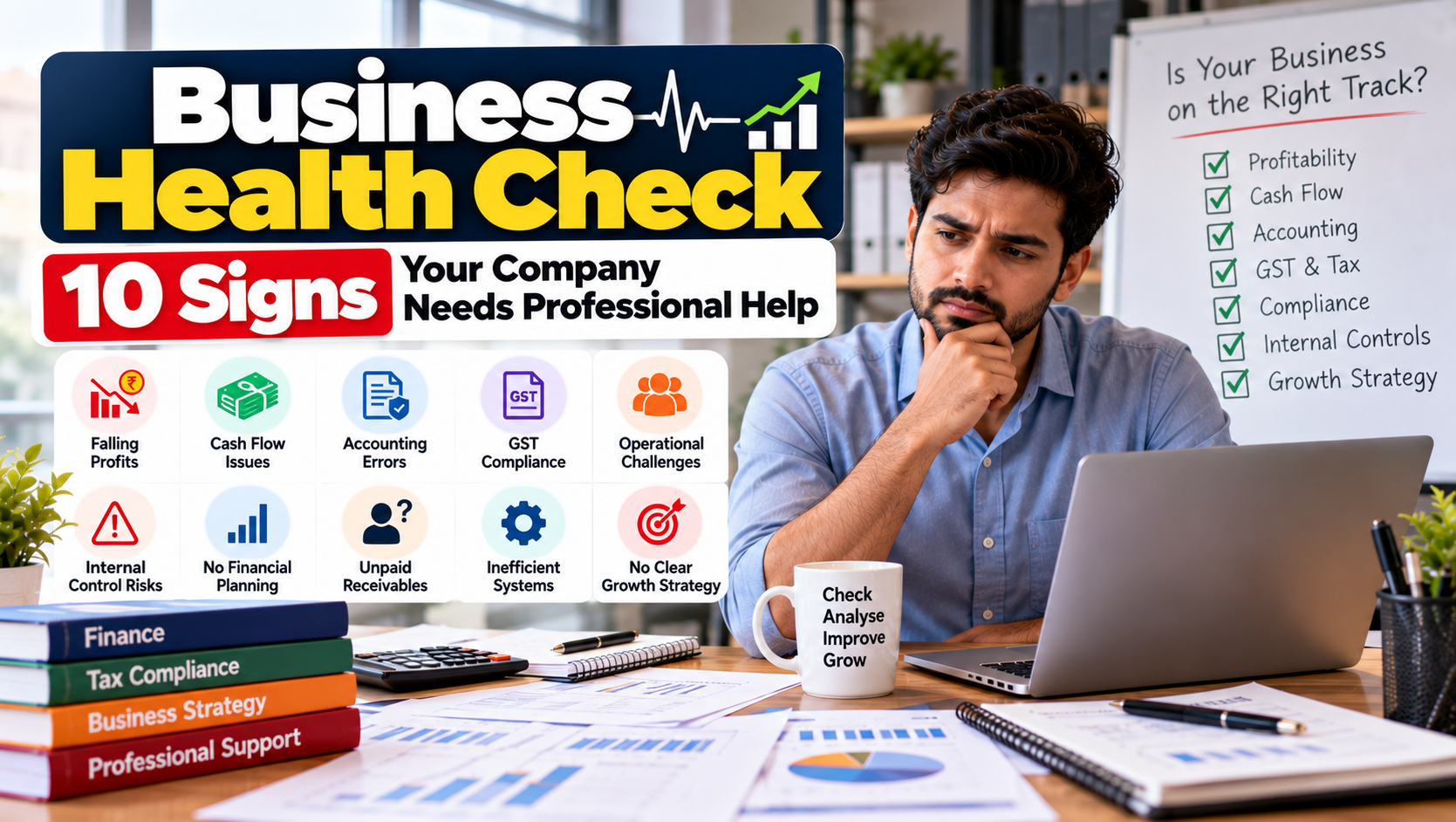
10 Signs Your Company Needs Professional Help
1. Your Sales Are Increasing, but Profits Are Declining
Increasing sales are usually considered a positive sign. However, revenue growth does not automatically mean that a business is becoming more profitable.
Imagine a company whose monthly sales increase from ₹10 lakh to ₹15 lakh. At first glance, the business appears to be growing successfully.
But during the same period, raw material costs, employee salaries, delivery expenses, advertising costs and other operating expenses may have increased even faster.
The result could be declining profits despite higher sales.
Warning signs to watch for
-
Revenue is increasing, but net profit is falling.
-
Operating expenses are growing faster than sales.
-
Discounts are reducing profit margins.
-
Certain products generate sales but contribute little profit.
-
The business cannot explain why profitability has changed.
How professional help can make a difference
An accountant or financial consultant can review your Profit and Loss statement, expense structure, pricing and product-level profitability.
This analysis can help identify unnecessary costs, low-margin products and opportunities to improve operational efficiency.
Business tip: Review revenue, gross profit and net profit together. Revenue alone does not provide a complete picture of business performance.
2. Your Business Frequently Faces Cash Flow Problems
Cash flow is one of the most important indicators of business health.
A company can be profitable on paper and still struggle to pay salaries, suppliers, rent or taxes because the money it has earned has not yet arrived in its bank account.
For example, a business may sell products worth ₹20 lakh in a month but receive only ₹12 lakh in customer payments. If its immediate expenses exceed the available cash, the company may face financial pressure despite recording substantial sales.
Common cash flow warning signs
-
Supplier payments are regularly delayed.
-
The business struggles to pay salaries on time.
-
Short-term borrowing is used to cover routine expenses.
-
Customer payments remain outstanding for long periods.
-
Tax payments are postponed because cash is unavailable.
-
The company has no reliable cash flow forecast.
What should you do?
Start by preparing a cash flow statement and a rolling cash flow forecast.
Track expected customer collections, supplier payments, payroll, loan instalments, taxes and other major expenses.
A professional accounting team can help establish a working capital monitoring process and identify the reasons behind recurring cash shortages.
Business tip: Monitor cash flow weekly if your company operates with tight margins or significant receivables. Do not wait until the end of the financial year to discover a cash shortage.
3. Your Accounting Records Are Incomplete or Outdated
Accounting records are the foundation of sound financial management.
If sales, purchases, expenses, bank transactions and liabilities are not recorded accurately, management cannot rely on financial reports to make decisions.
Unfortunately, some businesses update their accounts only when a tax return, audit or financial statement is due.
This creates unnecessary pressure and increases the risk of errors.
Warning signs to watch for
-
Bank accounts are not reconciled regularly.
-
Purchase invoices are missing.
-
Customer and supplier balances are incorrect.
-
Business expenses are mixed with personal transactions.
-
Financial reports are prepared several months late.
-
Management does not know the current profit or outstanding liabilities.
Why professional accounting matters
Professional accounting support can establish a consistent process for recording transactions, reconciling accounts and preparing monthly financial reports.
A well-maintained accounting system also makes it easier to identify duplicate payments, missing transactions and unexplained differences.
The goal is to maintain reliable financial records throughout the year rather than reconstructing them at the last minute.
Business tip: Aim to close your monthly accounts on a consistent schedule and investigate significant differences before finalising the reports.
4. Your Company Is Struggling with GST and Tax Compliance
Tax compliance becomes more complicated as a business grows.
Depending on the company's activities and legal structure, it may need to manage GST returns, input tax credit reconciliation, TDS, income tax filings, advance tax and other statutory obligations.
Missing a deadline or reporting incorrect information can result in additional fees, interest, penalties or notices, depending on the applicable law and circumstances.
Common compliance warning signs
-
GST returns are frequently filed at the last minute.
-
Input Tax Credit differences remain unresolved.
-
Sales in accounting records do not match GST reports.
-
TDS deductions or deposits are overlooked.
-
Tax notices are ignored or answered late.
-
The company does not maintain a compliance calendar.
How professional help can make a difference
An experienced accounting or tax professional can review the company's compliance obligations, reconcile financial data and establish a filing calendar.
They can also help identify discrepancies early and organise the supporting documents needed for filings or responses to tax authorities.
However, the business should continue to review its compliance status and provide complete, accurate information to its advisers.
Business tip: Maintain a central compliance calendar showing each obligation, its due date, the responsible person and its completion status.
5. You Do Not Know Your Company's Actual Financial Position
Ask yourself these questions:
-
How much profit did the company make last month?
-
How much money do customers currently owe?
-
What are the company's outstanding liabilities?
-
Which products or services are most profitable?
-
How much cash will be available over the next three months?
If these questions are difficult to answer, your business may need better financial reporting.
Many business owners rely on bank balances or sales figures to judge performance. But a bank balance alone does not reveal unpaid liabilities, outstanding receivables, inventory value or actual profitability.
What a healthy reporting system should include
A business should have access to relevant reports, such as:
-
Profit and Loss statement
-
Balance Sheet
-
Cash flow statement
-
Accounts receivable ageing report
-
Accounts payable report
-
Budget versus actual performance
-
Expense analysis
-
Business-specific performance indicators
These reports help management understand the company's financial position and identify potential problems early.
Business tip: Review a monthly management report rather than relying only on bank statements or sales dashboards.
6. Your Customers Are Paying Late
Customer payments are a major source of working capital for most businesses.
When customers delay payments, the company may struggle to pay suppliers, employees and other operating expenses.
The problem can become more serious when a business continues supplying customers without reviewing their outstanding balances.
Warning signs to watch for
-
The average time taken to collect payments is increasing.
-
More invoices are overdue.
-
A few customers account for most outstanding receivables.
-
Sales employees approve additional credit without checking payment history.
-
There is no formal process for following up on overdue invoices.
What should you do?
Create an accounts receivable ageing report that groups outstanding invoices by age.
For example:
| Outstanding period | Amount |
|---|---|
| 0–30 days | ₹2,00,000 |
| 31–60 days | ₹1,20,000 |
| 61–90 days | ₹75,000 |
| More than 90 days | ₹50,000 |
This example highlights where collection efforts may be needed. Actual priorities should depend on the contractual payment terms, customer circumstances and likelihood of recovery.
Professional support can help establish credit policies, collection procedures and regular receivables reporting.
Business tip: Set clear credit terms, send invoices promptly and follow up on overdue payments consistently.
7. Your Business Has No Clear Budget or Financial Plan
Operating without a financial plan is like travelling without knowing your destination or available resources.
A business may have ambitious sales targets but no realistic estimate of the costs, staffing, working capital or investment required to achieve them.
Without a budget, management may struggle to distinguish between planned expenditure and unnecessary spending.
Warning signs to watch for
-
Expenses are approved without budget checks.
-
Business expansion decisions are based on assumptions.
-
Hiring decisions are not linked to financial capacity.
-
Management cannot estimate future cash requirements.
-
Actual performance is not compared with planned performance.
How professional help can make a difference
A financial professional can help prepare an annual budget, monthly cash flow forecast and scenario analysis.
For example, the company can examine how a 10% decline in sales or an increase in raw material costs would affect profitability and cash availability.
This allows management to prepare for risks before they occur.
Business tip: Review actual financial performance against the budget every month and investigate significant differences.
8. Your Internal Controls Are Weak
Internal controls are the procedures a business uses to protect its assets, maintain accurate records and reduce the risk of errors or unauthorised transactions.
When a business is small, the owner may personally approve payments and monitor expenses. As the company grows, informal processes may no longer be sufficient.
Warning signs to watch for
-
The same person creates vendors and approves their payments.
-
Employees can make payments without appropriate authorisation.
-
Cash transactions are not documented properly.
-
Inventory differences are not investigated.
-
Multiple employees share accounting passwords.
-
Financial records can be changed without review.
Weak controls can lead to financial losses, duplicate payments, fraud, errors and disputes.
What should you do?
Introduce proportionate controls based on the size and risk of the business.
These may include:
-
Approval limits for payments
-
Vendor verification procedures
-
Bank reconciliation
-
Separation of key financial duties
-
Restricted system access
-
Periodic inventory checks
-
Review of unusual transactions
-
Documented expense policies
An accountant, internal auditor or business consultant can help assess control weaknesses and recommend practical improvements.
Business tip: Even a small company should have clear payment approval rules and regular bank reconciliation.
9. Your Business Is Growing Faster Than Your Systems
Growth creates opportunities, but it also introduces complexity.
A business that previously handled 50 invoices a month may struggle when it reaches 500. A company operating from one location may find it difficult to consolidate information across multiple branches.
Manual spreadsheets and informal processes that worked in the early stages may no longer be reliable.
Warning signs to watch for
-
Financial reports take too long to prepare.
-
Orders and payments are difficult to track.
-
Employees repeatedly enter the same data.
-
Inventory records do not match physical stock.
-
Management cannot compare branch performance.
-
Errors increase as transaction volume grows.
How professional help can make a difference
A professional adviser can assess whether the business needs better accounting software, automated workflows, stronger reporting or revised operating procedures.
Depending on the business, solutions may include cloud accounting, inventory integration, automated bank feeds, structured document management and improved approval workflows.
Technology should be selected based on business needs rather than simply choosing the most expensive system.
Business tip: Review your accounting and operational systems whenever transaction volume, staffing or business locations increase significantly.
10. You Are Making Major Decisions Without Reliable Financial Advice
Business owners regularly make decisions that affect profitability and long-term sustainability.
These may include:
-
Opening a new branch
-
Hiring additional employees
-
Buying equipment
-
Taking a business loan
-
Increasing prices
-
Launching a new product
-
Entering a new market
-
Bringing in investors
If these decisions are based only on intuition, the company may underestimate costs or overestimate its ability to fund the expansion.
Warning signs to watch for
-
Investment decisions are made without financial projections.
-
Loan repayments are not included in cash flow planning.
-
The company does not calculate product-level profitability.
-
Expansion plans lack a break-even analysis.
-
Management cannot explain the financial risks of a decision.
How professional help can make a difference
A financial consultant or Virtual CFO can help prepare financial forecasts, assess investment requirements, compare scenarios and evaluate potential risks.
For example, before opening a new branch, management can estimate the initial investment, monthly operating costs, expected revenue, break-even point and time required to recover the investment.
This does not guarantee success, but it creates a stronger basis for decision-making.
Business tip: Before making a major investment, prepare a financial model with realistic assumptions and at least one downside scenario.
How to Conduct a Basic Business Health Check
You do not need to wait until a serious problem develops before reviewing your company's performance.
A simple assessment can help identify areas that need attention.
| Business area | What to review | Warning sign |
|---|---|---|
| Profitability | Revenue, gross margin and net profit | Profit declining despite higher sales |
| Cash flow | Bank balance and forecast | Frequent cash shortages |
| Accounting | Bookkeeping and reconciliation | Incomplete or outdated records |
| Compliance | GST, TDS and tax obligations | Missed deadlines or unresolved differences |
| Receivables | Overdue customer invoices | Increasing collection delays |
| Payables | Supplier balances and due dates | Frequent late payments |
| Internal controls | Payment approvals and access | Unauthorised or unexplained transactions |
| Budgeting | Actual versus planned performance | Repeated overspending |
| Operations | Reporting and accounting workflows | Errors increasing with growth |
| Strategy | Forecasts and investment plans | Major decisions made without financial analysis |
A warning sign does not automatically mean that a business is failing. It means the issue deserves investigation and, where necessary, corrective action.
What Should You Do If Your Company Shows Multiple Warning Signs?
If several of these issues apply to your company, avoid trying to fix everything at once.
Use a structured approach.
Step 1: Review the Financial Records
Collect recent financial statements, bank statements, receivables, payables, tax records and major expense details.
Step 2: Identify the Most Urgent Risks
Prioritise issues that could affect cash availability, statutory compliance, payroll, debt repayments or business continuity.
Step 3: Reconcile the Accounts
Confirm that bank balances, customer accounts, supplier accounts and relevant tax records are supported by accurate information.
Step 4: Prepare a Cash Flow Forecast
Estimate expected collections and payments for the coming weeks and months. Identify potential shortages early.
Step 5: Create a Compliance Calendar
List the relevant filing obligations, payment deadlines, responsible persons and current status.
Step 6: Set Measurable Improvement Targets
For example, establish targets for reducing overdue receivables, shortening monthly closing time or resolving reconciliation differences.
Step 7: Review Progress Regularly
Monitor the results monthly and adjust the plan when business conditions change.
If the company has significant tax, legal, fraud or solvency concerns, seek appropriately qualified professional advice promptly.
Which Professional Services Can Help Your Business?
Different problems require different expertise. A business health check should identify the underlying issue before recommending a service.
Accounting and Bookkeeping
Useful when records are incomplete, financial reports are delayed or transactions are not reconciled regularly.
GST and Tax Compliance
Useful when the business has filing difficulties, unresolved tax differences or questions about its statutory obligations.
Internal Audit and Controls Review
Useful when the company needs to examine financial processes, authorisation procedures, asset protection or the risk of errors and fraud.
Financial Planning and Analysis
Useful when management needs budgets, forecasts, profitability analysis or investment evaluation.
Virtual CFO Services
Useful for growing businesses that need financial planning and strategic support without necessarily employing a full-time Chief Financial Officer.
Business and Corporate Compliance Support
Useful when the business needs help understanding its legal structure, statutory filings, registrations or ongoing corporate obligations.
Professional support should be proportionate to the company's size, risk and actual requirements.
How Often Should You Conduct a Business Health Check?
The appropriate frequency depends on the size and complexity of the business.
Monthly: Review cash flow, profitability, receivables, payables, expenses and key financial reports.
Quarterly: Assess budget performance, major business risks, compliance processes and progress towards growth targets.
Annually: Conduct a broader review of financial performance, strategic priorities, internal controls and the coming year's budget.
When circumstances change: Perform an additional review before major investments, borrowing, acquisitions, rapid expansion or significant changes in business operations.
Regular monitoring makes it easier to detect emerging issues before they become serious.
Business Health Check Checklist
Use this checklist to assess whether your company needs further review.
-
I know my company's current revenue and profitability.
-
My business has a reliable cash flow forecast.
-
Accounting records are updated regularly.
-
Bank accounts are reconciled.
-
Customer and supplier balances are reviewed.
-
GST and other applicable tax obligations are tracked.
-
Financial reports are available on time.
-
Business expenses are monitored against a budget.
-
Payment approvals and system access are controlled.
-
My company has a realistic growth and investment plan.
If several boxes remain unchecked, consider arranging a more detailed review with an appropriate accounting or business professional.
This checklist is a starting point, not a formal audit or a substitute for a professional assessment.
Frequently Asked Questions
1. What is a business health check?
A business health check is a structured review of a company's financial performance, accounting records, compliance, internal controls, operations and growth readiness.
2. How do I know if my business is financially healthy?
A financially healthy business generally has reliable records, sufficient working capital, sustainable profitability, manageable liabilities and a clear understanding of its financial risks. The appropriate indicators depend on the industry and business model.
3. Why is cash flow more important than sales?
Sales show the value of goods or services sold, but they do not necessarily indicate when the money will be received. A business needs sufficient available cash to pay its obligations when they fall due.
4. Can an accountant help improve business profitability?
An accountant can help analyse costs, margins, financial reports and working capital. These insights can support better decisions, although profitability also depends on pricing, demand, operations and management.
5. When should a small business hire a financial consultant?
A business may benefit from professional advice when it faces recurring cash shortages, declining margins, complex compliance requirements, expansion decisions or a lack of reliable financial information.
6. What is the difference between an accounting review and an audit?
An accounting review may be a management-focused assessment of records and processes. An audit is a more formal engagement with defined objectives, scope and applicable professional standards. A business health check should not be described as a statutory audit unless the relevant requirements are met.
7. How can professional accounting services help a growing company?
They can help maintain reliable books, reconcile accounts, organise tax compliance, prepare financial reports and establish more consistent financial processes.
A successful business is not defined by sales alone. It also needs sustainable profitability, reliable financial records, effective cash flow management and appropriate controls.
Declining margins, overdue customer payments, outdated accounting records, unresolved compliance issues and poor financial planning can all indicate that a company needs closer attention.
The good news is that identifying these warning signs early gives management an opportunity to take corrective action.
A regular business health check helps business owners understand their current position, identify risks and make better-informed decisions about the future.
If your company is experiencing several of the warning signs discussed in this article, consider reviewing your financial records, compliance processes and operational systems with an appropriately qualified professional.
At Clockwell International LLP, businesses can explore professional support for accounting, taxation, GST and corporate compliance based on their specific requirements. A structured review can help identify the areas that need attention and establish a clearer path towards stronger financial management.
Disclaimer: This article is intended for general informational purposes only and does not constitute legal, accounting, tax or investment advice. The appropriate actions depend on the company's circumstances, industry and applicable laws. Seek qualified professional advice for decisions specific to your business.
Published on October 12, 2026