

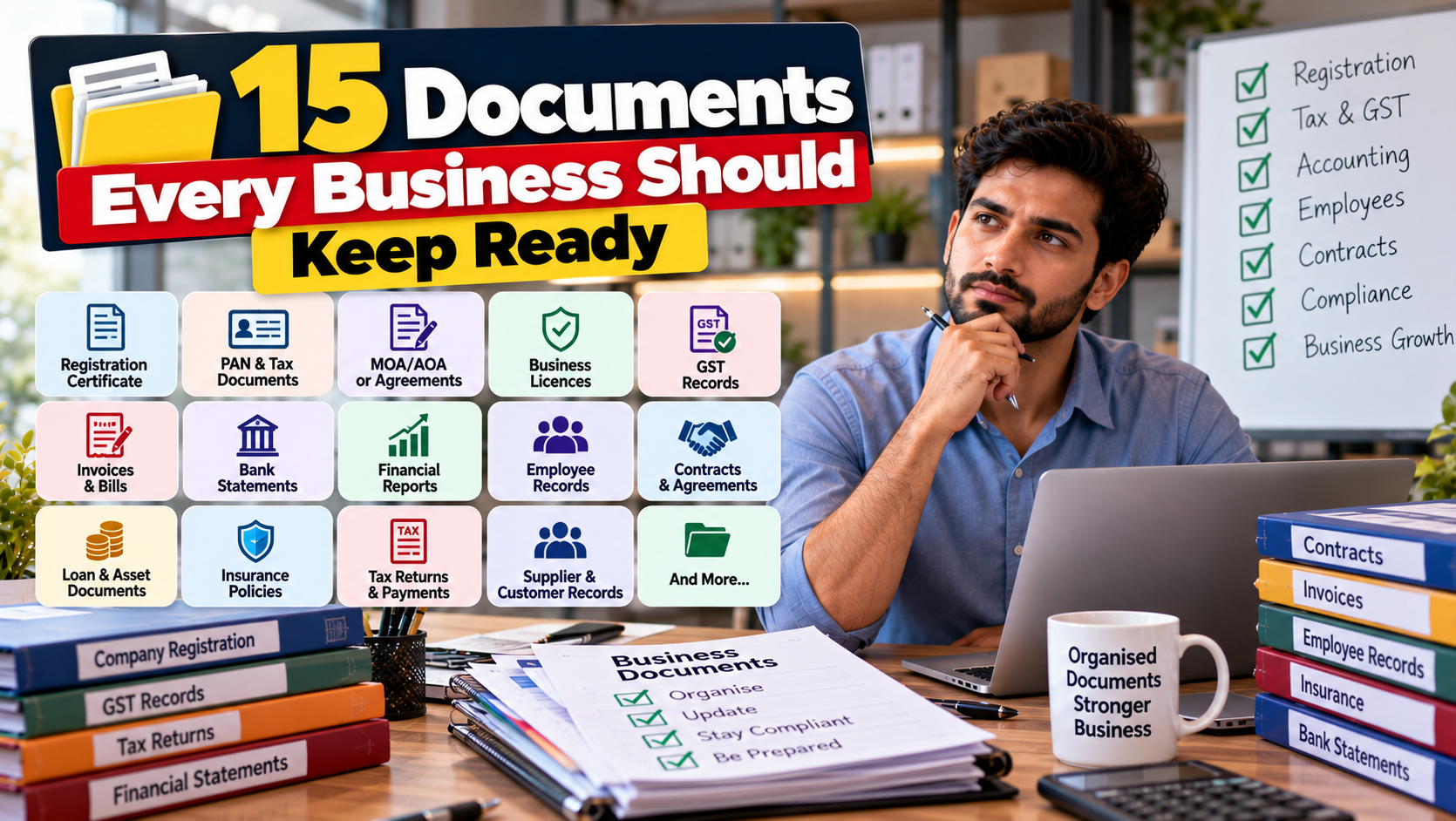
Why Is Business Documentation Important?
Business documents provide evidence of ownership, financial transactions, legal obligations and operational activities.
They help business owners understand their company's financial position, demonstrate compliance, manage relationships with customers and suppliers, and support important business decisions.
Well-organised documentation can help with:
-
Company registration and statutory compliance
-
GST and income tax filings
-
Financial reporting and audits
-
Business loan applications
-
Investor due diligence
-
Employee management
-
Customer and supplier agreements
-
Insurance claims
-
Dispute resolution
-
Business expansion
The exact documents required depend on the business structure, industry, location and activities. A sole proprietorship may not require the same corporate records as a private limited company, while a regulated business may need additional licences and approvals.
The following checklist provides a practical starting point for businesses in India.
15 Essential Documents Every Business Should Keep Ready
1. Business Registration Certificate
The first document every formally registered business should maintain is its registration or incorporation certificate, where applicable.
This document provides evidence of the business's legal registration under the relevant framework.
Depending on the business structure, it may include:
-
Certificate of Incorporation for a company
-
Certificate of Incorporation for an LLP
-
Partnership registration documents, where registered
-
Udyam registration certificate for an eligible MSME
-
Other applicable business registration certificates
Why is it important?
A registration certificate may be required when opening a business bank account, entering into contracts, applying for certain licences or completing other formal procedures.
For a company or LLP, it is also an important reference document for statutory and administrative purposes.
Business tip: Keep a clear digital copy of the certificate and record the business's legal name, registration number and date of registration in a central document register.
2. PAN and Tax Registration Documents
Businesses need to maintain the relevant tax identification and registration records applicable to their structure.
These may include:
-
PAN of the company or other relevant entity
-
Proprietor's PAN, where applicable
-
TAN, where applicable
-
GST registration certificate, if registered
-
Other tax registration details required for the business
PAN and TAN serve different purposes. PAN is used for tax identification, while TAN is generally relevant to persons required to deduct or collect tax at source under the applicable provisions.
Why is it important?
These records may be required for banking, tax compliance, invoicing, TDS-related activities and other official transactions.
Businesses should ensure that the details recorded in their accounting software, invoices and registration documents are consistent.
Business tip: Maintain a secure tax-document folder and restrict access to authorised personnel.
3. Memorandum of Association and Articles of Association
For a company, the Memorandum of Association (MOA) and Articles of Association (AOA) are important constitutional documents.
The MOA sets out key aspects of the company's constitution, including its permitted objects under the applicable legal framework.
The AOA contains provisions governing the company's internal management and procedures.
An LLP generally maintains an LLP agreement instead, while a partnership firm should maintain its partnership deed.
Why are these documents important?
They help establish the framework for ownership, management, authority and internal decision-making.
They may also be needed when dealing with banks, investors, legal advisers or parties reviewing the company's structure.
Business tip: Keep the latest approved or executed versions of these documents. If amendments are made, retain the relevant resolutions, agreements and filing records.
4. Director, Partner and Ownership Records
Businesses should maintain accurate records identifying their owners and the people authorised to manage or represent them.
Depending on the legal structure, these may include:
-
Details of shareholders or members
-
Director and designated partner records
-
Shareholding or ownership information
-
Register of members, where applicable
-
Share certificates and allotment records, where applicable
-
Board resolutions and relevant consents
-
Beneficial ownership records, where required
Why are these records important?
They help establish who owns the business, who has decision-making authority and who can act on its behalf.
Accurate ownership records are particularly important when a business raises investment, changes its ownership, appoints directors or enters into significant agreements.
Business tip: Update ownership and management records promptly when changes occur, and complete any required statutory filings.
5. Business Licences and Regulatory Approvals
Registration alone does not authorise every type of business activity.
Depending on the industry, location and nature of operations, a business may need additional licences, registrations or approvals.
Examples may include:
-
Shops and Establishments registration, where applicable
-
Local trade licences, where required
-
FSSAI licence or registration for relevant food businesses
-
Import Export Code for applicable import-export activities
-
Factory-related approvals, where applicable
-
Pollution-control permissions, where required
-
Industry-specific regulatory approvals
-
Fire and building safety documents, where applicable
Why are these documents important?
They help demonstrate that the business has obtained the approvals required for its activities.
Expired licences or missing renewals can interrupt operations or create compliance risks.
Business tip: Maintain a licence register containing the licence name, issuing authority, reference number, expiry date, renewal requirements and responsible employee.
6. GST Registration Certificate and GST Records
For GST-registered businesses, GST documentation is essential for tax compliance and financial reconciliation.
Important records may include:
-
GST registration certificate
-
Filed GSTR-1 returns
-
Filed GSTR-3B returns
-
Applicable annual returns
-
Sales invoices
-
Purchase invoices
-
Credit notes and debit notes
-
Input Tax Credit reconciliation
-
E-invoice records, where applicable
-
E-way bill records, where applicable
-
Relevant GST notices and replies
Why are these documents important?
These records help businesses report taxable supplies, determine tax liabilities, substantiate eligible Input Tax Credit and respond to discrepancies.
They are also useful when reconciling accounting records with GST portal information.
Business tip: Maintain separate records for sales, purchases, tax returns, ITC reconciliation and GST correspondence. Check that the accounting records and filed returns are consistent.
7. Sales Invoices and Customer Records
Sales invoices document the supplies made by a business and the amounts charged to customers.
Depending on the transaction and applicable rules, invoices or other prescribed documents may need to contain specific details.
Maintain relevant records such as:
-
Sales invoices
-
Customer purchase orders
-
Delivery challans, where applicable
-
Credit notes and debit notes
-
Customer agreements
-
Payment receipts
-
Sales returns and refund records
-
Outstanding customer balances
Why are these documents important?
Sales documentation helps establish revenue, track customer payments and support tax reporting.
It also provides evidence if a customer disputes an amount, delivery or payment.
For businesses selling through e-commerce marketplaces, it is important to reconcile gross sales, refunds, fees, taxes and net settlements.
Business tip: Use a consistent invoice-numbering system and ensure that every invoice is recorded in the accounting system.
8. Purchase Invoices and Supplier Records
Purchase invoices and supplier records document the goods and services a business obtains.
These records may include:
-
Supplier invoices
-
Purchase orders
-
Delivery receipts
-
Goods received notes, where applicable
-
Supplier agreements
-
Payment confirmations
-
Credit notes from suppliers
-
Expense bills
-
Supplier account statements
Why are these documents important?
They support expense recording, accounts payable management and eligible tax claims.
They also help businesses verify that goods or services were received and that payments match the underlying transactions.
For GST-registered businesses, purchase documentation is particularly important when assessing Input Tax Credit eligibility under the applicable rules.
Business tip: Match supplier invoices with purchase orders, delivery records and payment information where appropriate. Investigate missing invoices and unexplained differences promptly.
9. Bank Statements and Financial Transaction Records
Business bank statements provide a record of money received and paid through bank accounts.
Businesses should maintain statements and supporting records for all relevant business accounts.
These may include:
-
Current account statements
-
Loan account statements
-
Payment gateway settlements
-
E-commerce marketplace settlements
-
Bank charge records
-
Deposit and withdrawal evidence
-
Payment confirmations
-
Bank reconciliation statements
Why are these documents important?
Bank records help verify financial transactions, reconcile accounting balances and monitor cash flow.
They can also be required during loan applications, financial reviews, audits or investigations of unexplained transactions.
A bank statement alone does not explain the business purpose of every transaction, so supporting invoices and payment documents should also be retained.
Business tip: Reconcile bank accounts regularly and investigate transactions that cannot be matched with accounting records.
10. Financial Statements and Accounting Reports
Financial statements provide a structured view of a company's financial performance and position.
Depending on the business and reporting requirements, these may include:
-
Profit and Loss statement
-
Balance Sheet
-
Cash flow statement
-
Trial balance
-
General ledger
-
Accounts receivable report
-
Accounts payable report
-
Inventory reports
-
Budget and financial forecasts
-
Management reports
Why are these documents important?
Financial statements help business owners understand revenue, expenses, profitability, assets, liabilities and cash movements.
They are also important when reviewing business performance, applying for finance, discussing investment or planning expansion.
Without reliable financial reports, management may make decisions based on incomplete information.
Business tip: Prepare and review financial reports periodically rather than waiting until the end of the financial year.
11. Income Tax Returns and Tax Payment Records
Businesses should maintain their applicable income tax filings and supporting documentation.
Depending on the structure and circumstances, relevant records may include:
-
Filed income tax returns
-
Tax computation statements
-
Tax payment challans
-
Advance tax records, where applicable
-
TDS and TCS records, where applicable
-
Form 26AS and Annual Information Statement records, where relevant
-
Tax audit reports, where required
-
Notices and responses
-
Supporting schedules and working papers
Why are these documents important?
They help demonstrate tax filing history, reconcile reported income and payments, and support responses to tax queries.
They can also be useful when banks or other parties request financial and tax information.
Business tip: Keep the filed return, computation, payment evidence and supporting working papers together for each relevant financial year and assessment year.
12. Employee and Payroll Records
Businesses with employees should maintain relevant employment and payroll documentation.
Depending on the business and applicable laws, this may include:
-
Employment letters or contracts
-
Employee identity and contact records
-
Salary structures
-
Attendance and leave records
-
Payroll registers
-
Payslips
-
Salary payment evidence
-
TDS records relating to salaries
-
EPF and ESI records, where applicable
-
Professional Tax records, where applicable
-
Exit and full-and-final settlement records
Why are these documents important?
They help establish employment terms, calculate salaries, maintain payroll accuracy and demonstrate compliance with applicable employment and tax requirements.
Incomplete payroll records can lead to disputes, reporting errors and difficulty verifying employee costs.
Business tip: Restrict access to payroll records because they contain confidential personal and financial information.
13. Contracts and Business Agreements
Contracts define the rights, obligations and responsibilities of parties doing business together.
Relevant agreements may include:
-
Customer contracts
-
Supplier agreements
-
Service agreements
-
Employment contracts
-
Lease or rental agreements
-
Loan agreements
-
Partnership deeds
-
Shareholder agreements
-
Non-disclosure agreements
-
Franchise or distribution agreements
-
Technology and software agreements
Why are these documents important?
Written agreements help clarify payment terms, deliverables, responsibilities, confidentiality, termination conditions and dispute procedures.
They can also provide evidence of the terms agreed between the parties.
The importance of each contract depends on the transaction and its legal context.
Business tip: Store signed agreements securely, record renewal and expiry dates, and ensure that amendments are documented rather than relying only on informal conversations.
14. Loan, Investment and Asset Documents
Businesses often acquire assets, borrow money or receive funds from owners and investors.
Relevant documents may include:
-
Loan sanction letters
-
Loan agreements
-
Repayment schedules
-
Interest statements
-
Security or collateral documents
-
Investment agreements
-
Share allotment records
-
Fixed asset invoices
-
Asset registers
-
Warranty documents
-
Equipment maintenance records
Why are these documents important?
These records help establish the source of funds, repayment obligations, ownership of assets and relevant accounting treatment.
They are particularly important when the business applies for additional finance, sells an asset, raises investment or reviews its liabilities.
Business tip: Maintain an asset register with purchase date, cost, identification details, location, depreciation information and disposal records where relevant.
15. Insurance Policies and Claims Records
Insurance helps businesses manage specified risks, subject to the policy's terms, exclusions and conditions.
Depending on the business, relevant policies may include:
-
Property insurance
-
Fire and other specified-peril insurance
-
Equipment insurance
-
Vehicle insurance
-
Employee-related insurance
-
Public liability insurance
-
Professional indemnity insurance
-
Cyber insurance
-
Business interruption cover, where appropriate
Maintain the policy documents along with premium receipts, renewal notices, endorsements and claim correspondence.
Why are these documents important?
A business may need these records when renewing cover, making a claim, reviewing risk exposure or demonstrating insurance arrangements to a customer, lender or business partner.
Insurance should be reviewed periodically to ensure that the coverage remains appropriate for the business's current assets and activities.
Business tip: Keep a central insurance register with policy numbers, insured assets, coverage limits, renewal dates and the contact details of the insurer or broker.
How Long Should a Business Keep Its Documents?
There is no single retention period that applies to every business document in India.
Retention requirements depend on the type of record, the applicable law, the legal structure, the financial year and whether an audit, investigation, litigation or other matter is ongoing.
For example, company books of account, tax records, GST records, payroll records and contracts may be subject to different requirements.
Businesses should not destroy records simply because they are old or because a new financial year has started.
Before disposing of any records:
-
Identify the document type.
-
Check the applicable statutory retention requirement.
-
Confirm whether an audit, tax query, dispute or investigation is pending.
-
Review contractual and internal policy requirements.
-
Securely dispose of records only when permitted.
Best practice: Maintain a documented retention schedule that specifies how long each record category must be kept and who approves its disposal.
How to Organise Business Documents Efficiently
Collecting documents is only the first step. A business also needs a system for storing, retrieving and protecting them.
1. Create a Clear Folder Structure
Organise digital files by category and year.
For example:
-
Company Registration
-
Tax and GST
-
Accounting and Financial Statements
-
Sales and Customers
-
Purchases and Suppliers
-
Employees and Payroll
-
Contracts and Agreements
-
Banking and Loans
-
Assets and Insurance
-
Licences and Compliance
Use a consistent naming format, such as:
2026-09_SupplierName_InvoiceNumber.pdf
This makes it easier to search for records.
2. Maintain Digital Copies
Scan important paper documents and store readable digital copies where legally and operationally appropriate.
Keep original documents when required, particularly where a law, contract or authority requires them.
3. Control Access
Not every employee needs access to every business document.
Apply role-based permissions and stronger protections for sensitive information, such as payroll, identity records, banking details and ownership documents.
4. Back Up Important Files
Use a reliable backup system and test whether documents can be restored.
For important records, consider maintaining a separate backup protected from accidental deletion, account compromise or ransomware.
5. Track Deadlines
Maintain a central calendar for:
-
Licence renewals
-
Tax filings
-
Contract renewals
-
Insurance renewals
-
Loan repayments
-
Statutory meetings and filings
-
Other recurring compliance obligations
Assign responsibility for monitoring and completing each task.
Common Business Documentation Mistakes to Avoid
Even businesses with many documents can have poor record-management practices.
Avoid these common mistakes:
Keeping documents only in personal email accounts: Important records may become difficult to retrieve when an employee leaves.
Using inconsistent file names: Poor naming conventions make searches time-consuming.
Maintaining only paper copies: Physical records can be damaged, misplaced or difficult to access remotely.
Storing everything in one unrestricted folder: This can expose sensitive business and employee information.
Ignoring missing invoices: Missing supporting documents can create accounting and tax reconciliation problems.
Failing to update agreements: Old contracts may not reflect current responsibilities or commercial terms.
Deleting records without checking retention requirements: Premature disposal can create legal, tax or operational risks.
Failing to back up digital records: A technical failure or security incident can make important files unavailable.
A structured document-management process reduces these risks and supports more efficient business operations.
Business Documents Checklist
Use this checklist to review your current records.
-
Registration or incorporation certificate
-
PAN, TAN and applicable tax registration documents
-
MOA/AOA, LLP agreement or partnership deed, as applicable
-
Ownership and management records
-
Business licences and regulatory approvals
-
GST certificate and relevant GST records, where applicable
-
Sales invoices and customer records
-
Purchase invoices and supplier records
-
Bank statements and reconciliation records
-
Financial statements and accounting reports
-
Income tax returns and tax payment records
-
Employee and payroll records, where applicable
-
Contracts and business agreements
-
Loan, investment and asset documents
-
Insurance policies and claims records
Not every business needs every document in this list. Review the checklist against your legal structure, activities and applicable obligations.
Frequently Asked Questions
1. What are the most important documents for a small business?
A useful starting point includes business registration records, applicable tax registrations, invoices, bank statements, accounting reports, contracts and relevant licences. The exact requirements depend on the business.
2. Do all businesses need GST documents?
Only businesses to which GST registration or other GST obligations apply need the relevant GST records. Businesses that are not registered should still assess their tax obligations and monitor whether registration becomes necessary.
3. Should business documents be stored digitally?
Digital storage can make documents easier to search, share and back up. However, businesses should preserve originals when required and comply with applicable recordkeeping and security requirements.
4. Are bank statements enough for accounting?
No. Bank statements show bank transactions, but they do not replace invoices, receipts, contracts, payroll records or other documents that explain the business purpose of transactions.
5. Why are financial statements important?
Financial statements help owners understand profitability, assets, liabilities and cash flow. They also support management decisions and may be needed for financing, audit and other formal requirements.
6. How often should business documents be reviewed?
A business should update records as transactions occur, reconcile financial information regularly and review licences, contracts, tax obligations and other time-sensitive records according to their deadlines.
7. Can professional accountants help organise business documents?
Yes. Depending on the scope of engagement, accounting professionals can help organise financial records, establish reconciliation procedures, prepare reports and support applicable tax and compliance processes.
Final Thoughts
Business documents are more than administrative paperwork. They provide the evidence and information needed to manage finances, meet obligations, protect business interests and make informed decisions.
Keeping registration records, tax documents, invoices, financial statements, contracts, employee records and other essential documents organised can reduce last-minute stress and improve operational efficiency.
The best approach is to maintain records continuously rather than collecting them only when an audit, loan application, tax filing or business transaction requires them.
Start with these 15 document categories, identify what applies to your business, and create a secure system for storing, updating and retrieving every important record.
If your company needs help organising accounting records, reviewing compliance requirements or establishing a reliable financial reporting process, consider consulting an appropriate professional.
Disclaimer: This article is for general educational purposes and does not constitute legal, tax, accounting or compliance advice. Document requirements and retention periods vary by business structure, industry and applicable law. Confirm the requirements relevant to your business with a qualified professional.
Published on October 15, 2026