

1. Starting a Business Without Choosing the Right Structure
One of the first decisions an entrepreneur makes is choosing a business structure.
Common options in India include:
- Sole Proprietorship
- Partnership
- Limited Liability Partnership (LLP)
- One Person Company (OPC)
- Private Limited Company
Each structure has different implications for:
- Liability
- Taxation
- Compliance
- Ownership
- Fundraising
- Decision-making
- Business continuity
The common mistake
Many founders choose a structure simply because it is cheap or easy to register.
For example, a business planning to bring in investors may later discover that its original structure is not suitable for its funding plans.
Better approach
Choose the structure based on:
Current business → Future plans → Risk → Ownership → Funding → Compliance requirements
The cheapest structure today isn't necessarily the best structure for the next five years.
2. Mixing Personal and Business Finances
A common mistake among new entrepreneurs is using personal bank accounts and cards for business transactions.
For example:
Customer payment → Personal bank account
Business expense → Personal credit card
Employee salary → Personal account
This can make accounting and tax compliance unnecessarily complicated.
Better approach
Maintain separate business finances.
Use:
- Business bank account
- Business payment methods
- Proper invoices
- Expense records
- Accounting software
This creates a clear financial trail and makes it easier to understand the actual profitability of the business.
3. Not Registering the Business Properly
Some entrepreneurs start operating immediately without checking which registrations and licences apply to their business.
Depending on the business, these could include:
- Business/entity registration
- GST registration
- Shop & Establishment registration
- Local-body licence
- Professional Tax
- FSSAI licence
- Import Export Code
- Udyam/MSME registration
- Industry-specific licences
Not every business needs every registration.
The mistake is assuming that no registration is required without checking.
4. Ignoring Contracts
Verbal agreements may work for simple personal arrangements, but they are risky for business relationships.
New entrepreneurs sometimes start working with:
- Customers
- Suppliers
- Freelancers
- Agencies
- Employees
- Business partners
without a written agreement.
Why this is risky
What happens if:
- The customer doesn't pay?
- A supplier fails to deliver?
- A freelancer uses your company's confidential information?
- A partner leaves?
- A project scope changes?
- Intellectual property ownership becomes disputed?
Without a clear written agreement, proving what was actually agreed can become difficult.
Better approach
Use appropriate agreements such as:
- Service Agreement
- Vendor Agreement
- Employment Agreement
- NDA
- Partnership Agreement
- Founders' Agreement
- Consultancy Agreement
- Terms & Conditions
A contract should clearly define responsibilities, payment terms, timelines, confidentiality, intellectual property, termination and dispute resolution where relevant.
5. Not Protecting the Business Name and Trademark
A business name is an important asset.
Entrepreneurs sometimes spend months building a brand before discovering that:
- Someone else already owns a similar trademark.
- The chosen name is difficult to protect.
- Another business is already using a similar mark.
Better approach
Before investing heavily in branding:
- Search for similar trademarks.
- Check the proposed business name.
- Review relevant domain and social-media availability.
- Consider trademark registration where appropriate.
A registered trademark can provide stronger legal protection for the brand than simply registering a company or purchasing a domain name.
6. Assuming Company Registration Protects the Brand
This is an important distinction.
Company registration and trademark registration are not the same thing.
For example:
You register:
ABC Innovations Private Limited
That does not automatically mean you have exclusive trademark rights over every use of ABC or related marks.
Company-name approval and trademark protection serve different purposes.
Entrepreneurs should evaluate both separately.
7. Not Maintaining Proper Accounting Records
Some founders think accounting is only necessary when filing taxes.
That's a mistake.
Proper books help you understand:
- Revenue
- Gross margin
- Operating expenses
- Receivables
- Payables
- Cash flow
- Tax liabilities
- Business profitability
Poor records can also create problems during:
- Tax assessments
- GST reconciliation
- Audits
- Loan applications
- Investor due diligence
- Business valuation
Better approach
Update your accounts regularly rather than trying to reconstruct the entire year at the last minute.
8. Ignoring GST Compliance
If GST applies to your business, registration is only the beginning.
Businesses may also need to manage:
- GST invoices
- GSTR-1
- GSTR-3B
- Input Tax Credit
- GSTR-2B reconciliation
- E-invoicing, where applicable
- E-way bills, where applicable
- GST notices
One of the most common mistakes is treating GST filing as simply entering numbers into a return.
The figures should be reconciled with the underlying books and transaction records.
9. Missing Tax Deadlines
New entrepreneurs often concentrate on revenue and forget tax calendars.
Depending on the business and circumstances, tax compliance may involve:
- Income Tax
- GST
- TDS
- Advance Tax
- Professional Tax
- Other applicable statutory payments
Missing deadlines can result in:
- Interest
- Late fees
- Penalties
- Notices
- Compliance complications
Better approach
Create a tax calendar from the beginning of the financial year.
10. Hiring Employees Without Proper Documentation
A startup may begin with one or two employees and grow rapidly.
If employment arrangements aren't documented properly, disputes can arise regarding:
- Salary
- Working hours
- Responsibilities
- Leave
- Notice period
- Confidentiality
- Intellectual property
- Termination
- Benefits
A properly drafted employment agreement can establish expectations from the beginning.
11. Not Protecting Intellectual Property
Your business may own valuable intellectual property even if you don't realize it.
This can include:
- Brand names
- Logos
- Software
- Designs
- Content
- Product designs
- Photography
- Videos
- Business processes
- Databases
- Written materials
A common mistake is assuming that because the business paid someone to create something, the business automatically owns every associated intellectual-property right.
Ownership and licensing should be clearly addressed in contracts.
12. Using Freelancers Without an IP Agreement
Suppose you hire a freelancer to create your company's:
- Logo
- Website
- App
- Product design
- Marketing videos
Who owns the final work?
If the agreement doesn't clearly address intellectual-property rights, the answer may not be as straightforward as the entrepreneur assumes.
Better approach
Include appropriate provisions dealing with:
- Ownership
- Assignment
- Licensing
- Confidentiality
- Third-party materials
- Source files
- Usage rights
13. Not Having a Founders' Agreement
When two or more people start a business together, they often rely on friendship and trust.
That may work until the first major disagreement.
A founders' agreement can address:
- Ownership percentages
- Roles
- Responsibilities
- Capital contributions
- Decision-making
- Salary
- Exit
- Transfer of shares/interests
- Deadlock situations
- Intellectual property
- Confidentiality
The best time to discuss these matters is before a dispute happens.
14. Giving Equity Without Proper Documentation
Some startups informally promise:
"You'll get 10% of the company."
But what exactly does that mean?
Questions immediately arise:
- 10% of what?
- When does it become effective?
- Is there vesting?
- What happens if the person leaves?
- What happens after future fundraising?
- What rights come with the interest?
Equity arrangements should be properly documented and structured according to the applicable legal requirements.
15. Ignoring Data Privacy and Customer Information
Modern businesses collect significant amounts of customer data.
This may include:
- Names
- Phone numbers
- Email addresses
- Addresses
- Payment information
- Account information
- Website activity
Businesses should understand their obligations regarding personal-data handling and implement appropriate privacy and security practices.
This becomes particularly important for:
- E-commerce businesses
- SaaS companies
- Apps
- Online marketplaces
- Healthcare-related platforms
- Fintech businesses
16. Copying Terms & Conditions From Another Website
This is surprisingly common.
An entrepreneur finds a competitor's website and copies:
- Privacy Policy
- Terms & Conditions
- Refund Policy
- Disclaimer
and publishes them without reviewing whether they actually apply to the business.
Why this is risky
Your business model may be completely different.
A SaaS company, restaurant, e-commerce store and consulting firm don't necessarily need identical terms.
Your legal documents should reflect your actual business model.
17. Not Understanding Payment Terms
A business can be profitable on paper and still run out of cash because customers don't pay on time.
Contracts should clearly specify:
- Invoice date
- Payment deadline
- Advance payment
- Credit period
- Late-payment consequences
- Taxes
- Refund terms
- Dispute process
Don't leave important payment terms to assumptions.
18. Ignoring Outstanding Receivables
Legal and financial problems often begin with a simple sentence:
"The customer will pay next week."
Then next week becomes next month.
Then next month becomes six months.
Businesses should maintain a proper receivables process and follow up on overdue payments.
Where necessary, the business should understand the legal options available for recovery.
19. Not Checking Licences for the Industry
Some businesses require specific licences or registrations.
Examples can include:
- Food businesses
- Manufacturing
- Import/export
- Healthcare
- Education
- Financial services
- Transportation
- Construction
- Environmental activities
Don't assume that registering the company automatically gives permission to conduct every business activity.
Entity registration ≠ operational licence.
20. Ignoring Labour Compliance
As a business grows, employment-related compliance becomes increasingly important.
Depending on the establishment and workforce, businesses may need to consider:
- Shops & Establishments requirements
- Professional Tax
- Payroll records
- TDS
- Minimum-wage requirements
- Leave and working-hour requirements
- Employee-related statutory registrations
- Other applicable labour laws
The exact requirements depend on the business, location and workforce.
21. Failing to Renew Registrations and Licences
Some registrations are not simply "obtain once and forget."
Depending on the registration, businesses may need periodic:
- Renewals
- Returns
- Updates
- Amendments
- Certifications
Create a compliance calendar with:
Registration → Due date → Renewal period → Responsible person → Status
This simple system can prevent many avoidable compliance problems.
22. Not Updating Government Records After Changes
Businesses change over time.
For example:
- Office moves
- Directors change
- Partners change
- Shareholding changes
- Business activities change
- Contact details change
But some entrepreneurs update their internal records and forget to update the relevant government registrations.
Whenever a significant business change occurs, check whether an amendment or filing is required.
23. Treating Compliance as a Year-End Activity
One of the biggest mistakes is waiting until March or the end of the financial year to organize everything.
By then, you may discover:
- Missing invoices
- Unreconciled GST
- Unrecorded expenses
- Missing contracts
- Incorrect payroll
- Outstanding filings
- Unclear receivables
Better approach
Use a monthly compliance routine.
For example:
Every month:
- Update accounts
- Reconcile bank
- Review GST
- Review receivables/payables
- Check payroll
Every quarter:
- Review tax compliance
- Review contracts
- Review statutory registrations
- Review business performance
Annually:
- Complete annual filings
- Review licences
- Review agreements
- Review business structure
A Legal Checklist for New Entrepreneurs
Before launching your business, ask:
Business Structure
- Have I selected the appropriate business structure?
- Are ownership percentages documented?
- Are founder responsibilities clear?
Registrations
- Is entity registration required?
- Is GST applicable?
- Is Shop & Establishment registration applicable?
- Are local licences required?
- Are industry-specific licences required?
Contracts
- Customer agreement
- Vendor agreement
- Employment agreement
- NDA
- Founder agreement
- Freelancer/consultant agreement
Intellectual Property
- Trademark search
- Trademark strategy
- Domain name
- IP ownership clauses
Finance & Tax
- Business bank account
- Accounting system
- GST compliance
- TDS compliance
- Income Tax compliance
- Cash-flow tracking
Employment
- Employee contracts
- Payroll process
- Labour compliance review
- Confidentiality/IP provisions
Why Legal Planning Should Start Early
Legal planning isn't only about avoiding penalties.
It can also help a business:
- Build credibility
- Protect its brand
- Reduce disputes
- Improve financial discipline
- Prepare for investors
- Support bank financing
- Protect intellectual property
- Establish clear relationships with employees and vendors
- Scale more efficiently
Spending time on legal structure at the beginning is usually easier and less expensive than fixing a poorly structured business later.
When Should You Consult a Professional?
You don't necessarily need a lawyer or consultant for every routine business decision.
However, professional advice can be particularly valuable when:
- Starting a company with multiple founders
- Bringing in investors
- Signing major contracts
- Protecting valuable IP
- Hiring key employees
- Entering a partnership
- Expanding to another state or country
- Receiving a legal notice
- Facing a tax/GST dispute
- Buying or selling a business
- Restructuring the company
Getting advice before signing a major agreement or making a significant structural decision can often prevent much larger problems later.
How Clockwell Can Help New Entrepreneurs
At Clockwell, we help entrepreneurs build the administrative, tax and compliance foundation needed to operate and grow their businesses.
Our services include:
- Business & Company Registration
- LLP Registration
- GST Registration
- Trademark Registration
- Shop & Establishment Registration
- MSME/Udyam Registration
- Accounting & Bookkeeping
- Income Tax Filing
- GST Filing & Reconciliation
- TDS Compliance
- ROC Annual Filing
- Legal & Compliance Support
- Business Advisory
- Tax Advisory
- Virtual CFO Services
Whether you're launching a new business or formalizing an existing one, our team can help you identify the registrations and compliance requirements relevant to your business.
Entrepreneurship involves much more than building a product and finding customers. A strong business also needs a solid legal and compliance foundation.
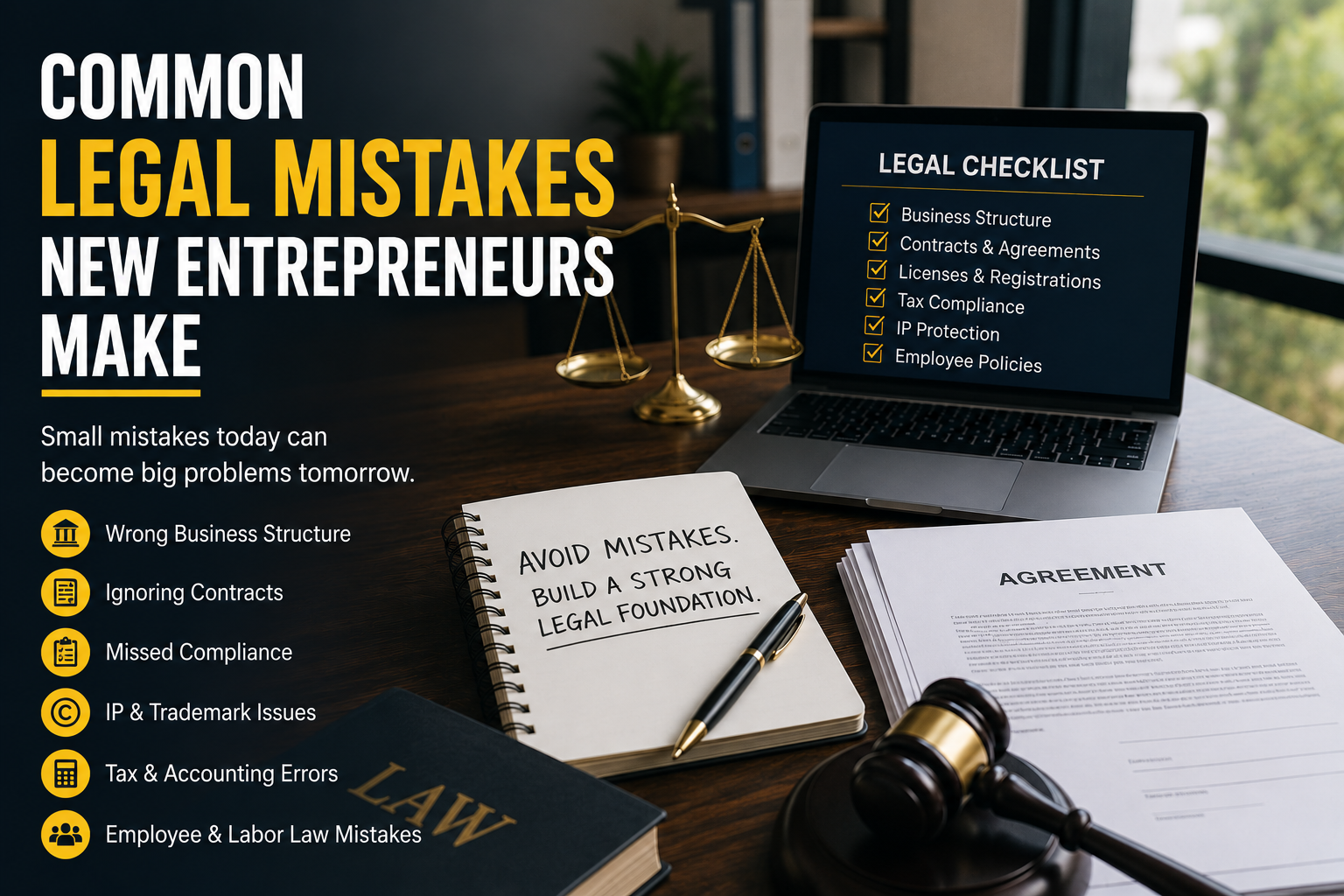
The most common legal mistakes new entrepreneurs make include:
Choosing the wrong business structure, ignoring contracts, failing to protect intellectual property, mixing personal and business finances, missing tax filings, overlooking licences, and treating compliance as an afterthought.
The solution isn't to make business unnecessarily complicated.
It is to establish the right systems from the beginning.
Choose the appropriate structure. Document important relationships. Protect your brand. Maintain proper accounts. Track compliance deadlines. Review legal requirements as your business grows.
A few hours of proper planning today can prevent months of disputes, corrections and unnecessary expenses later.
Published on August 21, 2026