
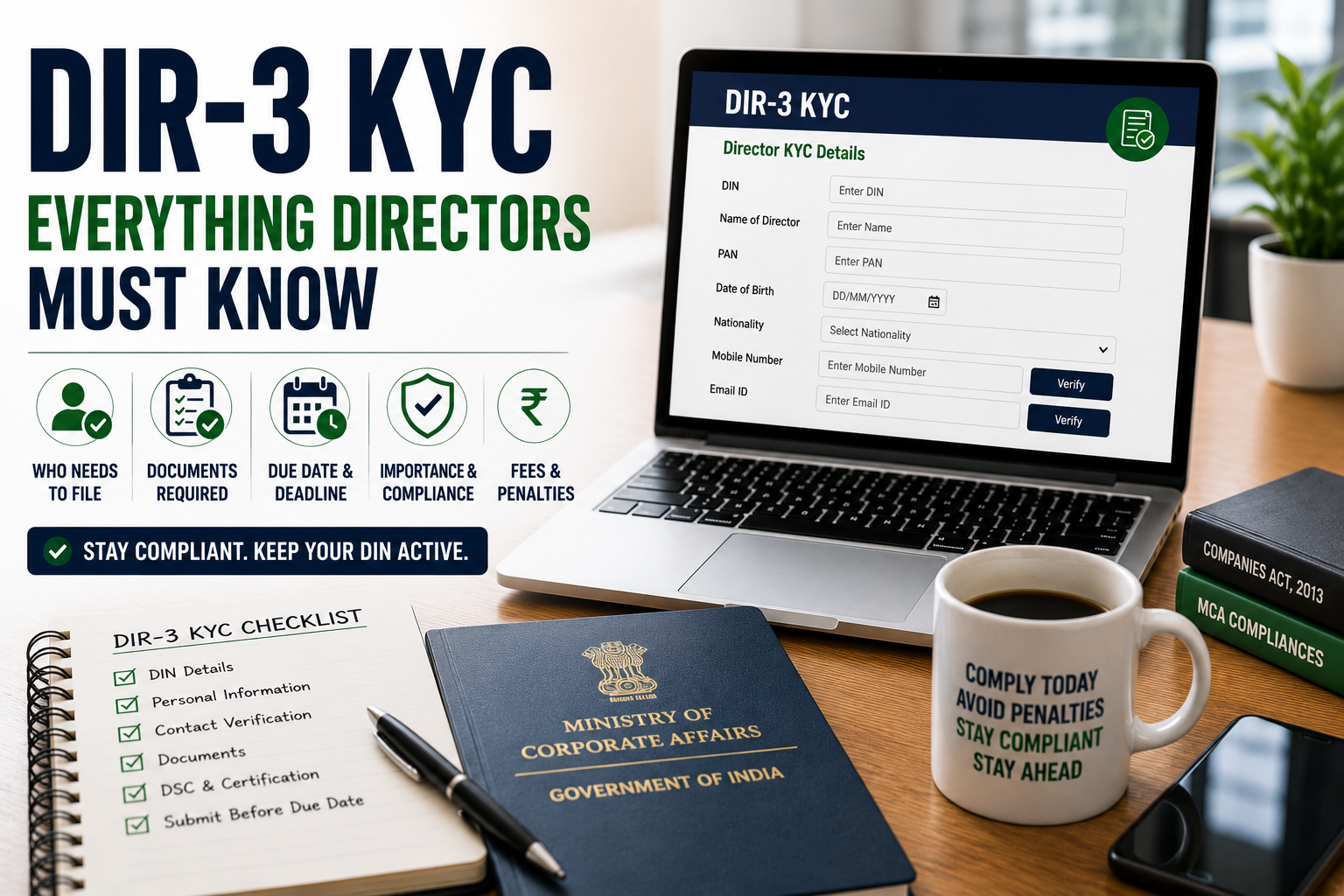
Being appointed as a director of a company comes with several legal and compliance responsibilities. One important annual compliance requirement is Director KYC, commonly known as DIR-3 KYC.
The Ministry of Corporate Affairs (MCA) requires individuals holding a Director Identification Number (DIN) to keep their KYC details updated. The requirement helps maintain accurate information about directors in the MCA's records.
For directors, DIR-3 KYC should not be treated as just another formality. Missing the applicable filing requirement can result in the DIN being deactivated and can create additional compliance work.
This guide explains DIR-3 KYC, who needs to file it, the documents required, the filing process, fees, consequences of non-compliance, and common mistakes to avoid.
What is DIR-3 KYC?
DIR-3 KYC is an MCA compliance form used to verify and update the Know Your Customer (KYC) details of individuals who have been allotted a Director Identification Number (DIN).
The KYC information can include details such as:
- Name
- Date of birth
- Father's name
- PAN
- Nationality
- Residential address
- Personal mobile number
- Personal email address
The purpose is to ensure that the MCA maintains current and verifiable information about DIN holders.
Who Needs to File DIR-3 KYC?
As a general rule, an individual who has been allotted a DIN and whose DIN is in the applicable status is required to complete the prescribed annual KYC compliance.
MCA guidance states that a DIN holder filing KYC for the first time must use e-Form DIR-3 KYC. Directors who have already completed DIR-3 KYC in a previous year and have no changes to their KYC information may generally use the DIR-3 KYC web service for subsequent annual KYC.
Importantly, the requirement is linked to the DIN and not simply to whether the individual is currently serving as a director in a particular company.
What is the DIR-3 KYC Due Date?
Under Rule 12A of the Companies (Appointment and Qualification of Directors) Rules, 2014, the annual KYC requirement applies to individuals allotted a DIN as of 31 March of the relevant financial year, with the KYC due by 30 September of the immediately following financial year.
For example, a DIN holder who falls within the relevant requirement for the financial year ending 31 March 2026 would generally have a 30 September 2026 annual KYC deadline.
Directors should verify the applicable MCA filing requirements for the relevant financial year before filing.
DIR-3 KYC vs DIR-3 KYC Web
This is an important distinction.
DIR-3 KYC Form
This is generally required when:
- A DIN holder is filing KYC for the first time.
- Existing KYC information needs to be updated or changed.
MCA guidance states that changes in KYC information must be updated through the e-form rather than the web service.
DIR-3 KYC Web Service
This is generally available for DIN holders who have already submitted DIR-3 KYC previously and whose KYC details remain unchanged.
Therefore:
First-time KYC / KYC changes → DIR-3 KYC
Subsequent annual KYC with no changes → DIR-3 KYC Web
Why is DIR-3 KYC Important?
Director KYC helps the MCA maintain accurate information about individuals associated with Indian companies.
For directors, completing the requirement on time helps avoid:
- DIN deactivation
- Additional filing fees
- Compliance complications
- Difficulties associated with restoring an inactive DIN
Keeping your DIN status compliant is particularly important if you are actively involved in company management or plan to accept directorships in the future.
Information Required for DIR-3 KYC
The exact information requested can depend on the filing and the MCA form version applicable at the time.
Common information includes:
- DIN
- Full name
- Father's name
- Date of birth
- PAN
- Nationality
- Residential address
- Personal mobile number
- Personal email address
The personal mobile number and email address are subject to OTP verification, and MCA guidance requires them to be unique in the DIN holder database.
Documents Required for DIR-3 KYC
Depending on the circumstances and applicable form requirements, directors may need supporting information or documents such as:
- PAN Card
- Passport, where applicable
- Address proof
- Residential address details
- Proof relating to changes in personal information
- Digital Signature Certificate (DSC)
Foreign nationals may have additional documentation requirements.
The exact document requirements should always be checked against the current MCA form and instruction kit before filing.
Step-by-Step DIR-3 KYC Filing Process
Step 1: Check Your DIN Status
First, verify that your DIN details are correct and check the current status of the DIN.
Step 2: Check Whether KYC Details Have Changed
Review:
- Name
- Address
- Mobile number
- PAN
- Other relevant information
If there has been a change, the appropriate e-form may be required.
Step 3: Prepare Your Documents
Keep your PAN, identification documents, address information, and other required details ready.
Step 4: Complete the Form
Enter the required KYC information carefully.
Errors in personal information can create validation or verification problems.
Step 5: Verify Mobile and Email
The registered personal mobile number and email address must undergo the prescribed OTP verification process.
MCA guidance states that the OTP is valid for 30 minutes.
Step 6: Apply Digital Signature
The form requires the applicable digital signature process.
Step 7: Professional Certification
Where applicable, the form must be certified by a practicing professional as prescribed under the filing requirements.
Step 8: Submit the Form
After completing the required verification and certification, submit the form through the MCA system.
DIR-3 KYC is processed electronically in Straight Through Processing (STP) mode according to the MCA instruction kit.
What Happens If DIR-3 KYC Is Not Filed?
Failure to complete the required KYC compliance can result in the DIN being marked as deactivated due to non-filing of DIR-3 KYC.
This can create problems for a person who needs to use the DIN for corporate compliance activities.
The MCA's guidance provides a mechanism for filing DIR-3 KYC where the DIN has been deactivated for non-filing, subject to the applicable fee.
What is the Late Fee for DIR-3 KYC?
The applicable fee depends on the filing situation.
The MCA's current instruction kit states that:
- Annual KYC filed within the applicable due date has no filing fee.
- A DIN that has been deactivated due to non-filing can generally be reactivated through the prescribed KYC filing with a ₹5,000 fee.
- The instruction kit also provides for a ₹500 fee for certain subsequent filings after annual KYC compliance, depending on the circumstances.
Since MCA fees and filing rules can be amended, directors should verify the applicable fee on the MCA portal at the time of filing.
Common DIR-3 KYC Mistakes
1. Waiting Until the Last Day
Last-minute filing can create unnecessary problems if:
- OTPs are delayed
- DSCs are expired
- Information doesn't match MCA records
- Technical issues occur
Complete the filing well before the deadline.
2. Using the Wrong Mobile Number
The prescribed personal mobile number must meet MCA's validation requirements.
Don't use a number that is incorrectly linked to another DIN holder.
3. Using an Incorrect Email Address
The personal email address is subject to verification.
Make sure you have access to the email account before starting the filing.
4. Ignoring Changes in Address
If your residential address has changed, don't simply submit unchanged information without checking whether an updated e-form is required.
5. Expired Digital Signature Certificate
An expired DSC can prevent successful filing.
Check the validity of the DSC before starting the process.
6. Assuming Disqualified Directors Are Exempt
MCA's published FAQ states that a person who has been allotted a DIN and whose DIN is in approved status is required to file DIR-3 KYC, and specifically notes that disqualified directors are also required to file.
DIR-3 KYC for Foreign Directors
Foreign directors should pay particular attention to:
- Passport details
- Nationality
- Foreign address
- Email verification
- Mobile verification
- Applicable notarization or authentication requirements
The documentation requirements can differ from those applicable to Indian residents.
It is advisable to check the current MCA instructions before filing.
Why Directors Should Complete KYC Every Year
Annual KYC is not simply about avoiding a penalty.
It helps ensure that:
- MCA records remain accurate.
- Personal information is current.
- DIN remains compliant.
- Corporate filings can proceed smoothly.
- Future directorship-related compliance is easier to manage.
A few minutes of timely compliance can prevent significantly more complicated issues later.
DIR-3 KYC Compliance Checklist
Before filing, directors should check:
-
DIN is correct
-
Name matches official records
-
PAN details are correct
-
Date of birth is correct
-
Residential address is updated
-
Personal mobile number is accessible
-
Personal email is accessible
-
OTP verification can be completed
-
DSC is valid
-
Required documents are available
-
Correct form/web service is being used
-
Filing is completed before the applicable deadline
How Clockwell Can Help With DIR-3 KYC
DIR-3 KYC may look like a simple compliance filing, but incorrect information or missed deadlines can create avoidable complications.
At Clockwell, we assist companies and directors with:
- DIR-3 KYC Filing
- DIN Compliance
- MCA Compliance
- ROC Annual Filing
- Company Registration
- LLP Compliance
- DSC Assistance
- Director-related MCA Filings
- GST Compliance
- Income Tax Filing
- Accounting & Bookkeeping
- Business Advisory
Our team can help verify the required information, prepare the filing, complete the applicable verification and certification process, and keep your corporate compliance on track.
DIR-3 KYC is an important annual MCA compliance requirement for eligible DIN holders. Directors should understand whether they need to file the full DIR-3 KYC form or use the web service, verify their personal details, keep their DSC and contact information ready, and complete the filing within the applicable deadline.
Most importantly, don't wait until the last minute. A timely KYC filing helps maintain an active and compliant DIN and avoids the additional cost and administrative work that can arise from non-filing.
If you're a company director and are unsure about your DIR-3 KYC status, filing method, documents, or deadline, professional MCA compliance assistance can help you complete the process correctly.
Published on August 14, 2026