

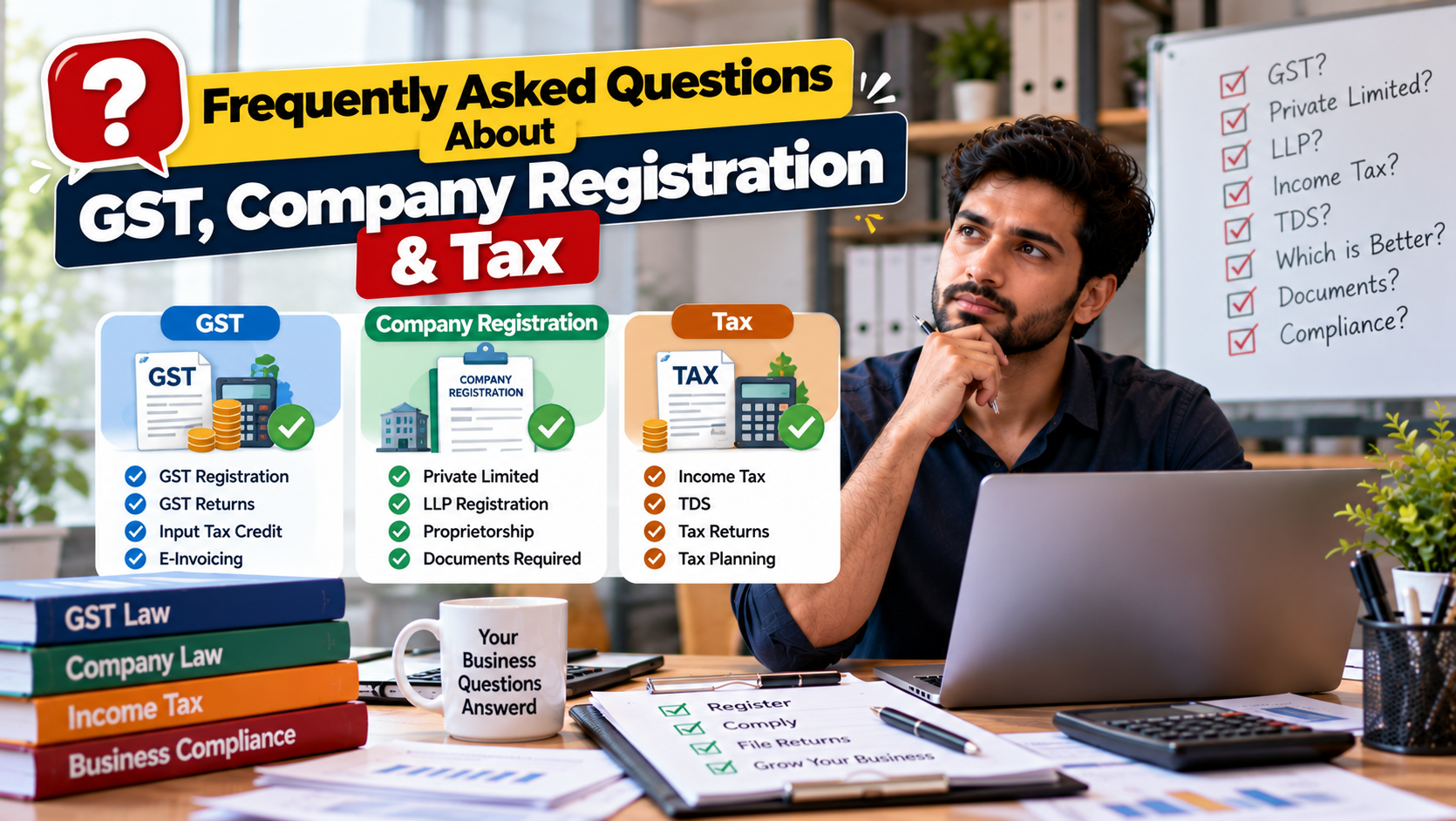
Starting and managing a business in India involves several legal, financial and tax-related responsibilities. Whether you are a startup founder, freelancer, shop owner, service provider or established entrepreneur, understanding GST, company registration and income tax can help you avoid compliance problems and make better business decisions.
Many business owners have similar questions: Is GST registration compulsory? Should I register a Private Limited Company or an LLP? What documents are required? Do small businesses need to file income tax returns? How can I reduce tax legally?
This guide answers the most frequently asked questions about GST, company registration and taxation in India in simple language.
1. Frequently Asked Questions About GST Registration
1. What is GST registration?
Goods and Services Tax (GST) registration is the process through which an eligible business obtains a Goods and Services Tax Identification Number (GSTIN). It allows the business to comply with applicable GST requirements, issue tax invoices where required, collect GST on taxable supplies and claim eligible input tax credit.
GST registration is completed through the official GST portal: https://www.gst.gov.in/.
2. Is GST registration compulsory for every business?
No. GST registration is not compulsory for every business from the beginning. The requirement depends on factors such as aggregate turnover, the type of goods or services supplied, the state in which the business operates, and specific compulsory-registration provisions.
Commonly applicable threshold limits include ₹20 lakh for services in many states and ₹40 lakh for eligible suppliers exclusively dealing in goods in many states. Lower limits and different conditions apply in certain states and circumstances. Some businesses may also be required to register irrespective of turnover under applicable provisions.
Important: Do not decide whether GST registration is required based on turnover alone. Interstate supplies, e-commerce activities, exemptions and other specific rules may affect the requirement.
3. What documents are required for GST registration?
The documents depend on the business structure and circumstances. Commonly required documents include:
-
PAN of the business or proprietor, as applicable
-
Aadhaar and identity details of the authorised person, where required
-
Proof of business address, such as an electricity bill or other accepted document
-
Rent agreement and owner’s consent or NOC, where applicable
-
Bank account details, when required for the application or subsequent compliance
-
Photographs and authorisation documents, where applicable
-
Certificate of incorporation, partnership deed or LLP agreement, depending on the entity
The exact document requirements should be checked against the current GST portal instructions.
4. How long does GST registration take?
The time required depends on the completeness of the application, document verification, risk-based checks and whether the tax officer requests additional information. Some applications may be processed quickly, while others can take longer.
To reduce delays, ensure that the PAN details, legal business name, address proof, authorised signatory information and supporting documents are accurate and consistent.
5. Can I register for GST using my home address?
In many cases, a residential address can be used as the principal place of business if the applicant has the required legal right to use the premises and can provide acceptable address evidence.
For rented premises, a rent agreement and supporting documents may be required. For owned premises, ownership or utility documents may be relevant. The applicable requirements depend on the circumstances and current GST rules.
6. What is the difference between GST registration and GST return filing?
GST registration is the process of obtaining a GSTIN when registration is required or chosen under the applicable rules.
GST return filing is the periodic reporting of relevant business transactions, taxable supplies, tax liability, eligible input tax credit and other prescribed information.
Obtaining GST registration does not complete your GST compliance. Registered taxpayers must meet their applicable return-filing and payment obligations, even when there is no business activity in a particular period, where a return is required.
7. What happens if a business does not register for GST when required?
Failure to register when legally required can result in tax demands, interest, penalties and other consequences under applicable law. It may also create difficulties with customers, vendors, invoicing and input tax credit.
Businesses approaching their applicable turnover threshold should review their GST obligations in advance rather than waiting until a compliance issue arises.
8. Can a business claim Input Tax Credit (ITC)?
Eligible GST-registered businesses may claim input tax credit for GST paid on qualifying business purchases, subject to the conditions, restrictions and documentation requirements under GST law.
ITC is not automatically available on every purchase. Businesses should verify tax invoices, supplier reporting, receipt of goods or services, business use and other applicable conditions. Certain expenses are specifically restricted from credit.
Maintaining accurate purchase records and regularly reconciling GST data can help prevent errors in ITC claims.
2. Frequently Asked Questions About Company Registration
9. Which business structure is best for a new business?
The right structure depends on ownership, liability, funding plans, compliance costs and long-term business goals.
Common business structures include:
-
Sole Proprietorship: Often suitable for an individual operating a small business.
-
Partnership Firm: Suitable for two or more people running a business together under a partnership arrangement.
-
Limited Liability Partnership (LLP): Provides a separate legal structure with limited liability for partners, subject to applicable law.
-
Private Limited Company: Often preferred by businesses planning structured growth, external investment or share-based ownership.
-
One Person Company (OPC): A company structure designed for a single member, subject to eligibility and applicable rules.
There is no single best structure for every entrepreneur. Compare the legal responsibilities, annual compliance, taxation and future expansion requirements before making a decision.
10. What is the difference between an LLP and a Private Limited Company?
An LLP and a Private Limited Company are separate legal entities, but their ownership and compliance structures differ.
| Feature | LLP | Private Limited Company |
|---|---|---|
| Ownership | Partners | Shareholders |
| Management | Designated partners and partners | Directors and shareholders |
| Ownership transfer | Governed by LLP agreement and law | Governed by company law and share-transfer rules |
| Investment structure | Partner contributions and agreed rights | Share capital and shareholding |
| Compliance | LLP-specific filings and requirements | Company-specific filings and requirements |
| Common use | Professional firms and closely held businesses | Startups and businesses planning equity-based investment |
The appropriate structure depends on the business model, investment plans, ownership arrangements and compliance capacity.
11. What documents are required to register a company in India?
Company registration generally requires identity and address proof for proposed directors and subscribers, PAN details where applicable, digital signatures, proposed company names, registered office documentation and incorporation-related declarations.
Depending on the application, documents may include:
-
PAN and identity proof of directors and subscribers
-
Address proof of directors and subscribers
-
Digital Signature Certificates (DSCs), where required
-
Proof of the proposed registered office address
-
Utility bill and owner’s NOC or consent, where applicable
-
Memorandum of Association (MOA)
-
Articles of Association (AOA)
-
Other declarations and forms required for incorporation
The documentation differs for an OPC, Private Limited Company, Section 8 Company and other entity types.
12. How long does company registration take?
Company registration timelines vary according to document readiness, name availability, application accuracy, regulatory review and any resubmission requirements.
An application may be delayed if the proposed name conflicts with an existing entity or trademark, the business activity details are inconsistent, or documents are incomplete.
The Ministry of Corporate Affairs (MCA) provides the official incorporation services through its portal: https://www.mca.gov.in/.
13. Is GST registration included in company registration?
Not automatically in every case. Company incorporation and GST registration are separate compliance processes, although the incorporation process may allow eligible applicants to apply for GST registration through integrated services.
Whether GST registration is necessary depends on the business’s GST obligations and the application route used. A company can be incorporated before it becomes liable for GST registration, depending on its activities and circumstances.
14. Does a registered company need to file annual returns?
Yes. Companies incorporated under the Companies Act generally have ongoing statutory responsibilities, including applicable annual filings, financial statements, accounting records, board and shareholder requirements, and other filings depending on the company’s circumstances.
LLPs also have their own annual and event-based filing obligations.
Missing required filings may result in additional fees, penalties or other legal consequences. Maintaining a compliance calendar helps businesses track due dates and responsibilities.
15. Can I register a company without renting a commercial office?
A separate commercial office is not necessarily required in every case. A qualifying residential address may be used as a registered office if the applicable legal and documentation requirements are met.
The proposed address must satisfy the requirements for registered office documentation and receipt of official communications. Confirm that the property owner’s consent and supporting documents are available before applying.
3. Frequently Asked Questions About Income Tax
16. Does every business need to file an income tax return?
The requirement depends on the legal structure, income, applicable filing conditions and other provisions of the relevant tax law.
Companies and LLPs generally have return-filing obligations even when they report a loss or have limited business activity, subject to applicable law. Proprietors and other taxpayers must assess their filing obligations based on the rules relevant to them.
A business should not assume that no return is required simply because it has low income, no profit or no transactions during the year.
17. What is the difference between GST and income tax?
GST and income tax are different taxes.
GST is an indirect tax generally linked to taxable supplies of goods and services. Registered businesses may collect GST from customers and pay the applicable tax after considering eligible credits.
Income tax is generally based on taxable income under the applicable tax rules. Businesses and individuals must determine their taxable income and meet the relevant payment and filing requirements.
A business may have obligations under both systems. GST registration or return filing does not replace income tax compliance.
18. What business expenses can be claimed for tax purposes?
Expenses incurred wholly and exclusively for business purposes may be deductible when permitted by the applicable tax law and supported by appropriate records.
Common examples, subject to eligibility, include:
-
Office rent and utilities
-
Employee salaries and professional fees
-
Advertising and marketing expenses
-
Business travel expenses
-
Software subscriptions and communication costs
-
Repairs and maintenance
-
Eligible depreciation on business assets
-
Other legitimate operating expenses
Personal expenses cannot simply be treated as business expenses. Capital expenditure, mixed personal and business use, and expenses specifically restricted under tax law require separate consideration.
Keep invoices, payment records and supporting documents to establish the nature and purpose of each expense.
19. What is the difference between a tax audit and a statutory audit?
A tax audit examines specified business or professional records to assess compliance with applicable tax-audit provisions. Whether it is required depends on the taxpayer’s circumstances and the law for the relevant tax year.
A statutory audit is an audit required under a specific law, such as the Companies Act for companies subject to its audit provisions.
The scope, legal basis and reporting requirements differ. A business may be subject to one, both or other audit requirements depending on its structure and activities.
20. What is TDS, and when does a business need to deduct it?
Tax Deducted at Source (TDS) is a mechanism under which tax is deducted from specified payments and deposited with the government, subject to applicable provisions.
Businesses may need to evaluate TDS requirements for payments such as salaries, contractor fees, professional fees, rent, interest and other specified transactions.
The applicable section, threshold, rate, timing and filing obligations depend on the payment type and the law in force. Incorrect deduction or delayed deposit can result in interest, penalties or other consequences.
21. What is advance tax?
Advance tax is income tax paid during the financial year in instalments when the taxpayer’s estimated tax liability meets the applicable conditions.
Instead of paying the entire amount at the end of the year, eligible taxpayers calculate their expected liability and pay it according to the prescribed schedule.
The requirement and instalment dates depend on the taxpayer category and applicable rules. Businesses should estimate profits regularly and review advance-tax exposure with a tax professional.
22. Can a business reduce its tax legally?
Yes. Businesses can manage tax efficiently by selecting an appropriate legal structure, maintaining accurate accounts, claiming eligible deductions, reviewing applicable tax regimes and complying with payment and filing deadlines.
Legal tax planning should be based on genuine transactions and reliable documentation. Hiding income, creating false expenses or using fabricated invoices can lead to serious consequences.
A qualified tax professional can help evaluate lawful options based on the business’s income, structure, transactions and long-term goals.
4. Business Compliance and Record-Keeping FAQs
23. Why should a business maintain proper accounting records?
Accurate accounting records help business owners understand profitability, cash flow, outstanding payments, operating expenses and financial performance.
They also support GST returns, income tax calculations, audits, loan applications, investor discussions and management decisions.
Businesses should maintain records of sales, purchases, expenses, bank transactions, payroll, assets, liabilities and other relevant financial activities. Regular bookkeeping is usually more effective than trying to reconstruct transactions at year-end.
24. What happens if GST returns or income tax returns are filed late?
Late filing may result in late fees, interest, penalties or other consequences, depending on the return, the delay and the applicable law.
Delayed filings can also affect business operations, reconciliation, tax-credit claims and compliance status. The exact consequences should be checked for the specific return and period.
The best approach is to maintain a compliance calendar, reconcile records regularly and prepare returns before the due date.
25. Can I manage GST, tax and company compliance myself?
Some business owners manage their own compliance, particularly when transactions are straightforward and they understand the relevant rules.
However, professional support may be useful when a business has multiple registrations, complex transactions, employees, interstate sales, e-commerce activity, tax notices, audit requirements or company-law obligations.
The decision should consider the complexity of the business, the risk of errors and the time required to maintain compliance.
5. Essential Business Compliance Checklist
Use this checklist to review the main compliance areas relevant to your business.
-
Confirm the appropriate business structure and registration status.
-
Check whether GST registration is required.
-
Maintain accurate sales, purchase and expense records.
-
Reconcile GST invoices, returns and eligible input tax credit.
-
Track GST return and tax-payment deadlines.
-
Review income tax return and advance-tax obligations.
-
Evaluate applicable TDS requirements.
-
Maintain bank statements, contracts and supporting documents.
-
Complete annual company or LLP filings where applicable.
-
Review audit requirements and preserve relevant financial records.
Not every item applies to every business. The checklist should be adapted to the entity type, business activities and applicable law.
6. When Should You Consult a Professional?
Consider seeking professional guidance when:
-
You are choosing between a proprietorship, LLP and Private Limited Company.
-
Your business is approaching a GST registration threshold.
-
You are unsure whether GST applies to a transaction.
-
You need help with GST returns, input tax credit or reconciliation.
-
Your business has received a tax notice.
-
You need to understand TDS, advance tax or audit requirements.
-
Your company or LLP has pending statutory filings.
-
You are planning to expand, seek investment or restructure your business.
Early advice can help identify compliance requirements before they become costly problems.
Understanding GST, company registration and tax compliance is an important part of running a successful business in India. The correct business structure, timely registrations, accurate accounting records and regular tax reviews can reduce avoidable errors and support long-term growth.
Because requirements vary according to the business structure, turnover, transaction type and relevant tax year, business owners should verify their specific obligations instead of relying only on general rules.
Clockwell International LLP can support businesses with company registration, GST-related services, accounting, tax compliance and other business-support requirements. Visit https://clockwell.in/ to learn more or contact info@clockwell.in to discuss your requirements.
Frequently Asked Questions — Quick Summary
Is GST registration compulsory for all businesses?
No. It depends on turnover, business activity, location and specific provisions under GST law.
Which is better: LLP or Private Limited Company?
It depends on ownership, investment plans, liability, compliance requirements and long-term goals.
Can I use my home address for company registration?
A residential address may be acceptable when the applicable registered-office requirements and documentation are satisfied.
Do businesses need to file income tax returns if they make a loss?
Companies and LLPs generally have filing obligations even in loss situations. Other taxpayers should assess the rules applicable to them.
Can I claim all business purchases as tax deductions or GST credit?
No. Income-tax deductions and GST input tax credit have separate eligibility conditions and restrictions.
Where can I verify official requirements?
Use the official GST portal at https://www.gst.gov.in/, the Ministry of Corporate Affairs at https://www.mca.gov.in/ and the Income Tax Department portal at https://www.incometax.gov.in/.
Published on October 16, 2026