
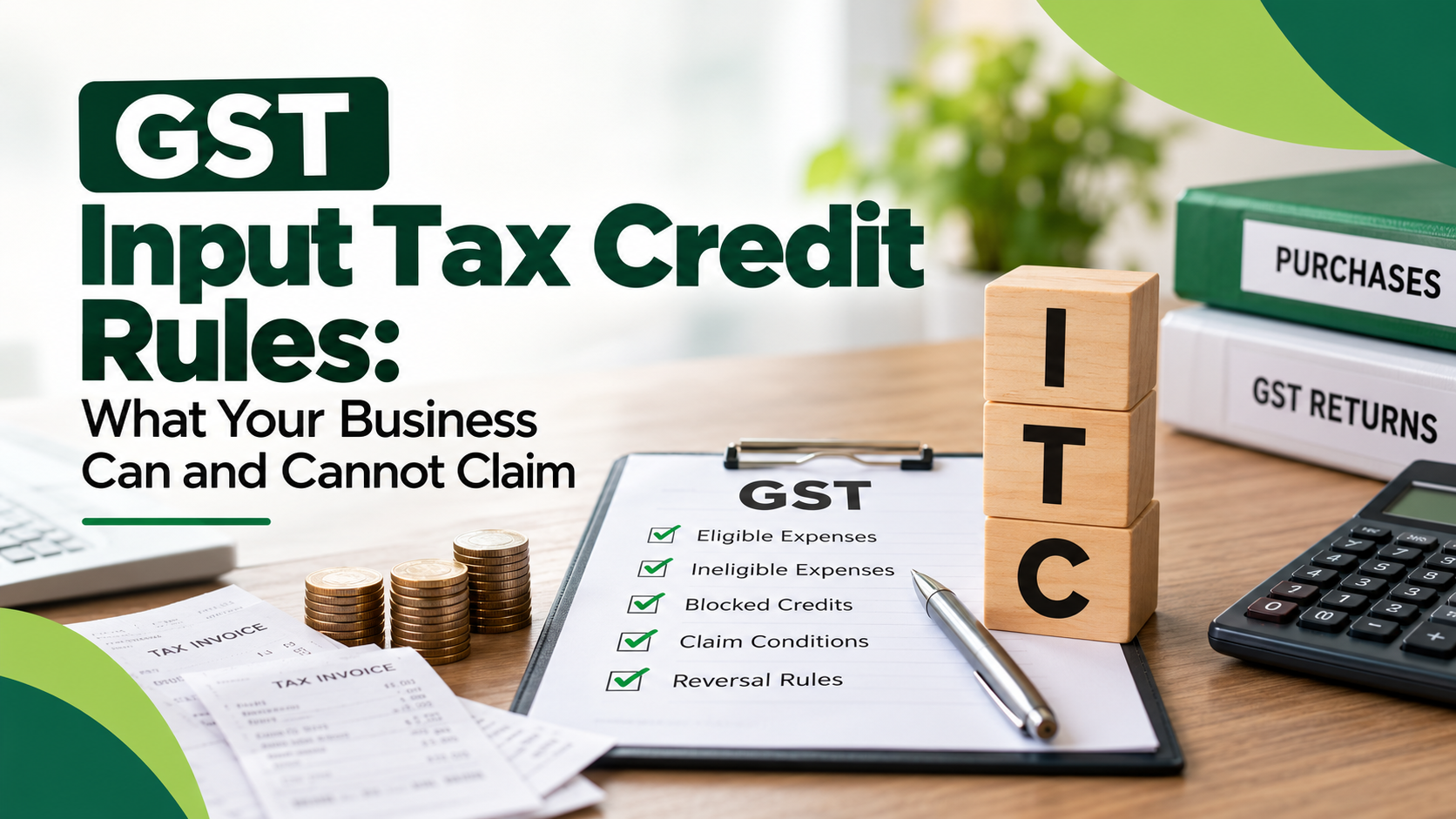
Goods and Services Tax (GST) has changed the way businesses manage their taxes in India. For business owners, understanding how GST works is essential not only for meeting tax obligations but also for managing expenses and improving cash flow. One of the most important features of GST is Input Tax Credit (ITC).
When a business purchases goods or services and pays GST on those purchases, it may be eligible to claim credit for the tax paid. This credit can generally be used to reduce the GST payable on its sales. However, not every purchase qualifies for an ITC claim. Businesses must follow specific eligibility conditions, maintain proper documentation and comply with GST filing requirements.
Understanding the GST input tax credit rule helps businesses identify eligible expenses, avoid incorrect claims and reduce the risk of penalties or tax disputes.
In this guide, we explain what Input Tax Credit means, the conditions for claiming it, which expenses qualify, which credits are blocked and how businesses can manage ITC correctly.
What Is Input Tax Credit Under GST?
Input Tax Credit, commonly known as ITC, allows eligible GST-registered businesses to claim credit for GST paid on purchases used in the course or furtherance of their business.
In simple terms, when a business purchases goods or services and pays GST to its supplier, it may use that eligible tax amount to offset the GST payable on its taxable sales.
For example, suppose a business purchases raw materials for ₹50,000 and pays 18% GST. The GST paid is ₹9,000. If the business sells its products and collects ₹18,000 as GST, it may use the eligible ₹9,000 input tax credit to reduce its output tax liability.
The remaining GST payable would be ₹9,000, assuming the full credit is eligible and there are no other adjustments.
This system helps reduce the cascading effect of taxes, where tax is effectively charged on a value that already includes tax paid at an earlier stage.
However, businesses cannot claim credit simply because GST appears on a bill. The purchase must satisfy the applicable GST law.
Understanding the GST Input Tax Credit Rule
The GST input tax credit rule is primarily governed by Sections 16 and 17 of the Central Goods and Services Tax (CGST) Act, 2017, along with the relevant rules.
Section 16 explains the eligibility conditions for claiming ITC, while Section 17 deals with the apportionment of credit and blocked credits.
Under these provisions, businesses must determine whether a purchase is connected with business activities, whether the relevant conditions are satisfied and whether any specific restriction applies.
For example, GST paid on eligible raw materials used to manufacture taxable products may qualify for ITC. However, GST paid on certain personal expenses or specified blocked-credit categories may not qualify.
The key principle is that ITC is available only when the purchase and the claim satisfy the applicable legal requirements.
Businesses should review their purchases carefully rather than treating every GST invoice as eligible credit.
Who Can Claim Input Tax Credit Under GST?
Generally, a registered person under GST may claim Input Tax Credit on eligible goods or services used or intended to be used for business purposes.
Common examples include:
-
Manufacturers purchasing raw materials.
-
Retailers purchasing goods for resale.
-
Wholesalers buying inventory from suppliers.
-
Service providers purchasing eligible business software or professional services.
-
Businesses purchasing eligible machinery and equipment.
-
Companies paying GST on eligible office-related services.
However, registration alone does not automatically make every purchase eligible.
Businesses operating under the Composition Scheme generally cannot claim ITC in the same way as regular taxpayers. Similarly, purchases used for personal purposes, exempt supplies or blocked-credit categories may require exclusion or apportionment.
Before claiming credit, businesses should confirm their GST registration status, tax scheme and the intended use of the purchase.
Conditions for Claiming GST Input Tax Credit
To understand the GST input tax credit rule correctly, businesses should review the following essential conditions.
1. Possession of a Valid Tax Invoice
A business must generally possess a valid tax invoice, debit note or another document permitted under GST law.
For imported goods, the relevant bill of entry may support the claim. Other prescribed documents may apply in specific situations.
The document should contain the applicable details required under GST rules. Businesses should verify the supplier's GSTIN, recipient details, invoice number, date, taxable value, tax amount and other relevant particulars.
Missing or incorrect information can create difficulties during reconciliation and compliance checks.
2. Receipt of Goods or Services
The business must receive the goods or services for which ITC is claimed.
For goods delivered in multiple lots or instalments, special rules may apply to the timing of credit. Certain deemed-receipt situations and specific statutory provisions may also affect eligibility.
Businesses should retain supporting records such as delivery challans, purchase orders, goods-receipt notes and service completion documents where relevant.
These records help demonstrate that the transaction actually took place.
3. Supplier Reporting and GSTR-2B Reconciliation
For invoices covered by the applicable reporting requirements, the supplier must furnish the invoice details in the prescribed outward-supply statement, and the relevant ITC details must be communicated to the recipient through Form GSTR-2B.
Businesses should reconcile their purchase registers with GSTR-2B before claiming credit.
If an invoice is missing, the business should contact the supplier and request correction or proper reporting. However, the appearance of an invoice in GSTR-2B does not automatically mean the credit is legally eligible.
The taxpayer must still check the other applicable conditions and restrictions.
4. Payment of Tax to the Government
The tax charged on the supply must be paid to the government, subject to the applicable legal provisions.
Businesses should maintain accurate supplier records and monitor transactions that may require additional verification.
Where the supplier has not fulfilled the relevant statutory requirements, ITC eligibility may be affected. Businesses should seek professional advice when a supplier's compliance failure creates uncertainty about a claim.
5. Filing the Required GST Returns
A registered taxpayer must file the applicable GST returns, including Form GSTR-3B, to claim and report eligible ITC in accordance with the law.
Accurate reporting is important because mistakes in returns may lead to differences between the books of accounts, purchase register, GSTR-2B and tax liability.
A regular reconciliation process helps businesses identify missing invoices, incorrect tax amounts and ineligible claims before filing.
6. Compliance With the Time Limit
ITC must be claimed within the applicable statutory time limit.
Under the general rule in Section 16(4), the deadline is ordinarily 30 November following the end of the relevant financial year or the date of filing the relevant annual return, whichever is earlier. Special provisions and statutory exceptions may apply to specified cases.
Businesses should not postpone invoice reconciliation until the end of the year. Regular monthly reviews help reduce the risk of missing eligible credits.
Which Business Expenses Are Generally Eligible for ITC?
The eligibility of a purchase depends on its business use and the applicable restrictions. The following are common examples that may qualify when all legal conditions are satisfied.
1. Raw Materials and Trading Inventory
Manufacturers and traders frequently purchase raw materials, components and products for resale.
GST paid on these purchases may qualify for ITC when the goods are used for eligible taxable business activities and the required conditions are met.
For example, a clothing manufacturer purchasing fabric for producing garments may generally claim eligible ITC on that purchase.
2. Machinery and Equipment
Businesses may purchase machinery, computers, production equipment and other assets for business operations.
GST on eligible capital goods may qualify for ITC. However, businesses should check whether the asset is used partly for personal purposes, exempt supplies or a category subject to specific restrictions.
They should also avoid claiming depreciation on the GST component of the capital goods when that would conflict with the applicable ITC rules.
3. Business Software and Technology Services
Companies often pay for accounting software, cloud services, website hosting, business tools and other digital services.
GST charged on these services may be eligible for ITC when they are used for business purposes and satisfy the applicable conditions.
Businesses should retain invoices and verify the nature and use of each subscription or service.
4. Professional and Consultancy Services
Legal, accounting, compliance, marketing and other professional services may support business operations.
GST paid on these services may qualify for credit if the services are used for eligible business activities and are not covered by a specific restriction.
For example, a business hiring a consultant to improve its operations may be eligible to claim ITC on the professional fee, subject to the relevant conditions.
5. Eligible Office Expenses
Certain office supplies, business-related maintenance services, internet services and other operating expenses may qualify for ITC.
However, the business purpose of each expense must be clear. Expenses that are personal, partly used for exempt activities or covered by blocked-credit provisions require additional review.
The GST input tax credit rule should therefore be applied according to the nature and actual use of each purchase.
Which Expenses Cannot Be Claimed Under GST?
Section 17(5) of the CGST Act identifies specific categories of blocked credit. These restrictions are important because GST paid on an expense does not automatically make it eligible for ITC.
1. Certain Motor Vehicles
ITC on certain motor vehicles used for transporting persons, particularly vehicles with a permitted seating capacity of up to 13 persons including the driver, is generally restricted.
However, exceptions apply in specified circumstances, including certain uses for further supply of such vehicles, passenger transportation and driving training.
Businesses should examine the vehicle's purpose and the relevant statutory provisions before claiming credit.
2. Food, Beverages and Certain Employee Benefits
ITC on food and beverages, outdoor catering, beauty treatment, health services, cosmetic and plastic surgery, club memberships and certain travel benefits is generally restricted, subject to the exceptions provided under GST law.
For example, a business should not automatically claim ITC on restaurant bills or employee-related benefits merely because the supplier has charged GST.
The treatment depends on the nature of the expense and whether a specific exception applies.
3. Personal Expenses
GST paid on goods or services used for personal purposes is generally not eligible for ITC.
For example, if a business owner purchases a personal household appliance and pays GST, the tax cannot ordinarily be claimed as business ITC simply because the invoice contains the business owner's name.
Where a purchase is used partly for business and partly for personal purposes, the credit must be restricted or apportioned according to the applicable rules.
4. Construction of Immovable Property
ITC is generally restricted on works contract services and goods or services used for the construction of immovable property on one's own account, subject to statutory exceptions.
The treatment can differ depending on whether the property is plant and machinery, whether the work relates to repairs or construction, and the specific nature of the transaction.
Businesses planning office construction, commercial property development or major renovation should obtain professional advice before claiming ITC.
5. Goods Lost, Stolen, Destroyed or Written Off
ITC is generally not available on goods that are lost, stolen, destroyed, written off or disposed of by way of gift or free samples, as specified under Section 17(5).
For example, a retailer distributing free product samples should review the relevant ITC restrictions rather than assuming the tax paid on those products can be retained as credit.
Businesses should maintain accurate inventory records and identify any credit that needs to be reversed.
6. Purchases From Composition Taxpayers
A regular taxpayer generally cannot claim ITC on purchases from a supplier who is paying tax under the Composition Scheme, because such a supplier does not charge GST in the same manner as a regular taxpayer.
Businesses should verify the supplier's tax status and ensure that purchase records reflect the correct treatment.
7. Other Restricted or Ineligible Credits
Other restrictions may apply to certain purchases, including goods or services used for exempt supplies, supplies used for non-business purposes and specified transactions where the tax treatment does not permit ITC.
The eligibility decision should be based on the applicable provisions rather than a general assumption that all business expenses qualify.
What Happens When Goods or Services Are Used for Both Business and Personal Purposes?
Some purchases serve more than one purpose. For example, a computer may be used for both business and personal activities, or a business may make both taxable and exempt supplies.
In these cases, the taxpayer may need to apportion ITC and claim only the eligible portion.
Section 17 of the CGST Act and the relevant rules govern the restriction and calculation of credit in such situations.
Businesses should establish a reasonable, documented method of identifying eligible use and apply the prescribed calculation requirements.
Accurate records help explain the amount claimed and reduce the risk of disputes during an audit or departmental review.
How Does the ITC Reversal Rule Work?
In some circumstances, a business that has already claimed ITC must reverse the credit or pay the applicable amount.
One important example involves non-payment to the supplier. Where the recipient fails to pay the supplier the value of the supply along with the tax within 180 days from the invoice date, the relevant credit generally must be reversed or paid as required under the applicable provisions. The credit may generally be re-availed after payment to the supplier, subject to the law.
Other circumstances may also require reversal, including changes in the use of goods or services, exempt supplies, personal use and blocked-credit situations.
Businesses should review outstanding supplier payments and purchase records regularly. Timely reconciliation helps identify potential reversals before they become larger compliance issues.
Common Mistakes Businesses Should Avoid
Even businesses with proper accounting systems can make ITC mistakes. Some of the most common include:
-
Claiming credit without checking invoice details.
-
Failing to reconcile purchase records with GSTR-2B.
-
Claiming credit on personal or blocked expenses.
-
Missing the statutory deadline for eligible ITC.
-
Ignoring supplier-payment requirements.
-
Failing to reverse ineligible credit.
-
Claiming the same invoice more than once.
-
Incorrectly calculating credit for exempt or mixed-use supplies.
These errors can create differences in GST returns, increase the risk of notices and lead to additional tax, interest or penalties where applicable.
A consistent compliance process is usually more effective than trying to correct several months of errors at once.
Practical Checklist for Claiming ITC
Before claiming Input Tax Credit, businesses should verify the following:
-
Confirm that the business is eligible to claim ITC under its GST registration and tax scheme.
-
Check that the purchase is used or intended for eligible business purposes.
-
Verify the tax invoice or other prescribed supporting document.
-
Confirm receipt of the goods or services.
-
Reconcile the relevant invoice with GSTR-2B where applicable.
-
Check for blocked-credit restrictions under Section 17(5).
-
Review whether any apportionment or reversal is required.
-
Ensure the claim is made within the applicable statutory time limit.
-
Report the credit correctly in the relevant GST return.
-
Retain supporting invoices, payment records and reconciliation statements.
Following this checklist can help businesses maintain better GST records and reduce avoidable errors.
How Professional GST Compliance Support Can Help
Managing Input Tax Credit can become challenging when a business handles a large number of invoices, works with multiple suppliers or makes both taxable and exempt supplies.
Professional GST compliance support can help businesses review purchase records, reconcile invoices, identify potentially ineligible credit and maintain accurate returns.
A structured review can also help identify missing invoices, duplicate entries, supplier-reporting differences and potential reversal requirements.
For growing businesses, regular compliance reviews can improve financial visibility and help the management team make better decisions.
Clockwell International provides business and compliance-related services to help businesses manage their statutory responsibilities. Businesses seeking assistance with GST compliance can explore the services available through the Clockwell website and determine the support appropriate to their needs.
Frequently Asked Questions
1. What is the GST input tax credit rule?
The GST input tax credit rule explains when a registered taxpayer can claim credit for GST paid on eligible business purchases. The main provisions are found in Sections 16 and 17 of the CGST Act, 2017, along with the relevant rules.
2. Can a business claim ITC on every purchase?
No. ITC is subject to eligibility conditions and restrictions. Personal expenses, specified blocked credits, certain employee-related expenses and purchases used for exempt supplies may be ineligible or require apportionment.
3. Is GSTR-2B enough to confirm ITC eligibility?
No. GSTR-2B is an important reconciliation statement, but businesses must also check the applicable legal conditions, the actual use of the purchase and any blocked-credit restrictions.
4. What is blocked input tax credit?
Blocked input tax credit refers to credit that cannot be claimed under specific provisions of GST law. Section 17(5) contains several important restrictions, including those relating to specified motor vehicles, certain employee benefits, construction and certain goods lost or written off.
5. What is the general time limit for claiming ITC?
Under the general rule in Section 16(4), ITC ordinarily must be claimed by 30 November following the relevant financial year or before filing the relevant annual return, whichever is earlier. Specified exceptions and special provisions may apply.
6. What happens if a business claims ineligible ITC?
The business may need to reverse the credit or pay the applicable tax amount. Interest and penalties may also apply depending on the circumstances and the relevant provisions.
7. Can ITC be claimed on office expenses?
Some office expenses may qualify if they are used for eligible business purposes and meet the GST conditions. However, the business must check whether any specific restriction or apportionment requirement applies.
Input Tax Credit is an important part of India's GST system because it can reduce the tax burden on eligible business purchases. However, claiming credit correctly requires more than collecting invoices. Businesses must verify purchase eligibility, maintain supporting documents, reconcile supplier records, observe statutory deadlines and identify blocked credits.
Understanding the GST input tax credit rule can help businesses avoid common errors, improve recordkeeping and manage their tax obligations more effectively.
By adopting regular reconciliation practices and seeking professional guidance when necessary, businesses can make more informed ITC decisions and strengthen their overall GST compliance process.
For further information about business compliance and GST-related support, visit Clockwell International.
Published on October 27, 2026