

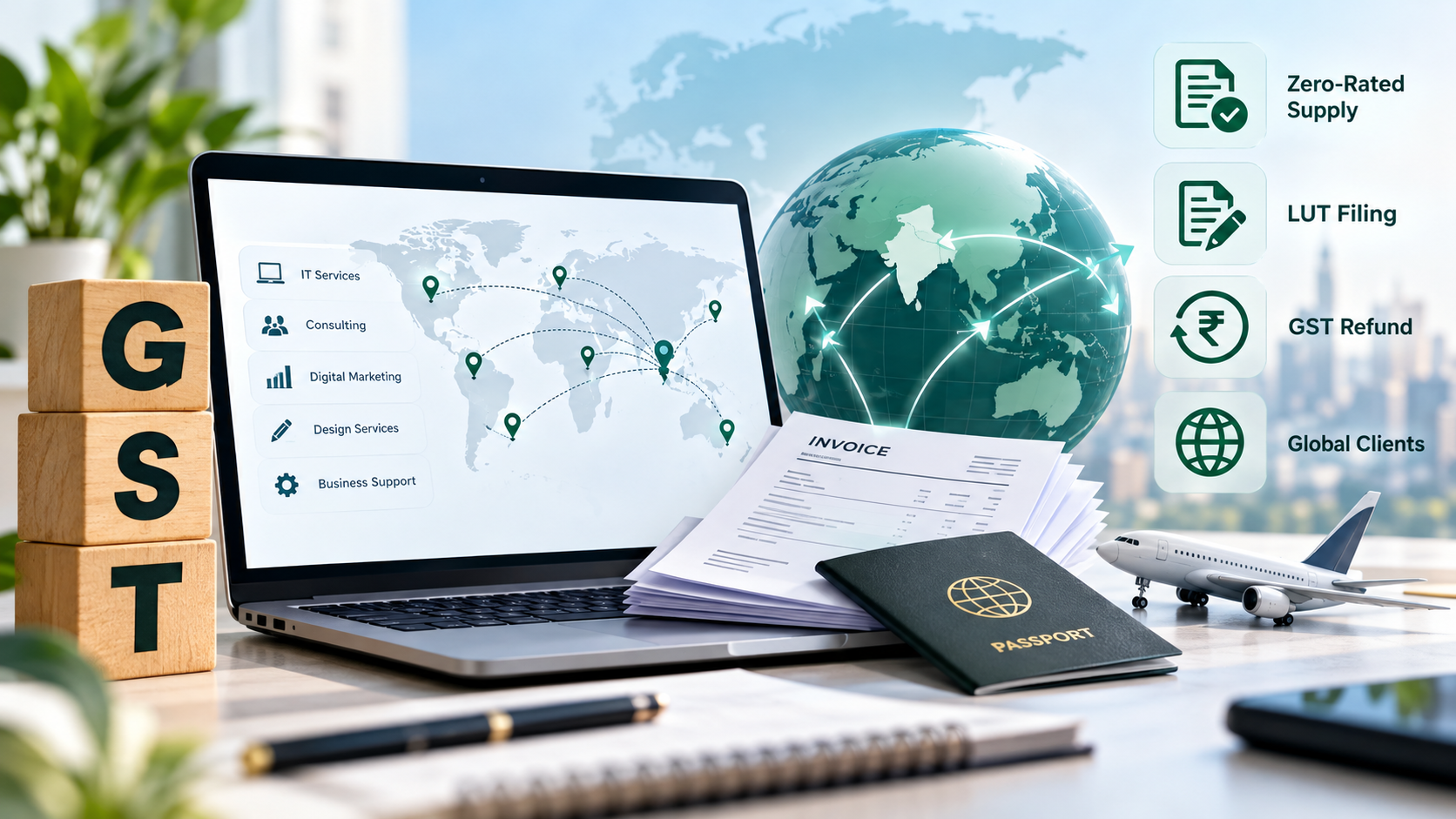
In today's digital economy, Indian businesses are no longer limited to serving customers within the country. Freelancers, IT companies, consultants, digital marketing agencies, software developers, designers, and business service providers can work with clients from the United States, the United Kingdom, the UAE, Australia, and many other countries.
While international clients create exciting opportunities for business growth, they also raise an important question: Do you need to pay GST when you provide services to a client outside India?
Understanding GST on export of services is essential for businesses that earn revenue from international customers. The right approach can help you comply with Indian tax regulations, maintain accurate records, and understand whether you qualify for input tax credit refunds.
Under India's Goods and Services Tax framework, qualifying exports of services are treated as zero-rated supplies. This means the GST treatment differs from an ordinary domestic taxable supply. However, providing a service to a foreign customer does not automatically make it an export under GST. Specific legal conditions must be satisfied.
In this guide, Clockwell International explains the concept in simple language, covering eligibility conditions, LUT filing, refund procedures, documentation, common mistakes, and practical examples.
What Is GST on Export of Services?
GST on export of services refers to the tax treatment of services supplied by a business or professional in India to a recipient outside India.
For example, imagine a digital marketing freelancer based in Kerala who manages social media campaigns for a company in the United States. The freelancer receives payment for SEO, advertising management, or content creation services.
If the transaction satisfies the legal definition of an export of services under the Integrated Goods and Services Tax (IGST) Act, it can qualify as a zero-rated supply.
Zero-rated does not simply mean that the business has no GST responsibilities. It means that the qualifying export receives a special tax treatment, including eligibility for input tax credit and refunds subject to applicable conditions.
What does zero-rated supply mean?
A zero-rated supply is a category recognised under Section 16 of the IGST Act, 2017. It includes qualifying exports of goods or services and supplies to Special Economic Zone developers or units for authorised operations.
For eligible service exporters, the benefits may include:
-
Supplying services without paying IGST upfront under a valid Letter of Undertaking (LUT), subject to applicable rules.
-
Claiming a refund of eligible unutilised input tax credit, subject to the law and prescribed conditions.
-
Avoiding the ordinary output-tax burden on qualifying exports when the relevant requirements are met.
These benefits are not automatic. Registration status, the nature of the service, place-of-supply rules, documentation, and refund eligibility must all be considered.
What Are the Conditions for Export of Services Under GST?
Section 2(6) of the IGST Act defines an export of services through specified conditions. Businesses should evaluate each requirement before treating a transaction as a zero-rated export.
1. The supplier must be located in India
The person or business providing the service must be located in India for the transaction to qualify under the relevant export definition.
For example, a consulting firm operating from Kerala that provides business advisory services to a company abroad may satisfy this condition.
2. The recipient must be located outside India
The recipient of the service must be located outside India.
The recipient is the person or business receiving the service. Merely receiving payment from a foreign bank account does not establish that the customer is located abroad.
Businesses should retain contracts, client details, invoices, and other records that support the recipient's identity and location.
3. The place of supply must be outside India
The place of supply is a legal concept used to determine the location of a service for GST purposes. It is not always the same as the supplier's office, the customer's billing address, or the location of the bank making payment.
For many services supplied to a recipient outside India, the general rule under Section 13(2) of the IGST Act places the supply at the recipient's location. However, special rules and exceptions may apply depending on the type of service and the circumstances.
For this reason, businesses should check the relevant place-of-supply provision rather than assuming that every service delivered online to an overseas client qualifies as an export.
4. Payment must satisfy the applicable foreign-exchange requirement
Payment for the service must be received in convertible foreign exchange or in Indian rupees wherever permitted by the Reserve Bank of India, in accordance with the applicable legal requirements.
For example, a freelancer receiving USD payments from an overseas customer should preserve the relevant bank statements, payment-platform records, and remittance evidence.
The precise payment and timing requirements should be checked for the transaction in question.
5. Supplier and recipient must not be merely establishments of the same person in the excluded circumstances
The statutory definition has also addressed cases involving establishments of the same person in India and outside India. The exact wording and applicable amendments must be checked against the law in force for the transaction date.
This is particularly important for multinational companies, overseas branches, and businesses operating through multiple establishments.
The five conditions above are the traditional statutory framework used to assess exports of services. Businesses should check the latest applicable amendments and notifications before filing returns or claiming refunds.
How Does GST Apply to Export of Services?
When a transaction qualifies as an export of services, it is treated as a zero-rated supply. A registered exporter will generally consider the following two matters:
-
Whether to export under LUT without payment of IGST.
-
Whether eligible input tax credit can be claimed as a refund under the applicable provisions.
The available route depends on the current legal framework and the taxpayer's eligibility. The general process for exports without payment of tax is described in Section 16 of the IGST Act and the applicable CGST refund rules.
Option 1: Export services under LUT without payment of IGST
A Letter of Undertaking, commonly called an LUT, allows an eligible registered exporter to supply qualifying services without paying IGST upfront, subject to the applicable conditions.
The exporter files the prescribed undertaking through the GST Portal and follows the relevant requirements.
This option is useful for eligible businesses that want to avoid paying output tax upfront and then waiting for a refund of that tax.
However, an LUT does not mean that every expense becomes refundable. Any input tax credit refund must meet the applicable eligibility rules, documentation requirements, and calculation method.
Option 2: Pay IGST and claim a refund where legally permitted
Businesses should not assume that paying IGST and claiming it back is available as a routine alternative for every export of services.
The permitted refund route must be determined under the law in force. Section 16 of the IGST Act was amended to revise the framework for zero-rated supplies, and the current statutory conditions should be checked before choosing a payment-and-refund approach.
For most eligible service exporters exploring zero-rated treatment, understanding LUT filing and the refund of unutilised input tax credit is an important starting point.
What Is LUT Filing Under GST?
LUT stands for Letter of Undertaking. It is a declaration furnished by an eligible registered person to export goods or services without payment of IGST, subject to the prescribed rules.
The GST Portal provides a facility to furnish the LUT using Form GST RFD-11.
According to the GST Portal's published user guide, the general navigation is:
-
Log in to the official GST Portal.
-
Open Services.
-
Select User Services.
-
Choose Furnish Letter of Undertaking (LUT).
-
Select the relevant financial year and complete the required declarations and details.
-
Submit the form using the applicable verification procedure and retain the acknowledgement.
The portal's instructions and current form requirements should be followed when filing.
Why is LUT important?
LUT filing can help an eligible exporter supply services without paying IGST upfront. It also supports a documented compliance process for international transactions.
Businesses should ensure that the LUT covers the relevant financial year and is furnished before making exports under the scheme as required by the applicable rules.
They should also monitor payment receipts and fulfil any conditions associated with the undertaking. If the conditions are not met, tax and interest consequences may arise.
How Can Businesses Claim a GST Refund on Export of Services?
A refund of eligible unutilised input tax credit can help reduce the cost of providing international services.
Input tax credit, or ITC, generally refers to eligible GST paid on business purchases and input services. Examples might include certain software subscriptions, professional services, or other business expenses used to provide taxable or zero-rated services, subject to the relevant restrictions.
Step 1: Confirm that the supply qualifies
Review the service agreement, customer location, place-of-supply rules, payment terms, and other export conditions.
Step 2: Maintain correct invoices
Invoices should contain the details required under GST law. Export invoices should be prepared using the appropriate prescribed wording and particulars for the selected route.
Step 3: File GST returns correctly
Report export supplies in the relevant GST returns and ensure that the figures agree with the supporting records.
Step 4: Calculate eligible input tax credit
Determine the eligible credit attributable to the relevant supplies. Blocked credits and other statutory restrictions must be considered.
Step 5: Submit the refund application
Where eligible, apply using the prescribed refund process and the appropriate category on the GST Portal.
Step 6: Retain supporting documents
Keep invoices, contracts, payment evidence, bank records, return acknowledgements, and other documents needed to support the claim.
Refund calculations for services exported without payment of tax are governed by the applicable rules, including Rule 89 of the CGST Rules. The calculation is not necessarily equal to the total GST paid on every business expense.
Practical Examples of GST on Export of Services
Understanding the rules becomes easier when we apply them to common business situations.
Example 1: Digital marketing freelancer in Kerala
A digital marketing freelancer in Malappuram provides SEO services to a company in the United Kingdom.
The freelancer creates SEO reports, optimises website pages, and prepares a monthly performance report. The client pays the agreed fee from abroad.
If the transaction satisfies the applicable export-of-services conditions, the service may qualify as a zero-rated supply. The freelancer should maintain the service agreement, invoices, payment records, and applicable GST documentation.
If eligible and registered under GST, the freelancer can examine the LUT route and any available input tax credit refund.
Example 2: Indian software development company
An Indian software development company builds a website for a customer in Australia.
The contract specifies the development work, payment terms, deliverables, and customer details. The company receives payment through an authorised banking channel.
If the transaction meets the export conditions, the company may be able to apply zero-rated treatment. It must still review the applicable place-of-supply rules and ensure that the transaction is not covered by a relevant exception.
Example 3: Business consultancy services
A consultancy firm in India provides strategic business advice to a client based in the UAE.
The consultancy charges a professional fee and maintains the contract, invoices, correspondence, and payment records.
The service may qualify as an export if all the legal requirements are met. The business should not rely solely on the fact that the customer has an overseas address.
Example 4: Services provided to a foreign customer but used in India
Suppose an overseas company hires an Indian service provider for a project involving an Indian business operation.
Even if the payment comes from outside India, the GST classification needs careful examination. The place of supply, identity of the actual recipient, contractual arrangements, and any applicable special rule may affect the outcome.
Key lesson: A foreign customer and a foreign-currency payment do not, by themselves, establish an export of services under GST.
What Documents Are Required for Export of Services?
Proper documentation is essential for GST compliance and for supporting a refund claim.
Businesses should maintain the following records, as applicable:
-
GST registration details: Relevant registration information for the Indian supplier.
-
Letter of Undertaking: A valid LUT acknowledgement, if the export is made under LUT.
-
Service agreement: A contract or other evidence describing the services, parties, and payment terms.
-
Export invoices: Invoices containing the particulars required under GST law.
-
Payment records: Bank statements, remittance advice, payment-platform records, and other evidence of receipt.
-
GST returns: Filed returns and details of reported export supplies.
-
Input tax credit records: Purchase invoices and records supporting the eligible credit claimed.
-
Refund documents: The prescribed application and supporting evidence, where a refund is sought.
The exact documents depend on the transaction, the refund category, and the rules in force. Businesses should check the applicable GST Portal requirements rather than treating this list as exhaustive.
Common Mistakes Businesses Should Avoid
Errors in export documentation and GST reporting can create unnecessary compliance problems.
1. Assuming every foreign-client transaction is an export
A transaction must satisfy the statutory conditions. A foreign address alone is insufficient.
2. Ignoring place-of-supply rules
The place of supply can determine whether the transaction qualifies as an export. Businesses should examine the relevant statutory provision for their type of service.
3. Forgetting to furnish the LUT
Eligible registered businesses intending to export under LUT should complete the required process and maintain the acknowledgement.
4. Reporting inconsistent invoice values
Differences between invoices, books of accounts, GST returns, and payment records can complicate compliance and refund verification.
5. Claiming ineligible input tax credit
Not every expense qualifies for ITC. Businesses must follow the CGST Act's eligibility conditions and restrictions.
6. Delaying refund applications
Refund claims are subject to prescribed time limits and procedural requirements. Businesses should monitor deadlines and retain the relevant records.
7. Overlooking intermediary arrangements
Some businesses provide services as intermediaries rather than supplying the underlying service on their own account. The contractual arrangement and applicable GST provisions must be reviewed because intermediary classification can affect export treatment.
8. Treating zero-rated supply as completely exempt
Zero-rated supplies and exempt supplies do not have identical input tax credit treatment. Exporters should understand the distinction before preparing their returns and refund calculations.
Zero-Rated Supply vs Exempt Supply: What Is the Difference?
These terms are sometimes confused, but they have different implications for input tax credit.
|
Feature |
Zero-rated supply |
Exempt supply |
|---|---|---|
|
GST treatment |
Special treatment under Section 16 of the IGST Act |
Exempt under the applicable GST provisions |
|
Examples |
Qualifying exports of services |
Services specifically exempt under GST notifications |
|
Input tax credit |
Eligible credit may be available, subject to conditions |
Related credit is generally restricted, subject to applicable provisions |
|
Refund of credit |
May be available under the prescribed zero-rated refund route |
Generally not available merely because the supply is exempt |
The exact treatment depends on the relevant statutory provisions and the taxpayer's circumstances.
Why Professional GST Support Matters
International service transactions can involve more than one tax and compliance requirement. Businesses may need to consider GST registration, place-of-supply rules, LUT filing, invoicing, foreign remittances, input tax credit, refund calculations, and return filing.
For freelancers and small businesses, handling these tasks without a clear process can be time-consuming. For growing companies, inconsistent documentation may make it harder to demonstrate compliance or support a refund claim.
Professional support can help businesses:
-
Review whether their services qualify as exports under GST.
-
Understand the relevant LUT and invoicing requirements.
-
Maintain consistent GST records.
-
Review eligible input tax credit and refund documentation.
-
Identify potential compliance issues before filing returns.
Clockwell International provides business-related support in areas such as accounting, taxation, GST, and compliance. Businesses can explore its services to understand which assistance is appropriate for their specific requirements.
Frequently Asked Questions (FAQs)
1. Is GST applicable to export of services from India?
Qualifying exports of services are treated as zero-rated supplies under Section 16 of the IGST Act. The applicable conditions must be satisfied before using this treatment.
2. What is the GST rate on export of services?
A qualifying export receives zero-rated treatment. This does not mean that every transaction involving a foreign customer automatically has a 0% GST outcome. Eligibility and the prescribed procedure must be established.
3. What is LUT in GST?
LUT stands for Letter of Undertaking. It allows eligible registered exporters to supply qualifying goods or services without payment of IGST upfront, subject to applicable conditions.
4. Can a freelancer export services without paying GST?
A freelancer may qualify for zero-rated export treatment if the legal conditions are satisfied. GST registration obligations, the nature of the service, place of supply, and other applicable requirements must be assessed separately.
5. Can I claim an ITC refund on export of services?
An eligible registered exporter may claim a refund of unutilised input tax credit under the applicable provisions when exporting under LUT without payment of IGST. The refund is subject to eligibility, calculation rules, and documentation requirements.
The statutory definition allows payment in convertible foreign exchange or in Indian rupees wherever permitted by the Reserve Bank of India. The specific payment arrangement must satisfy the applicable legal requirements.
7. What happens if an exporter fails to follow LUT conditions?
Failure to comply with the applicable undertaking conditions can lead to tax and interest liabilities and other consequences under the relevant rules. The outcome depends on the nature of the non-compliance and the facts of the transaction.
8. Which GST form is used to file an LUT?
Form GST RFD-11 is used for furnishing a Letter of Undertaking through the GST Portal, following the prescribed process.
9. Are export services and exempt services the same?
No. Qualifying exports are zero-rated supplies, while exempt supplies fall under a different GST category. Their input tax credit treatment can differ.
10. Where can I verify the latest GST requirements?
Businesses should consult the official CBIC GST resources and the GST Portal for current legislation, notifications, forms, and filing instructions.
Understanding GST on export of services is important for Indian businesses that work with international customers. Although qualifying exports are treated as zero-rated supplies, businesses must satisfy the applicable legal conditions and follow the correct compliance procedures.
From determining the place of supply to filing an LUT, maintaining export invoices, reporting transactions, and claiming eligible input tax credit refunds, every step requires proper attention.
Freelancers, consultants, digital marketing agencies, IT companies, and other service providers should review their transactions carefully rather than assuming that every service supplied to a foreign customer automatically qualifies for zero-rated treatment.
Published on October 26, 2026