

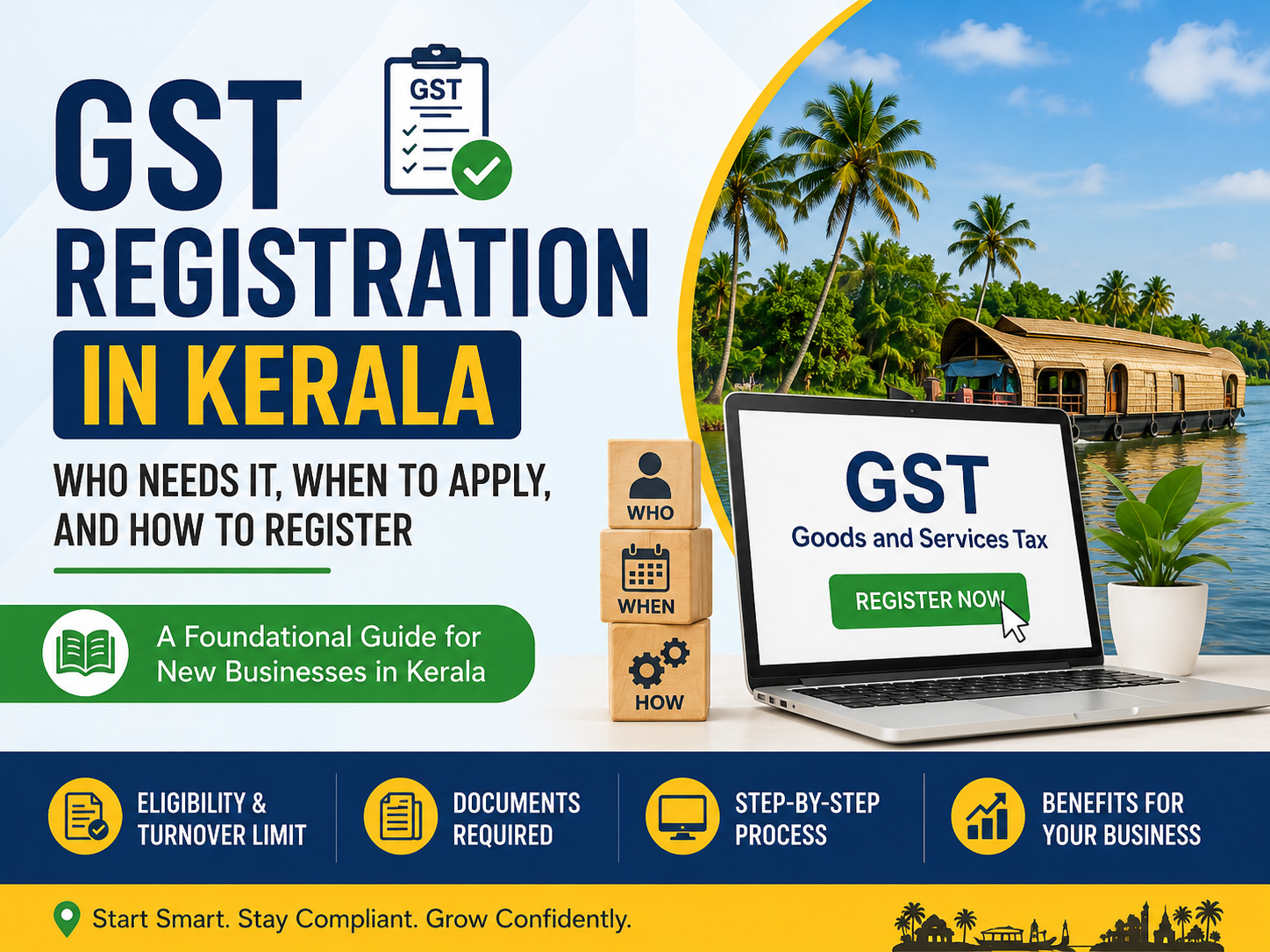
Starting a business is an exciting journey. Whether you are opening a retail shop, launching an online business, providing professional services, or starting a manufacturing unit, one of the first questions that comes to mind is:
"GST register cheyyan undo?" (Do I need GST registration?)
This is one of the most common questions asked by entrepreneurs, startups, freelancers, traders, and service providers across Kerala.
Many business owners are confused about GST registration requirements. Some believe GST is required for every business, while others assume they can avoid registration completely. The truth lies somewhere in between.
Understanding GST registration is crucial because non-compliance can lead to penalties, business restrictions, and difficulties in dealing with customers and suppliers. On the other hand, obtaining GST registration at the right time can improve credibility, enable input tax credit benefits, and help your business grow smoothly.
In this comprehensive guide, we will explain:
- What GST is
- Who needs GST registration
- When GST registration becomes mandatory
- Voluntary GST registration
- GST turnover limits
- Documents required
- Step-by-step registration process
- Benefits of GST registration
- Common mistakes to avoid
Let's begin.
What is GST?
GST (Goods and Services Tax) is an indirect tax introduced in India on 1 July 2017. It replaced multiple taxes such as VAT, Service Tax, Excise Duty, and several state-level taxes.
GST is charged on the supply of goods and services across India.
The main objective of GST is to create a unified tax structure and simplify taxation for businesses.
Whenever a registered business sells goods or services, it collects GST from customers and pays it to the government after adjusting eligible input tax credits.
Why is GST Registration Important?
GST registration is more than just a legal requirement.
It provides businesses with:
Legal Recognition
A GSTIN (Goods and Services Tax Identification Number) legally identifies your business under GST law.
Input Tax Credit Benefits
You can claim credit for GST paid on purchases, reducing overall tax costs.
Business Growth
Many corporate clients, government agencies, and large companies prefer dealing with GST-registered businesses.
Interstate Business Opportunities
GST registration allows businesses to operate more smoothly across different states.
Increased Trust
Customers often consider GST registration as a sign of a legitimate and professional business.
Who Needs GST Registration in Kerala?
One of the most important questions for new entrepreneurs is whether GST registration is mandatory.
The answer depends on your business type, turnover, and activities.
1. Businesses Crossing the GST Turnover Limit
GST registration becomes mandatory once your annual turnover exceeds the prescribed threshold.
For Service Providers
If annual turnover exceeds ₹20 lakh, GST registration becomes mandatory.
Examples:
- Digital marketing agencies
- Consultants
- Accountants
- Architects
- Freelancers
- Software developers
For Suppliers of Goods
If annual turnover exceeds ₹40 lakh, GST registration becomes mandatory in most cases.
Examples:
- Retail shops
- Wholesale traders
- Manufacturing units
- Distributors
Once you cross the applicable threshold, you must apply for GST registration within the prescribed time.
2. E-Commerce Sellers
If you sell products through online marketplaces such as:
- Amazon
- Flipkart
- Meesho
- Jiomart
GST registration may be required depending on the nature of sales and applicable GST provisions.
Online sellers should evaluate GST requirements before starting operations.
3. Interstate Suppliers
Businesses supplying goods or services to customers located in other states may need GST registration depending on applicable GST regulations.
For example:
A business registered in Kerala supplying services to clients in Karnataka, Tamil Nadu, Maharashtra, or Delhi should carefully assess GST obligations.
4. Input Service Distributors
Organizations distributing input tax credits among branches require GST registration under relevant GST provisions.
5. Casual Taxable Persons
Businesses participating in exhibitions, trade fairs, or temporary business activities in another state may require temporary GST registration.
6. Non-Resident Taxable Persons
Foreign businesses supplying goods or services in India generally require GST registration under applicable rules.
7. Businesses Required to Deduct or Collect Tax
Certain entities involved in TDS or TCS mechanisms under GST require registration.
Can Small Businesses Take GST Registration Voluntarily?
Yes.
Even if your turnover is below the mandatory threshold, you can voluntarily apply for GST registration.
Many startups and small businesses choose voluntary registration because it offers several advantages.
Benefits of Voluntary GST Registration
- Claim Input Tax Credit
- Improve business credibility
- Deal with larger companies
- Participate in government tenders
- Expand business operations confidently
- Easier business scaling
For many startups in Kerala, voluntary registration becomes a strategic business decision rather than a legal requirement.
When Should You Apply for GST Registration?
Timing is important.
Many businesses wait until they cross the threshold limit, which can create compliance issues.
Ideally, you should apply:
Before Crossing the Threshold
Monitor your turnover regularly.
If you expect turnover to exceed the limit soon, begin the registration process early.
Before Working with Large Clients
Many corporate clients require vendors to provide GST invoices.
Before Launching an Online Business
Many e-commerce platforms require GST-related compliance.
Before Expanding to Other States
Businesses planning interstate operations should evaluate GST requirements beforehand.
What Happens If You Don't Register?
Ignoring GST obligations can result in serious consequences.
Penalties
Authorities may impose penalties for failure to register when registration becomes mandatory.
Interest Liability
Delayed tax payments may attract interest.
Business Restrictions
You may face difficulties:
- Opening vendor accounts
- Participating in tenders
- Working with corporate clients
- Expanding operations
Loss of Input Tax Credit
GST paid on purchases may become a cost rather than a recoverable credit.
Documents Required for GST Registration
Before applying, keep the following documents ready.
For Proprietorship Businesses
Identity Proof
- PAN Card
- Aadhaar Card
Address Proof
- Electricity Bill
- Water Bill
- Property Tax Receipt
Business Address Proof
- Rental Agreement
- Lease Agreement
- Ownership Documents
Bank Account Details
- Cancelled Cheque
- Bank Statement
- Passbook Copy
Photograph
Passport-size photograph of proprietor.
For Partnership Firms
Additional documents:
- Partnership Deed
- PAN of Partnership Firm
- Partner Identity Proofs
- Authorization Letter
For LLPs
Additional documents:
- LLP Agreement
- Certificate of Incorporation
- PAN of LLP
- Designated Partner Documents
For Private Limited Companies
Additional documents:
- Certificate of Incorporation
- PAN Card
- MOA
- AOA
- Board Resolution
- Director Documents
Step-by-Step GST Registration Process
The GST registration process is completely online.
Let's understand each step.
Step 1: Gather Documents
Collect all required documents before starting the application.
Proper documentation helps avoid delays and rejections.
Step 2: Visit GST Portal
Access the official GST registration portal.
Choose the option for new registration.
Step 3: Fill Basic Information
Provide:
- Business Name
- PAN Number
- Mobile Number
- Email Address
- State (Kerala)
OTP verification is completed at this stage.
Step 4: Receive Temporary Reference Number
After verification, a Temporary Reference Number (TRN) is generated.
This helps continue the registration process later.
Step 5: Complete Application Form
Enter:
- Business details
- Promoter details
- Authorized signatory information
- Principal place of business
- Additional business locations
- Bank details
- Nature of goods and services
Step 6: Upload Documents
Upload required documents in the specified format.
Ensure all files are clear and readable.
Step 7: Verification
The application is verified using:
- Aadhaar Authentication
- Digital Signature Certificate (where applicable)
- Electronic Verification Code
Step 8: Application Processing
GST authorities review the application.
Additional clarification may be requested if required.
Step 9: GSTIN Allotment
Upon approval, a GST Identification Number (GSTIN) is issued.
Your business is now officially registered under GST.
Understanding GSTIN
GSTIN stands for Goods and Services Tax Identification Number.
It is a unique 15-digit number assigned to every registered taxpayer.
Example format:
32ABCDE1234F1Z5
This number must appear on:
- GST invoices
- Tax documents
- Business communications
- Compliance filings
Benefits of GST Registration for Kerala Businesses
Many entrepreneurs see GST as a compliance burden.
However, GST registration can actually support business growth.
Input Tax Credit
You can claim GST paid on:
- Office rent
- Raw materials
- Professional services
- Business purchases
This reduces overall tax costs.
Better Business Opportunities
Large organizations often prefer registered vendors.
GST registration helps secure bigger contracts.
Improved Market Reputation
A GSTIN signals professionalism and compliance.
Customers trust registered businesses more.
Expansion Across India
GST simplifies interstate business operations.
This is particularly useful for online businesses and service providers.
Easier Funding and Loans
Financial institutions often evaluate compliance records.
GST registration can strengthen business documentation.
Common GST Registration Mistakes
Avoid these common errors.
Wrong Business Name
Ensure the business name matches official records.
Incorrect PAN Details
PAN mismatches are among the most common causes of rejection.
Poor Quality Documents
Blurred or incomplete documents may delay approval.
Wrong Business Address
Always provide accurate and verifiable address details.
Selecting Incorrect Business Activity
Choose the correct nature of business to avoid future complications.
GST Registration for Freelancers in Kerala
Many freelancers believe GST applies only to large businesses.
This is incorrect.
Freelancers such as:
- Graphic designers
- Digital marketers
- Content writers
- Software developers
- Consultants
- Trainers
must evaluate GST requirements based on turnover and business activities.
If turnover exceeds the applicable threshold, registration becomes mandatory.
GST Registration for Startups
Startups often require GST registration even during early growth stages.
Reasons include:
- Investor expectations
- Vendor requirements
- Input tax credit benefits
- Corporate client onboarding
- Marketplace registrations
Many startups choose voluntary GST registration from the beginning.
GST Registration for Online Businesses
Online businesses are growing rapidly in Kerala.
Examples include:
- E-commerce stores
- Dropshipping businesses
- Digital product sellers
- Service-based websites
- Online consultancies
GST compliance should be assessed before launching operations to avoid future complications.
How Long Does GST Registration Take?
The processing time varies depending on:
- Document accuracy
- Aadhaar authentication
- Verification requirements
In many cases, GST registration is completed within a few working days when documents are submitted correctly.
GST Registration Cost
The government does not charge a registration fee for obtaining GST registration.
However, businesses often engage professionals or consultants to:
- Prepare documentation
- Submit applications
- Resolve notices
- Ensure compliance
Professional assistance can help avoid mistakes and save time.
Do You Need Professional Help?
While GST registration is available online, many business owners prefer expert assistance because:
- Documentation can be confusing
- Errors may lead to rejection
- GST rules frequently change
- Proper classification is important
A professional consultant can guide you through the process and ensure compliance from day one.
Frequently Asked Questions (FAQs)
Is GST registration mandatory for every business in Kerala?
No. GST registration depends on turnover, business activities, and specific GST provisions.
Can I get GST registration before starting my business?
Yes. Many entrepreneurs apply before commencing operations.
Is GST registration free?
Government registration itself is free, though professional service charges may apply.
Can a home-based business get GST registration?
Yes. Home-based businesses can apply if they meet eligibility requirements.
Can freelancers obtain GST registration?
Yes. Freelancers can register voluntarily or when registration becomes mandatory.
Can I operate without GST registration?
Only if your business does not fall under mandatory registration requirements.
If you're planning to start a business in Kerala, understanding GST registration should be one of your top priorities.
Whether you run a shop, startup, consultancy, online business, manufacturing unit, or freelance service, GST compliance plays a vital role in your business journey.
The key questions every entrepreneur should ask are:
- Do I need GST registration?
- When should I apply?
- What documents are required?
- How can I avoid compliance issues?
For many businesses, GST registration is not just about meeting legal requirements—it is about building credibility, claiming tax benefits, and preparing for long-term growth.
Published on June 20, 2026