

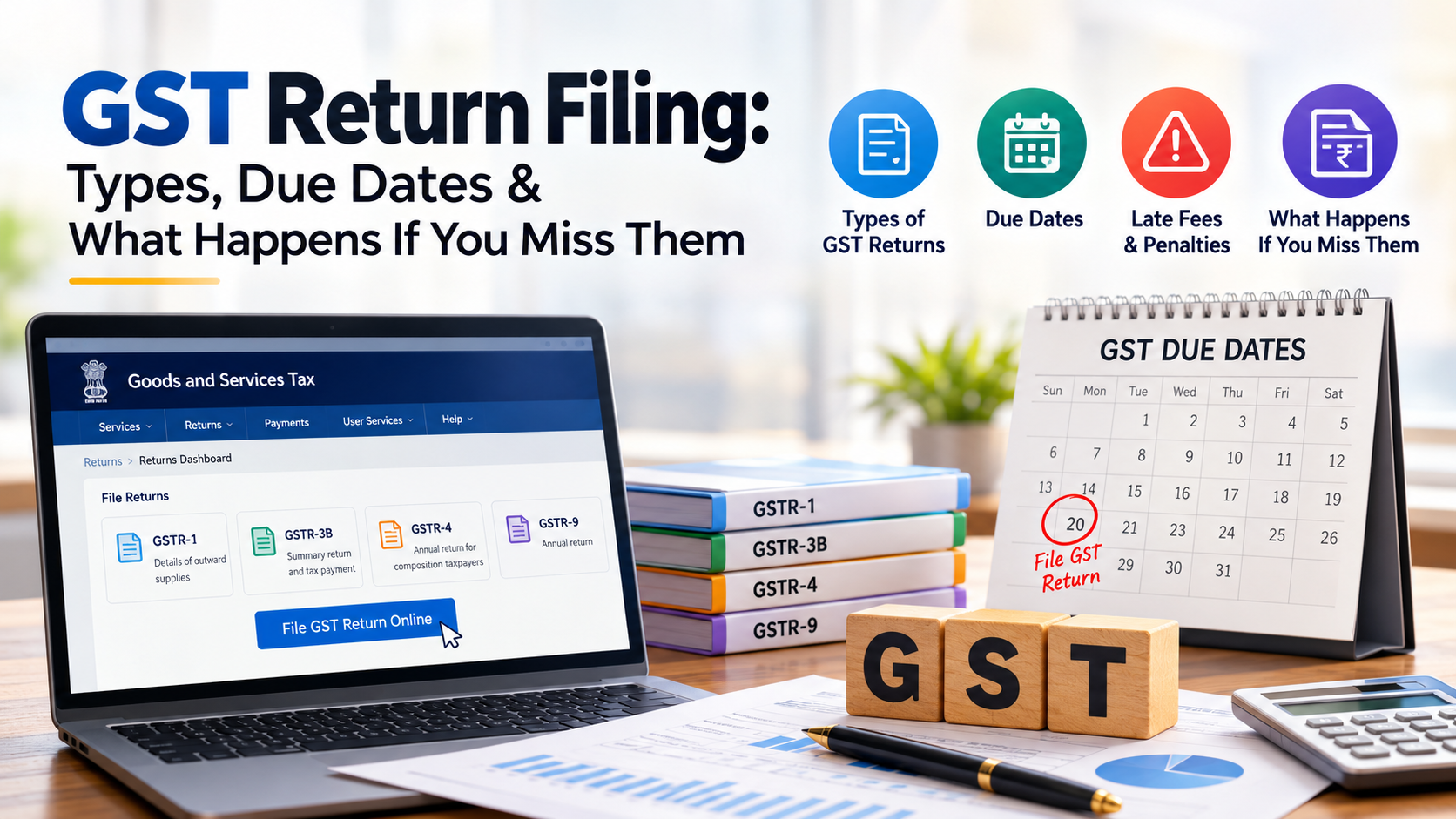
Running a business means balancing several responsibilities at once. Along with managing customers, sales, employees, and daily operations, business owners must also keep their financial records accurate and meet their tax obligations. For businesses registered under India's Goods and Services Tax (GST) system, filing the required returns on time is an important part of staying compliant.
Yet GST compliance can be confusing, particularly for small businesses. Some owners are unsure which forms they need to submit, while others struggle to remember the deadlines. A common misconception is that a business does not need to file a return when there have been no sales during a particular month.
These misunderstandings can result in late fees, interest charges, notices, and additional administrative work.
Understanding the different GST return forms, their filing schedules, and the consequences of missing deadlines can make compliance much easier. With organised records and a clear filing routine, businesses can reduce avoidable errors and manage their tax responsibilities more effectively.
This article covers the main GST return types, their usual due dates, the possible consequences of late filing, and practical ways to keep your business on track.
Understanding GST Returns
A GST return is a statement submitted electronically by a registered taxpayer to report the information required for a particular tax period. Depending on the form, this information may include sales, purchases, tax collected, input tax credit, and tax payable.
These returns help the tax authorities monitor transactions and determine whether businesses are meeting their GST obligations.
Consider a business that sells products worth ₹5,00,000 in a month. It collects GST on applicable sales and purchases goods or services from other businesses. To manage its compliance, it must maintain the relevant invoices, calculate its tax liability, report the required transactions, and claim eligible input tax credit in accordance with the applicable rules.
GST returns help create a record of these activities and support transparent tax reporting.
The forms a business must file depend on its registration category, turnover, applicable scheme, and filing frequency. Therefore, identifying the correct forms is the first step towards effective GST compliance.
Why Timely GST Filing Matters
GST return filing is more than a recurring administrative task. It affects several aspects of a business's financial management and compliance.
Maintaining compliance: Businesses must submit the returns applicable to them within the prescribed time. Failure to do so may result in late fees, notices, and other consequences under the law.
Managing input tax credit: Eligible businesses can claim input tax credit on qualifying purchases, subject to the relevant conditions. Accurate invoices and proper reconciliation help businesses manage these records.
Improving financial visibility: Regular reporting provides a clearer picture of sales, purchases, tax liabilities, and cash flow. This information can help owners make informed financial decisions.
Reducing errors and discrepancies: Comparing accounting records with GST information can help identify missing invoices, incorrect figures, and other inconsistencies before they create larger problems.
Supporting business credibility: Consistent tax compliance and organised financial records help businesses demonstrate professionalism when dealing with lenders, suppliers, customers, and other stakeholders.
Types of GST Returns Businesses Should Know
India's GST system includes different forms for different reporting requirements. Not every form applies to every registered taxpayer, so businesses should first establish their category and applicable obligations.
1. GSTR-1: Reporting Outward Supplies
GSTR-1 is used to report details of outward supplies, including applicable sales invoices, credit notes, debit notes, and other prescribed transaction information.
Regular taxpayers who are required to report outward supplies generally file this return according to their applicable filing frequency. Certain categories, such as composition taxpayers and input service distributors, follow different requirements.
The usual filing deadlines are:
-
Monthly filers: The 11th day of the following month.
-
Eligible quarterly filers: The 13th day of the month following the quarter.
For example, a business filing monthly generally needs to report its January sales by 11 February.
These are standard deadlines and may be changed through government notifications.
2. GSTR-3B: Summary Reporting and Tax Payment
GSTR-3B is a summary return used by regular taxpayers to report relevant tax liabilities, eligible input tax credit, and other prescribed details.
It helps taxpayers summarise their GST position for a particular period and discharge applicable tax liabilities.
The usual deadlines are:
-
Monthly filers: The 20th day of the following month.
-
Eligible quarterly filers: Generally the 22nd or 24th day of the month following the quarter, depending on the applicable state or union territory and notifications.
For instance, the usual deadline for a monthly filer submitting the January GSTR-3B is 20 February.
GSTR-1 and GSTR-3B perform different functions. Filing GSTR-1 does not remove the obligation to submit GSTR-3B where it is required.
3. GSTR-4: Annual Return for Composition Taxpayers
Eligible businesses registered under the composition scheme follow a simplified compliance framework.
GSTR-4 is the annual return applicable to composition taxpayers, subject to the relevant rules and exceptions.
Its usual due date is 30 April following the end of the financial year, unless the government notifies a different deadline.
Composition taxpayers should also understand their separate tax payment and statement requirements. The applicable obligations depend on their registration status and the rules in force.
4. CMP-08: Quarterly Composition Tax Statement
CMP-08 is used by eligible composition taxpayers to declare the relevant self-assessed tax payable and make the applicable payment.
It is generally filed quarterly, with the following usual deadlines:
| Quarter | Usual due date |
|---|---|
| April–June | 18 July |
| July–September | 18 October |
| October–December | 18 January |
| January–March | 18 April |
Composition taxpayers should confirm their current requirements to determine which statements, returns, and payments apply to their business.
5. GSTR-9: Annual GST Return
GSTR-9 is the annual return applicable to eligible registered taxpayers under the relevant provisions. It consolidates information relating to GST transactions during a financial year.
Depending on the applicable requirements, it may include information about outward and inward supplies, taxes paid, input tax credit, and other prescribed details.
The usual due date is 31 December following the end of the financial year, subject to applicable exemptions and extensions.
For example, the usual due date for the financial year ending 31 March 2026 is 31 December 2026 where the annual return requirement applies and no extension changes the deadline.
Not every GST-registered business is necessarily required to file GSTR-9. Eligibility, exemptions, turnover criteria, and current notifications must be checked before filing.
6. GSTR-9C: Reconciliation Statement
GSTR-9C is a reconciliation statement applicable to taxpayers whose aggregate turnover exceeds the prescribed threshold under the relevant rules.
It reconciles specified information between the annual return and financial statements, together with other required details.
Where applicable, its usual deadline is 31 December following the end of the financial year, subject to current legal provisions and extensions.
Businesses should confirm whether this requirement applies to them rather than assuming that every registered taxpayer must submit GSTR-9C.
7. GSTR-5 and GSTR-6: Returns for Specific Taxpayer Categories
Some forms are intended for particular categories of taxpayers.
-
GSTR-5: Generally applies to non-resident taxable persons.
-
GSTR-6: Applies to input service distributors for reporting the relevant distribution of input tax credit.
These forms have separate eligibility conditions and filing schedules. Their deadlines may differ from those for standard monthly and quarterly returns.
Businesses should verify their applicable forms and due dates through the official GST portal or with a qualified tax professional.
GST Return Filing Due Dates at a Glance
The table below provides a convenient summary of common filing deadlines. These are standard due dates, not confirmation that a deadline has not been extended or modified.
| GST return or form | Purpose | Usual deadline |
|---|---|---|
| GSTR-1 – Monthly | Reporting outward supplies | 11th of the following month |
| GSTR-1 – Quarterly | Reporting outward supplies | 13th after the quarter |
| GSTR-3B – Monthly | Summary reporting and tax payment | 20th of the following month |
| GSTR-3B – Quarterly | Summary reporting and tax payment | Generally 22nd or 24th after the quarter |
| CMP-08 | Composition tax statement | 18th after each quarter |
| GSTR-4 | Annual composition return | 30 April following the financial year |
| GSTR-9 | Annual return, where applicable | Generally 31 December following the financial year |
| GSTR-9C | Reconciliation, where applicable | Generally 31 December following the financial year |
The precise requirements depend on the taxpayer's category, filing scheme, state or union territory where relevant, and current government notifications. Confirm the deadline for your particular tax period on the GST portal.
How to File GST Returns Online
Registered taxpayers can prepare and submit applicable returns through the GST portal. The exact steps may differ according to the form being filed, but the general process involves the following stages.
Step 1: Collect Your Financial Records
Gather sales invoices, purchase invoices, credit notes, debit notes, bank records, and other supporting documents for the relevant tax period.
Keeping these documents organised makes it easier to identify missing information and report transactions accurately.
Step 2: Reconcile Sales and Purchases
Compare your accounting records with the information available in the GST system.
Check sales figures, purchase details, and input tax credit eligibility. Investigate discrepancies before preparing the return.
Step 3: Log In to the GST Portal
Visit the official website at https://www.gst.gov.in/ and sign in using your registered credentials.
Open the Returns Dashboard under the Services menu and select the appropriate financial year and tax period.
Step 4: Choose the Correct Return
Select the form that applies to your registration category and filing frequency.
Regular taxpayers commonly need to consider GSTR-1 and GSTR-3B, whereas composition taxpayers follow a different compliance process.
Step 5: Enter and Review the Required Details
Check the relevant sales figures, tax liabilities, eligible input tax credit, and other required information.
Review the figures before submitting the return. Errors discovered after filing may require additional correction steps under the applicable rules.
Step 6: Pay Any Tax Due
Where tax is payable, ensure that the liability is discharged using the permitted payment methods and available credits, subject to GST rules.
Remember that submitting a return does not automatically mean that every outstanding tax liability has been paid.
Step 7: Complete Filing and Save the Acknowledgement
Follow the required verification process using an authorised method available for your filing, such as electronic verification or a digital signature, as applicable.
Save the acknowledgement and retain your supporting records for future reference.
If you are uncertain about tax calculations, input tax credit, reconciliations, or filing requirements, professional assistance can help you manage the process.
What Happens If You Miss a GST Filing Deadline?
Missing a GST deadline can create financial and administrative difficulties. The consequences depend on the return involved, the length of the delay, outstanding tax liabilities, and the applicable legal provisions.
1. Late Filing Fees
Late fees are among the most common consequences of delayed filing.
Section 47 of the CGST Act contains provisions for late fees when taxpayers fail to furnish specified returns or details within the prescribed period. The applicable amount depends on the return type, statutory limits, and any concessions or notifications in force.
Annual returns have a separate statutory calculation. Therefore, businesses should not assume that one late-fee rate applies to every GST form.
The GST portal generally calculates the applicable late fee based on the relevant return and filing details.
2. Interest on Delayed Tax Payments
If a business fails to pay GST within the prescribed time, interest may become payable on the outstanding tax under the applicable provisions.
Late fees and interest serve different purposes:
-
Late fees relate to delayed filing of applicable returns or statements.
-
Interest relates to delayed payment of tax where required by law.
A business that files late and also has unpaid tax may face both, depending on its circumstances.
3. Notices from the GST Department
Taxpayers who fail to submit required returns may receive notices from the tax authorities.
The GST system provides for notices to return defaulters in specified circumstances. Such notices should be taken seriously, even when a business has stopped trading or has no tax liability for a particular period.
Business owners should review the notice, identify the outstanding requirement, and respond within the prescribed time.
4. Restrictions Affecting Future Compliance
Continued non-filing can affect subsequent compliance activities. Depending on the applicable rules and the taxpayer's circumstances, it may lead to restrictions involving return filing, registration, or other GST-related processes.
Resolving pending returns promptly is generally preferable to allowing outstanding tax periods to accumulate.
5. Input Tax Credit Reconciliation Problems
GST compliance requires businesses to maintain accurate purchase invoices and review their eligible input tax credit.
When records are incomplete or returns are delayed, reconciling these details can become more difficult. Suppliers and customers may also depend on accurate invoice reporting to manage their own compliance.
Businesses should maintain consistent records and check the relevant conditions before claiming input tax credit.
6. More Administrative Work
One missed deadline can become a larger problem when several tax periods remain outstanding.
The business may need to retrieve old invoices, reconstruct accounting records, calculate liabilities, reconcile returns, pay applicable charges, and respond to notices.
A regular compliance routine is usually easier to manage than correcting multiple periods at once.
How Much Is the Late Fee for GST Return Filing?
The late fee payable depends on the type of return and the legal provisions applicable to the taxpayer.
Section 47 of the CGST Act contains statutory late-fee provisions for specified returns and statements. However, the actual amount may be affected by return-specific rules, notified limits, concessions, and applicable central or state provisions.
Businesses should therefore verify the amount applicable to their particular return rather than relying on a general online estimate.
Imagine a business misses a filing deadline because some sales invoices have not been received by its accountant. The business should identify the outstanding return, confirm the applicable requirements, calculate any outstanding tax and charges, and complete the filing as soon as possible.
Important: Late fees and interest are not necessarily the same for every taxpayer. Check the liability displayed on the GST portal and seek professional advice if the calculation is unclear.
Can You Submit a GST Return After the Due Date?
In many cases, an outstanding GST return can still be filed after its original deadline. However, filing late does not automatically eliminate the consequences of the delay.
The taxpayer may need to pay applicable late fees, interest, and outstanding tax before completing the process.
When several returns are pending, it is important to check the filing sequence and resolve earlier periods where necessary. Portal restrictions and statutory conditions may affect which returns can be filed next.
Businesses should also review any notices or compliance issues connected with their registration.
The practical approach is to identify the missing return, check the relevant period, verify the amount payable, and complete the filing without further delay.
Practical Ways to Avoid Missing GST Deadlines
A simple compliance routine can prevent many filing-related problems.
Maintain a Compliance Calendar
Create a calendar listing the deadlines applicable to your business. Include GSTR-1, GSTR-3B, quarterly statements, annual returns, and any other relevant obligations.
Set reminders several days before each deadline so that there is enough time to identify and correct errors.
Keep Your Books Updated
Avoid waiting until the last day of the month to organise invoices and accounting records.
Record sales, purchases, credit notes, debit notes, and expenses regularly. Updated records make it easier to prepare accurate returns.
Reconcile Your GST Information
Compare your accounting records with the information available through the GST portal.
Review sales invoices, purchase details, tax calculations, and input tax credit eligibility. Investigate differences before filing.
Assign Clear Responsibilities
If your business works with an accountant, finance employee, or external tax consultant, establish who prepares, reviews, and submits each return.
Business owners should retain oversight instead of assuming that every compliance task has been completed.
Plan for Tax Payments
Estimate your GST liability regularly and include it in your cash-flow planning.
Keeping the funds required for tax payments separate from operating expenses can help reduce the risk of delayed payment.
Understand Nil Return Requirements
A business with no sales during a tax period may still need to file a nil return, depending on its return form and registration category.
Do not assume that the absence of transactions automatically removes the filing obligation.
Get Professional Help When Necessary
If you are unsure about GST calculations, input tax credit, reconciliation, return selection, or a departmental notice, consult a qualified GST professional.
Professional support can help identify errors and make compliance easier to manage.
Common GST Filing Errors to Avoid
Businesses can make mistakes even when they file regularly. Common examples include choosing the wrong tax period, reporting sales figures that do not match accounting records, claiming input tax credit without meeting the relevant conditions, and forgetting to submit a required nil return.
Other problems arise when business owners confuse the GSTR-1 deadline with the GSTR-3B deadline, assume that submitting a return also means the tax has been paid, or ignore outstanding liabilities and portal notices.
Waiting until the final day to resolve invoice mismatches can also create unnecessary pressure.
Before filing, review the return period, taxable values, applicable tax rates, credit eligibility, outstanding liabilities, and supporting documents. A consistent review process can help reduce avoidable errors.
How Clockwell Can Support Your GST Compliance
Managing tax compliance alongside everyday business operations can be difficult, especially for small businesses without a dedicated finance team.
Business owners must concentrate on customers, employees, operations, and growth while also keeping their financial records accurate and meeting the deadlines that apply to them.
Clockwell can be presented as a professional support partner for businesses seeking assistance with accounting, taxation, GST-related compliance, and financial record management. Depending on the services offered and the agreed scope of work, professional support can help organise documents, review compliance requirements, prepare relevant information, and manage filing responsibilities.
Working with an experienced professional may also help business owners identify missing records, understand their obligations, and establish a more consistent compliance routine.
If you need help managing your business compliance requirements, visit Clockwell to explore the company's services and determine whether they suit your needs.
Frequently Asked Questions About GST Returns
What is GST return filing?
GST return filing is the process of submitting the prescribed information about a registered business's transactions, tax liabilities, and other relevant details to the GST authorities.
What are the main GST return forms?
Common forms include GSTR-1 for outward supplies, GSTR-3B for summary reporting and tax payment, GSTR-4 for eligible composition taxpayers, GSTR-9 for applicable annual returns, and GSTR-9C for applicable reconciliation requirements. Other forms serve specific taxpayer categories.
What is the due date for GSTR-1?
The usual deadline is the 11th of the following month for monthly filers and the 13th of the month following the quarter for eligible quarterly filers. Government notifications may change these dates.
When is GSTR-3B due?
Monthly filers generally have until the 20th of the following month. Eligible quarterly filers generally have a deadline on the 22nd or 24th of the month following the quarter, depending on the applicable state or union territory and notifications.
Do I need to file a GST return if my business has no sales?
A nil return may still be mandatory, depending on the return and your registration category. Normal taxpayers generally need to file applicable GSTR-1 and GSTR-3B returns even when there is no business activity during the period.
What are the consequences of filing GST returns late?
Late filing may result in applicable late fees, interest on delayed tax payments, compliance notices, and other consequences under the relevant rules. The exact outcome depends on the return type and circumstances.
Where can I submit GST returns?
Registered taxpayers can use the official GST portal. After logging in, navigate to Services, select Returns, and open the Returns Dashboard to access the relevant tax period and available forms.
How can I reduce GST compliance errors?
Maintain accurate invoices, update your accounting records regularly, reconcile transactions, track deadlines, review input tax credit eligibility, and obtain professional assistance when needed.
GST compliance is easier to manage when business owners understand their applicable return forms, keep their financial records organised, and plan ahead for filing deadlines.
GSTR-1, GSTR-3B, composition-related forms, and annual returns each have different purposes. Understanding those differences helps businesses avoid confusion and manage their tax responsibilities more effectively.
Missing a deadline can lead to late fees, interest where applicable, notices, and additional administrative work. A well-maintained compliance calendar, regular bookkeeping, and timely action can help reduce these risks.
Businesses that need help with GST return filing online should begin by confirming their registration category, identifying the applicable forms, checking official due dates, and ensuring that their records are complete.
With a consistent process and appropriate professional support, businesses can handle GST compliance more confidently and dedicate more time to their day-to-day operations and growth.
Published on October 20, 2026