
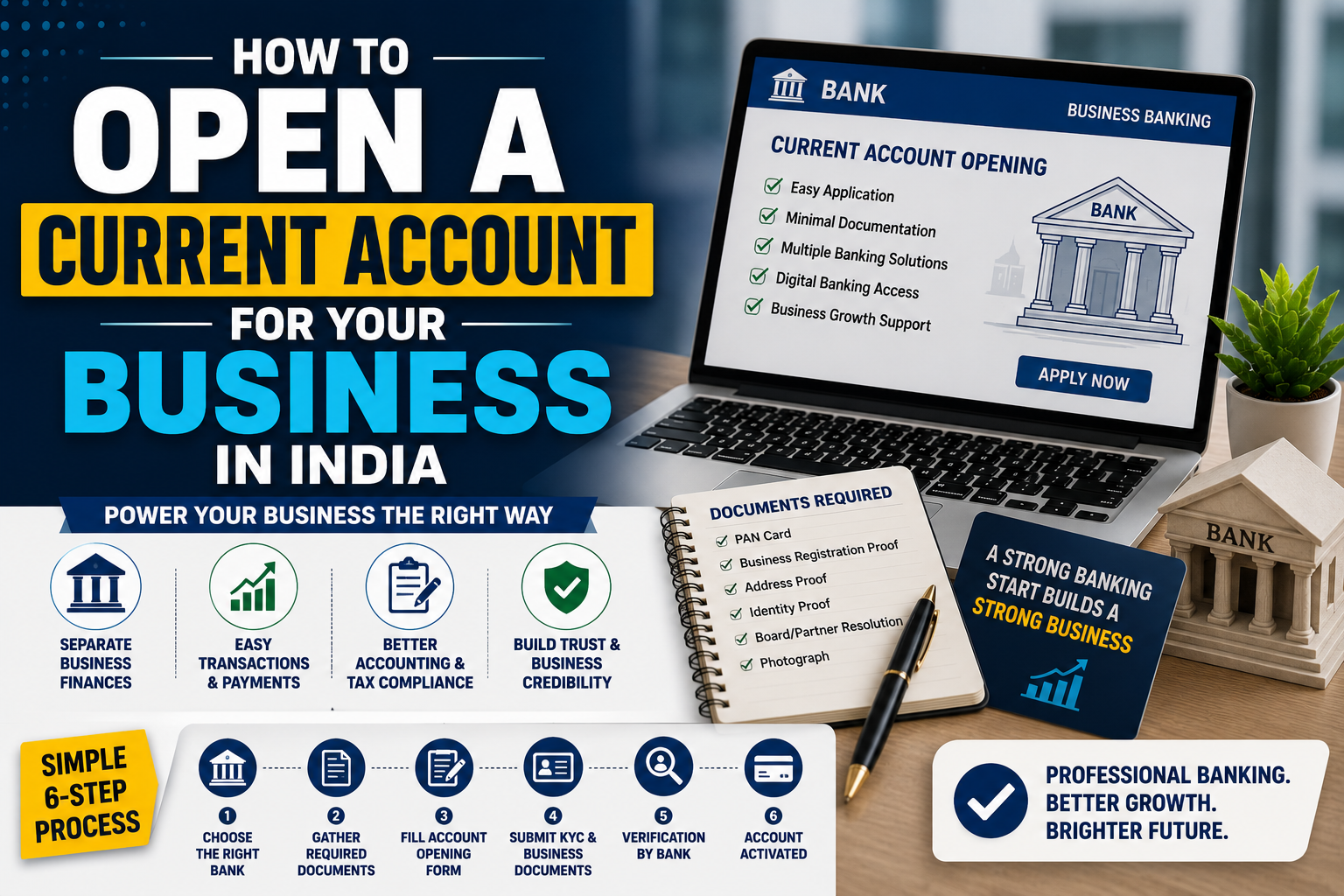
Starting a business involves more than just registering your company and obtaining licenses. One of the most important steps after incorporation is opening a Current Account in your business's name.
A dedicated business bank account helps you receive customer payments, pay suppliers, manage cash flow, maintain accurate accounting records, and build financial credibility. It also separates your personal and business finances, making tax compliance and auditing much easier.
Whether you are running a Private Limited Company, LLP, Partnership Firm, Sole Proprietorship, Startup, or MSME, opening a business current account is a crucial step toward professional financial management.
In this guide, we'll explain everything you need to know about opening a Current Account for your business in India, including eligibility, required documents, the account opening process, benefits, and common mistakes to avoid.
What is a Current Account?
A Current Account is a type of bank account designed specifically for businesses, professionals, firms, and organizations that carry out frequent financial transactions.
Unlike a savings account, a current account is intended for day-to-day business operations and generally offers:
- Unlimited deposits and withdrawals (subject to bank policies)
- High transaction limits
- Cheque book facility
- Internet banking
- Mobile banking
- UPI and payment solutions
- NEFT, RTGS, and IMPS transfers
- Merchant payment services
- Business debit cards
Most current accounts do not earn interest on the account balance.
Why Every Business Needs a Current Account
Many small business owners initially use their personal savings account for business transactions.
While this may seem convenient, it can create problems later.
A dedicated business current account helps:
- Separate personal and business finances
- Simplify bookkeeping
- Improve tax compliance
- Build business credibility
- Facilitate digital payments
- Track business income and expenses
- Prepare financial statements more efficiently
Who Can Open a Business Current Account?
Most banks in India allow the following entities to open a current account:
- Sole Proprietorship
- Partnership Firm
- Limited Liability Partnership (LLP)
- Private Limited Company
- One Person Company (OPC)
- Public Limited Company
- Trusts
- Societies
- NGOs
- Educational Institutions
Eligibility and documentation may vary slightly between banks.
Benefits of Opening a Current Account
1. Professional Financial Management
A current account keeps all business transactions organized, making it easier to monitor income, expenses, and cash flow.
2. Easy Digital Payments
Businesses can conveniently receive payments through:
- UPI
- NEFT
- RTGS
- IMPS
- Payment gateways
- QR codes
- POS machines
3. Better Accounting
Maintaining a separate account simplifies:
- GST filing
- Income Tax Return filing
- Audits
- Financial reporting
- Business expense tracking
4. Business Credibility
Customers, suppliers, and financial institutions generally have greater confidence in businesses that operate through an official business bank account.
5. Loan Eligibility
Banks often review your business banking history when evaluating applications for:
- Business loans
- Working capital finance
- Overdraft facilities
- Cash credit
- Equipment finance
A well-maintained current account can support your financial profile.
6. Multiple User Access
Many business current accounts offer:
- Authorized signatories
- Role-based access
- Multiple users
- Approval workflows
These features are particularly useful for growing businesses.
Documents Required to Open a Current Account
The required documents depend on the type of business.
For Sole Proprietorship
Typically required:
- PAN Card
- Aadhaar Card
- Passport-size photograph
- Business registration proof (if applicable)
- GST Registration (if applicable)
- Shop & Establishment Certificate (where applicable)
- Business address proof
For Partnership Firm
Generally required:
- Partnership Deed
- PAN Card of the firm
- PAN and KYC of partners
- Address proof
- GST Registration (if applicable)
- Partnership authorization letter
For LLP
Common documents include:
- Certificate of Incorporation
- LLP Agreement
- PAN of LLP
- Designated Partner KYC
- Address proof
- Board/Partner Resolution (if required)
For Private Limited Company
Banks usually ask for:
- Certificate of Incorporation
- PAN Card
- Memorandum of Association (MOA)
- Articles of Association (AOA)
- Board Resolution authorizing account opening
- KYC documents of directors and authorized signatories
- Registered office address proof
Banks may request additional documents depending on their internal policies.
Step-by-Step Process to Open a Current Account
Step 1: Choose the Right Bank
Compare banks based on:
- Minimum balance requirements
- Transaction charges
- Digital banking features
- Branch network
- Customer support
- Business banking services
- Loan facilities
Choose an account that suits your business needs.
Step 2: Gather Documents
Ensure all required KYC and business documents are complete and up to date.
Incomplete documentation is one of the most common reasons for delays.
Step 3: Fill the Application Form
Complete the current account application provided by the bank.
Double-check:
- Business name
- PAN
- Address
- Contact details
- Authorized signatories
Step 4: Submit KYC Documents
Provide identity and address proof for the business and the authorized signatories.
Banks will verify these documents as part of the account opening process.
Step 5: Complete Verification
Depending on the bank, verification may include:
- Document verification
- Video KYC
- In-person verification
- Registered office verification
Step 6: Activate the Account
Once approved, the bank issues:
- Account number
- Cheque book
- Debit card (if applicable)
- Internet banking credentials
- Mobile banking access
Your business account is then ready for use.
How to Choose the Best Current Account
Before selecting a bank, consider:
Minimum Balance Requirement
Choose an account with a balance requirement that aligns with your cash flow.
Transaction Charges
Compare fees for:
- Cash deposits
- Withdrawals
- NEFT
- RTGS
- IMPS
- Cheque processing
- Demand drafts
Digital Banking
Look for features such as:
- Mobile banking
- Internet banking
- UPI
- Bulk payments
- Payment gateway integration
- Accounting software integration
Business Support
Some banks offer:
- Relationship managers
- Trade finance
- Overdraft facilities
- Payroll services
- Merchant solutions
These can be valuable as your business grows.
Common Mistakes to Avoid
Many business owners make avoidable errors, such as:
- Opening the wrong type of account
- Mixing personal and business transactions
- Submitting incomplete documents
- Ignoring minimum balance requirements
- Not updating KYC details
- Choosing a bank based only on low charges
- Failing to authorize the correct signatories
Taking time to plan can save future complications.
Tips for Managing Your Business Current Account
To make the most of your current account:
- Use it exclusively for business transactions.
- Reconcile your bank statements regularly.
- Maintain proper accounting records.
- Monitor transaction charges.
- Enable online banking alerts.
- Keep KYC details updated.
- Review your banking needs as your business grows.
These practices support better financial management and compliance.
Why Professional Guidance Matters
Opening a current account may seem straightforward, but delays often occur due to incomplete documentation or incorrect business registrations.
Professional advisors can help with:
- Company Registration
- LLP Registration
- Partnership Registration
- GST Registration
- PAN & TAN Assistance
- Business Documentation
- Bank Account Documentation
- Accounting Setup
- Financial Compliance
This ensures your business is ready for banking and regulatory requirements from the beginning.
How Clockwell Can Help
At Clockwell, we provide complete business setup and compliance services for startups, entrepreneurs, and growing businesses.
Our services include:
- Company Registration
- LLP Registration
- Partnership Firm Registration
- GST Registration
- PAN & TAN Assistance
- Business Advisory
- Accounting & Bookkeeping
- Income Tax Compliance
- ROC Compliance
- Virtual CFO Services
- Financial Planning
- Business Documentation Support
We help you prepare the required documents, complete statutory registrations, and guide you through the process of opening a business current account efficiently.
Opening a Current Account for your business is an essential step in establishing a professional and well-managed enterprise. It not only helps separate personal and business finances but also improves accounting accuracy, tax compliance, cash flow management, and credibility with customers, suppliers, and financial institutions.
Choosing the right bank, maintaining proper documentation, and following sound financial practices can make day-to-day business operations much smoother. Whether you're launching a startup, registering a Private Limited Company, or expanding an existing business, a dedicated current account provides a strong financial foundation.
If you need assistance with business registration, documentation, or compliance before opening your current account, Clockwell is ready to support you at every stage of your business journey.
Published on August 6, 2026