
Every year during the Income Tax Return (ITR) filing season, millions of taxpayers face the same question:
Should I choose the New Tax Regime or stick with the Old Tax Regime?
Making the wrong choice could mean paying thousands—or even lakhs—of rupees more in taxes than necessary.
The government introduced the new tax regime to simplify taxation and reduce compliance requirements. However, the old tax regime continues to attract taxpayers who actively invest in tax-saving instruments and claim deductions.
As we move through 2026, understanding the differences between these two systems has become more important than ever. Whether you are a salaried employee, business owner, freelancer, startup founder, consultant, or professional, selecting the right regime can significantly impact your financial planning.
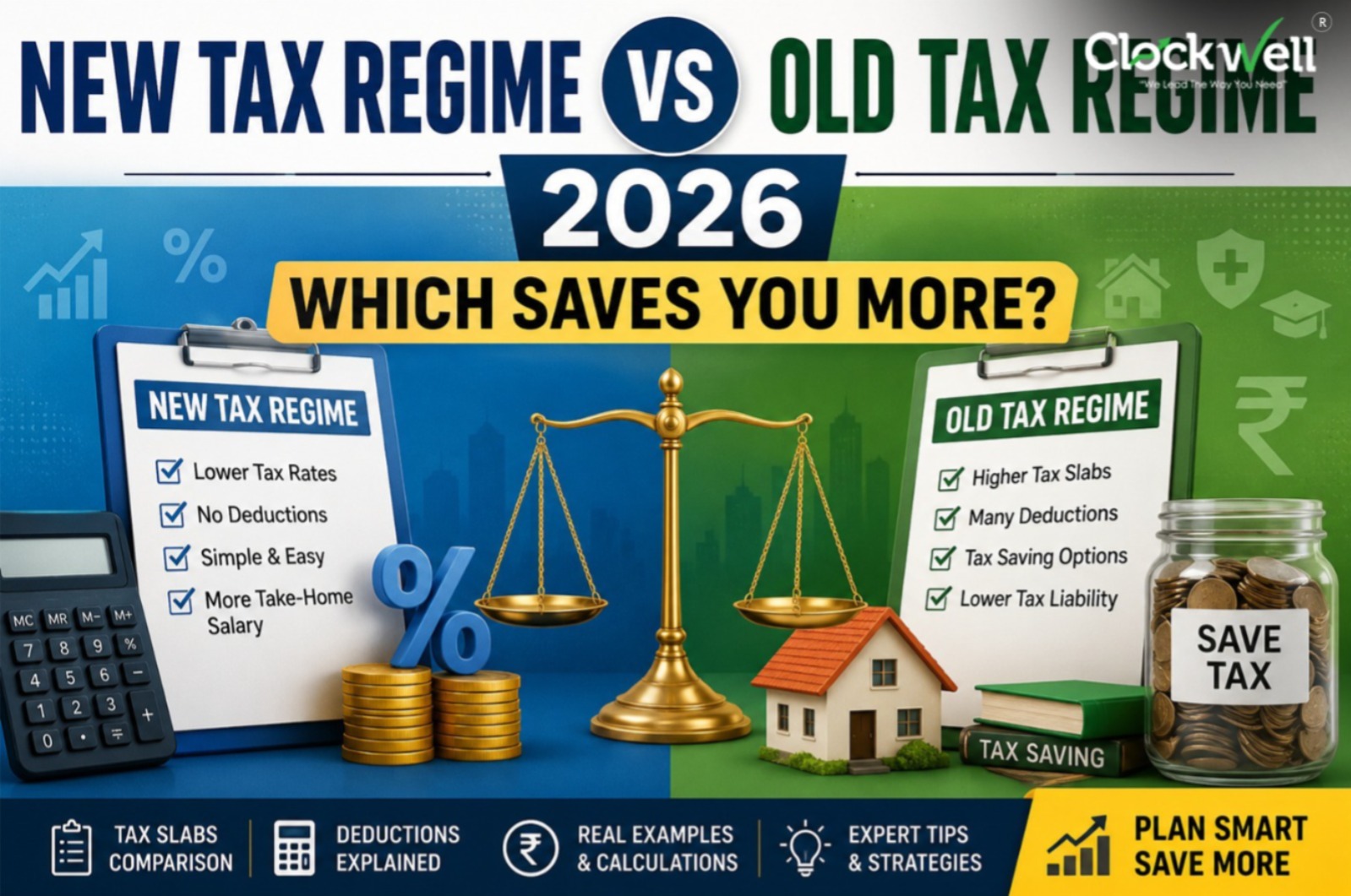
This comprehensive guide on New Tax Regime vs Old Tax Regime 2026 explains everything you need to know, including tax slabs, deductions, benefits, eligibility, comparisons, practical examples, and expert recommendations.
What is New Tax Regime vs Old Tax Regime 2026?
The Indian Income Tax system currently allows eligible taxpayers to choose between two taxation methods:
1. Old Tax Regime
The traditional tax system allows taxpayers to claim various deductions, exemptions, and tax-saving benefits.
Popular deductions include:
- Section 80C
- Section 80D
- House Rent Allowance (HRA)
- Leave Travel Allowance (LTA)
- Home Loan Interest
- NPS Contributions
- Education Loan Interest
The old regime rewards taxpayers who actively invest and save.
2. New Tax Regime
The new regime offers lower tax rates but removes most deductions and exemptions.
Its objective is simple:
- Reduce paperwork
- Simplify tax filing
- Provide lower tax rates
- Encourage easier compliance
Under the new regime, taxpayers generally cannot claim most traditional tax-saving deductions.
Real-World Example
Consider two employees earning ₹12 lakh annually.
Employee A
Claims:
- ₹1.5 lakh under Section 80C
- ₹25,000 under Section 80D
- ₹1 lakh HRA benefits
- ₹2 lakh home loan interest
The old regime may provide substantial tax savings.
Employee B
Has no investments, no home loan, and does not claim deductions.
The new regime may be more beneficial.
This is why understanding New Tax Regime vs Old Tax Regime 2026 is critical.
Why is New Tax Regime vs Old Tax Regime 2026 Important?
Choosing the correct tax regime affects:
1. Total Tax Liability
Your final tax outgo depends heavily on the regime selected.
2. Investment Strategy
The old regime encourages disciplined savings.
3. Cash Flow Management
The new regime leaves more money available immediately.
4. Financial Planning
Long-term goals such as retirement planning are influenced by your tax strategy.
5. Compliance Requirements
The new regime involves fewer calculations and documentation.
6. Return Filing Accuracy
Choosing the wrong regime can result in missed opportunities and higher taxes.
Who Needs New Tax Regime vs Old Tax Regime Comparison?
The comparison is relevant for:
Salaried Employees
The largest group affected during annual ITR filing.
Business Owners
Need tax-efficient planning strategies.
Startups and Entrepreneurs
Must optimize cash flow and tax obligations.
Freelancers
Income structures vary, making tax planning crucial.
Professionals
Doctors, lawyers, consultants, architects, and accountants must evaluate both options.
Senior Citizens
Need to maximize post-tax income and retirement savings.
When Should You Consider New Tax Regime vs Old Tax Regime 2026?
You should evaluate both regimes:
During Financial Year Planning
Preferably at the beginning of the financial year.
Before Making Investments
Avoid investing solely for tax savings without comparison.
Before Filing ITR
Conduct a detailed tax calculation.
After Salary Revision
Income changes may alter the optimal regime.
After Taking a Home Loan
Home loan deductions may make the old regime attractive.
Before Major Financial Decisions
Marriage, property purchase, business expansion, or retirement planning.
Key Features of New Tax Regime vs Old Tax Regime 2026
Features of Old Tax Regime
Multiple Deductions
Allows extensive tax-saving claims.
Investment-Based Savings
Rewards disciplined investing.
HRA Benefits
Useful for salaried employees living in rented accommodation.
Home Loan Benefits
Provides significant tax relief.
NPS Benefits
Additional tax deductions available.
Features of New Tax Regime
Lower Tax Rates
Reduced tax slabs.
Simpler Compliance
Minimal documentation.
No Mandatory Investments
No need to lock money into tax-saving schemes.
Faster Return Filing
Less complexity during ITR preparation.
Better for Low-Deduction Taxpayers
Suitable for individuals who do not claim exemptions.
Tax Slab Comparison 2026
New Tax Regime
| Income Range | Tax Rate |
|---|---|
| Up to ₹4 lakh | Nil |
| ₹4 lakh – ₹8 lakh | 5% |
| ₹8 lakh – ₹12 lakh | 10% |
| ₹12 lakh – ₹16 lakh | 15% |
| ₹16 lakh – ₹20 lakh | 20% |
| ₹20 lakh – ₹24 lakh | 25% |
| Above ₹24 lakh | 30% |
Old Tax Regime
| Income Range | Tax Rate |
|---|---|
| Up to ₹2.5 lakh | Nil |
| ₹2.5 lakh – ₹5 lakh | 5% |
| ₹5 lakh – ₹10 lakh | 20% |
| Above ₹10 lakh | 30% |
Taxpayers should verify current rates while filing returns as government updates may occur.
Step-by-Step Process to Choose the Right Tax Regime
Step 1: Calculate Gross Income
Include:
- Salary
- Business income
- Rental income
- Interest income
- Capital gains
Step 2: Identify Eligible Deductions
List:
- 80C investments
- Insurance premiums
- NPS contributions
- Home loan interest
- HRA benefits
Step 3: Calculate Tax Under Old Regime
Subtract all eligible deductions and exemptions.
Compute tax payable.
Step 4: Calculate Tax Under New Regime
Apply applicable tax slabs without most deductions.
Compute tax payable.
Step 5: Compare Both Results
Choose the regime resulting in lower tax liability.
Maintain documentation supporting your decision.
Documents Required for Tax Regime Evaluation
Salary Slips
Shows income and allowances.
Form 16
Provides annual salary and tax details.
Investment Proofs
Required under the old regime.
Examples:
- ELSS
- PPF
- Life Insurance
Home Loan Statements
Necessary for claiming interest deductions.
Rent Receipts
Required for HRA claims.
Health Insurance Receipts
Needed for Section 80D deductions.
NPS Contribution Statements
Supports additional tax benefits.
Bank Statements
Verify interest income and transactions.
Benefits of New Tax Regime vs Old Tax Regime 2026
1. Lower Tax Burden
Selecting the correct regime minimizes tax liability.
2. Better Financial Planning
Supports informed investment decisions.
3. Improved Cash Flow
Optimizes monthly disposable income.
4. Simplified Compliance
Especially under the new regime.
5. Investment Discipline
Encouraged under the old regime.
6. Reduced Filing Errors
Proper planning minimizes mistakes.
7. Higher Savings
More efficient tax management.
8. Better Retirement Planning
Supports long-term wealth creation.
9. Enhanced Budgeting
Predictable tax obligations.
10. Greater Financial Awareness
Improves overall money management.
Common Mistakes to Avoid
Choosing Without Calculation
Never select a regime based on assumptions.
Example
Many taxpayers automatically choose the new regime without checking deductions.
Ignoring HRA Benefits
HRA can significantly reduce taxable income.
Forgetting Home Loan Benefits
Home loan deductions often make the old regime advantageous.
Investing Only for Tax Savings
Avoid poor investments solely to save taxes.
Missing Documentation
Maintain records for all claims.
Not Reviewing Annually
The best regime can change each year.
Ignoring Professional Advice
Complex income structures require expert evaluation.
Challenges and Solutions
Challenge 1: Understanding Deductions
Solution
Create a checklist of eligible deductions.
Challenge 2: Complex Calculations
Solution
Use tax calculators or consult professionals.
Challenge 3: Changing Tax Rules
Solution
Stay updated with annual budget announcements.
Challenge 4: Documentation Issues
Solution
Maintain digital records throughout the year.
Challenge 5: Multiple Income Sources
Solution
Seek professional tax planning assistance.
Cost, Fees, or Investment Required
Tax Filing Costs
Generally range between:
- ₹500 to ₹2,000 for simple filings
- ₹2,000 to ₹10,000+ for complex cases
Professional Consultation Fees
Depend on:
- Income complexity
- Business structure
- Number of deductions
- Capital gains transactions
Investment Requirements Under Old Regime
Tax-saving investments may include:
- PPF
- ELSS
- Life Insurance
- NPS
- Tax-saving Fixed Deposits
Cost Factors
- Home loans
- Insurance premiums
- Financial planning services
- Investment commitments
Latest Updates, Rules, and Trends in 2026
Several trends are influencing the debate around New Tax Regime vs Old Tax Regime 2026.
Growing Adoption of New Regime
More taxpayers are shifting toward the new regime because of simplified compliance.
Digital Tax Filing
Technology-driven tax filing is reducing errors.
Increased Use of Tax Planning Software
AI-based tools help taxpayers compare both regimes instantly.
Greater Focus on Financial Literacy
Individuals are becoming more aware of tax optimization strategies.
Professional Tax Advisory Demand
Businesses increasingly seek expert assistance to maximize savings.
Which Regime Saves You More?
Choose the Old Tax Regime If:
You have:
- Large Section 80C investments
- Home loan deductions
- Significant HRA benefits
- NPS contributions
- Medical insurance deductions
Choose the New Tax Regime If:
You:
- Do not claim many deductions
- Prefer simplicity
- Want less paperwork
- Have limited tax-saving investments
General Rule
If your total deductions exceed approximately ₹3–4 lakh annually, the old regime may often provide greater savings.
If deductions are minimal, the new regime usually becomes more attractive.
However, individual calculations remain essential.
FAQ Section
1. Which tax regime is better in 2026?
It depends on your income and deductions. Taxpayers with significant deductions often benefit from the old regime, while others may save more under the new regime.
2. Can I switch between tax regimes every year?
Salaried individuals generally have flexibility to choose while filing returns, subject to applicable tax rules.
3. Is HRA available under the new regime?
Generally, HRA benefits are not available under the new regime.
4. Can I claim Section 80C under the new regime?
Most Section 80C deductions are not available under the new regime.
5. Is home loan interest deductible under the new regime?
Most home loan benefits available under the old regime are restricted under the new regime.
6. Which regime is better for salaried employees?
The answer depends on deductions, exemptions, and salary structure.
7. Which regime is better for freelancers?
Freelancers should compare tax calculations under both regimes before deciding.
8. Can business owners choose either regime?
Eligibility depends on current tax regulations and business circumstances.
9. Does the new regime require investments?
No. The new regime does not require tax-saving investments.
10. Should I consult a tax professional?
Yes. Professional advice can help identify the most tax-efficient option and prevent costly mistakes.
Expert Tips
Calculate Tax Under Both Regimes Every Year
Never rely on previous-year assumptions.
Track Deductions Throughout the Year
Avoid last-minute tax planning.
Use Digital Documentation
Store receipts, investment proofs, and loan statements digitally.
Focus on Financial Goals
Invest for wealth creation first and tax savings second.
Review Salary Structure Annually
Changes in compensation can impact regime selection.
Plan Before March
Tax planning is most effective when done throughout the year.
Seek Professional Guidance
Complex tax situations require expert evaluation.
Monitor Budget Announcements
Tax rules can change every year.
Maintain Compliance
File returns accurately and on time.
Think Long-Term
The right regime should support both tax savings and financial growth.
Choosing between the New Tax Regime vs Old Tax Regime 2026 is one of the most important tax decisions taxpayers make during every ITR season. While the new regime offers simplicity and lower tax rates, the old regime continues to provide substantial benefits for individuals who actively claim deductions and exemptions.
There is no one-size-fits-all answer. The best option depends on your income level, investments, home loan status, insurance coverage, retirement planning strategy, and overall financial goals.
Before filing your return, calculate your tax liability under both systems and compare the outcomes carefully. A few minutes of analysis can result in significant tax savings.
Need help choosing the right tax regime or filing your Income Tax Return? Contact a professional tax consultant today to evaluate your situation, maximize your savings, and ensure full compliance with the latest tax regulations.
Published on June 24, 2026