
Running a company in India involves much more than managing sales, employees, and customers. Every registered company must comply with various legal obligations under the Companies Act, 2013. One of the most important responsibilities is filing statutory returns and forms with the Registrar of Companies (ROC).
Missing an ROC filing deadline can result in heavy penalties, additional filing fees, legal notices, and even disqualification of directors in certain situations. Whether you operate a Private Limited Company, One Person Company (OPC), Limited Company, or LLP, staying updated with compliance due dates is essential.
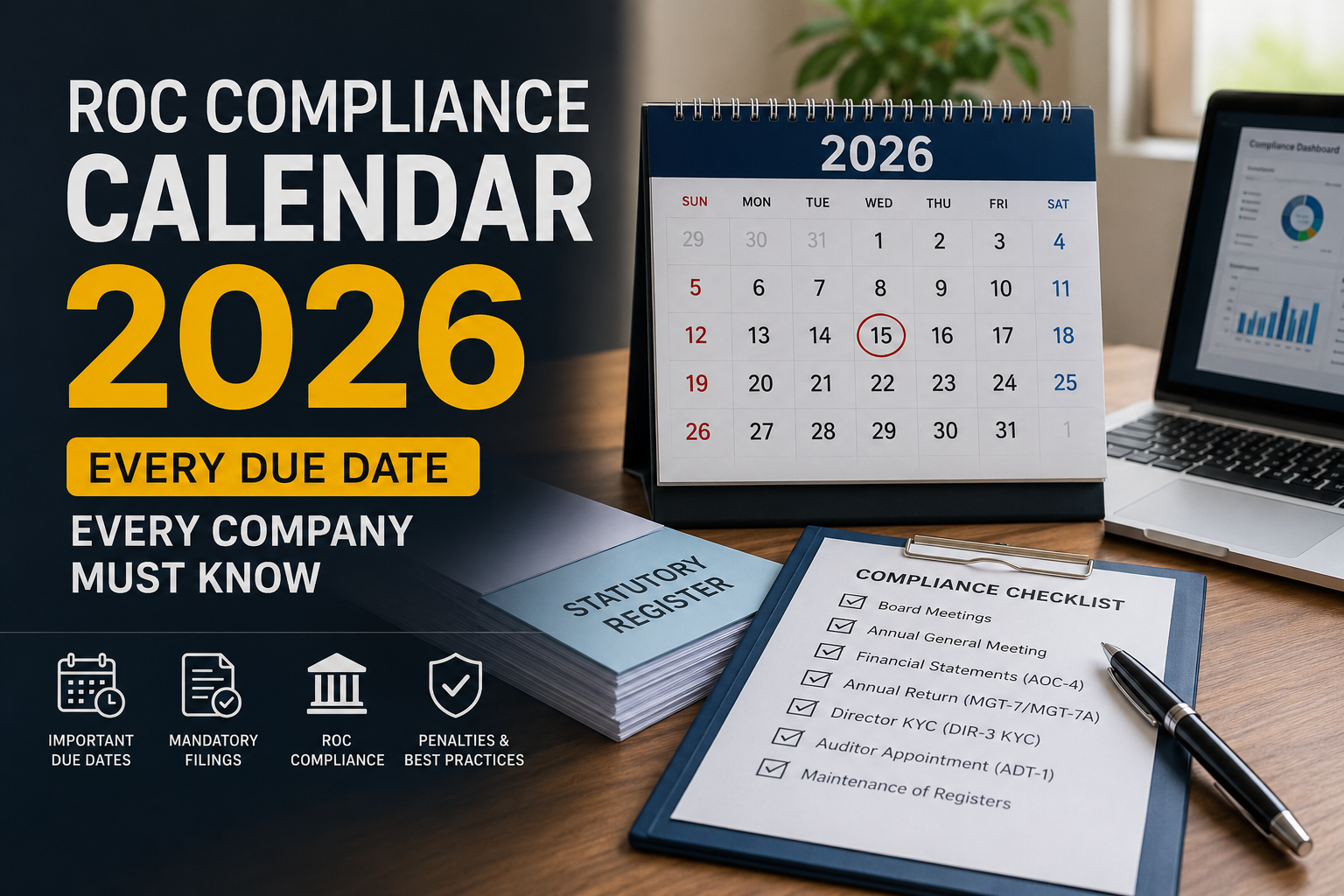
This ROC Compliance Calendar 2026 provides a complete overview of the major annual ROC compliances, important filing dates, and practical tips to help your business remain compliant throughout the year.
What is ROC Compliance?
ROC (Registrar of Companies) compliance refers to the statutory filings and legal obligations that every registered company must complete with the Ministry of Corporate Affairs (MCA).
These compliances ensure that a company's financial position, management structure, statutory records, and governance remain transparent and up to date.
ROC compliance is mandatory regardless of whether the company has earned a profit or carried out business during the financial year.
Who Must Follow ROC Compliance?
ROC compliance applies to:
- Private Limited Companies
- One Person Companies (OPC)
- Public Limited Companies
- Section 8 Companies
- Limited Liability Partnerships (LLPs) (through LLP-specific filings)
- Dormant Companies
- Foreign Companies registered in India
Every company registered with the MCA has ongoing compliance responsibilities.
Why ROC Compliance Matters
Timely ROC filings help businesses:
- Avoid heavy penalties
- Maintain active company status
- Build credibility with banks and investors
- Improve corporate governance
- Prevent legal complications
- Facilitate funding and expansion
A compliant company enjoys greater trust among customers, investors, and government authorities.
ROC Compliance Calendar 2026
Below are the major annual ROC compliance requirements that companies should monitor during 2026.
1. Board Meetings
Private Limited Companies are required to conduct board meetings at prescribed intervals.
Important Points
- Maintain minutes of meetings
- Record important resolutions
- Ensure proper notice to directors
- Preserve statutory records
Regular board meetings demonstrate good corporate governance.
2. Annual General Meeting (AGM)
Every company (except where exempted) must hold its Annual General Meeting.
AGM Covers:
- Adoption of financial statements
- Appointment or reappointment of auditors
- Appointment of directors
- Approval of dividends (if applicable)
- Business resolutions
Holding the AGM within the prescribed timeline is a legal requirement.
3. Filing of Financial Statements (Form AOC-4)
After the AGM, companies must file their audited financial statements with the Registrar of Companies.
Documents Usually Filed
- Balance Sheet
- Profit & Loss Account
- Cash Flow Statement (where applicable)
- Auditor's Report
- Board Report
Accurate financial reporting is one of the most important ROC compliances.
4. Filing Annual Return (Form MGT-7 / MGT-7A)
Companies must file their Annual Return containing important company information.
The return generally includes:
- Shareholding details
- Directors and Key Managerial Personnel
- Registered office information
- Company activities
- Compliance declarations
This filing keeps MCA records updated.
5. Director KYC (DIR-3 KYC)
Every director holding a Director Identification Number (DIN) must complete annual KYC.
Required Information
- PAN
- Aadhaar
- Mobile number
- Email address
- Address proof
Failure to complete KYC may deactivate the DIN.
6. Auditor Appointment (ADT-1)
Whenever applicable, companies must file auditor appointment details with ROC.
Maintaining proper auditor records ensures statutory compliance.
7. Maintenance of Statutory Registers
Apart from ROC filings, companies should continuously maintain:
- Register of Members
- Register of Directors
- Register of Charges
- Share Transfer Records
- Minutes Books
- Share Certificates
Proper record maintenance simplifies annual compliance.
Estimated Annual Compliance Timeline for 2026
| Compliance | Typical Timeline* |
|---|---|
| Board Meetings | Throughout the year |
| Director KYC (DIR-3 KYC) | Annual |
| Annual General Meeting (AGM) | As per Companies Act |
| AOC-4 Filing | After AGM |
| MGT-7 / MGT-7A Filing | After AGM |
| Auditor-related Filings | As applicable |
| Statutory Register Updates | Continuous |
*Actual due dates depend on the company's financial year, incorporation date, and applicable MCA notifications. Always verify the latest MCA circulars before filing.
Common ROC Compliance Mistakes
Many companies receive penalties due to avoidable mistakes such as:
- Missing filing deadlines
- Incorrect financial statements
- Failure to hold AGM
- Non-maintenance of statutory registers
- Director KYC not completed
- Filing incorrect company information
- Delayed auditor appointments
Regular compliance reviews help prevent these issues.
Penalties for Non-Compliance
Failure to comply with ROC requirements may result in:
- Additional filing fees
- Monetary penalties
- Director disqualification (in certain cases)
- Company status issues
- Legal notices
- Difficulty obtaining loans or investment
- Increased regulatory scrutiny
Compliance is always less expensive than paying penalties.
Best Practices to Stay ROC Compliant
Maintain an Annual Compliance Calendar
Track all important ROC filing deadlines well in advance.
Keep Accounting Records Updated
Accurate bookkeeping supports timely financial statement preparation.
Conduct Internal Compliance Reviews
Regularly review statutory registers and legal records.
Complete Audits Early
Avoid last-minute delays by scheduling audits ahead of deadlines.
Monitor MCA Notifications
Regulatory updates may introduce changes in filing requirements.
Work With Compliance Professionals
Professional support reduces filing errors and ensures timely compliance.
Benefits of Timely ROC Compliance
Businesses that remain compliant enjoy several advantages:
- Better corporate reputation
- Improved investor confidence
- Easier access to bank finance
- Lower compliance risk
- Strong legal standing
- Better business continuity
Compliance is an investment in long-term business success.
How Clockwell Can Help
Clockwell offers complete ROC and corporate compliance solutions, including:
- Company Incorporation
- Annual ROC Filings
- AOC-4 and MGT-7 Filing
- Director KYC (DIR-3 KYC)
- Board Resolution Documentation
- Statutory Register Maintenance
- Annual Compliance Management
- Accounting & Bookkeeping
- GST Registration & Return Filing
- Income Tax Compliance
- Business Advisory Services
Our experienced compliance professionals ensure your company meets every ROC requirement accurately and on time, allowing you to focus on growing your business.
Frequently Asked Questions (FAQs)
Is ROC compliance mandatory for inactive companies?
Yes. Even dormant or inactive companies may have certain annual ROC compliance obligations.
Can a company be penalized for late ROC filing?
Yes. Late filings generally attract additional fees and may lead to further legal consequences depending on the nature of the default.
What happens if Director KYC is not completed?
Failure to complete DIR-3 KYC may result in the Director Identification Number (DIN) being marked inactive until the compliance is completed
Do small companies also need annual ROC filing?
Yes. Small companies have compliance obligations, although certain forms and reporting requirements may differ depending on the applicable legal provisions.
ROC compliance is not just a legal requirement—it is an essential part of responsible corporate governance. By maintaining accurate records, conducting timely board meetings, filing annual returns, and monitoring statutory deadlines, businesses can avoid unnecessary penalties and build long-term credibility.
A well-planned ROC Compliance Calendar 2026 helps business owners stay organized, reduce compliance risks, and focus on sustainable growth. Whether your company is newly incorporated or well established, timely ROC compliance should remain a top priority.
With expert support from Clockwell, your business can meet every compliance deadline confidently and efficiently.
Published on July 9, 2026