
Starting a business is exciting. Whether you're a freelancer, retailer, consultant, digital marketer, manufacturer, or online seller, many entrepreneurs begin their journey as a sole proprietor because it's simple, affordable, and easy to manage.
However, as your business grows, your legal structure should grow with it.
A business that earns more revenue, hires employees, attracts investors, or expands into new markets may eventually outgrow a sole proprietorship. At that stage, upgrading to a Private Limited Company can provide better legal protection, stronger credibility, and greater opportunities for growth.
But the question is:
When is the right time to upgrade?
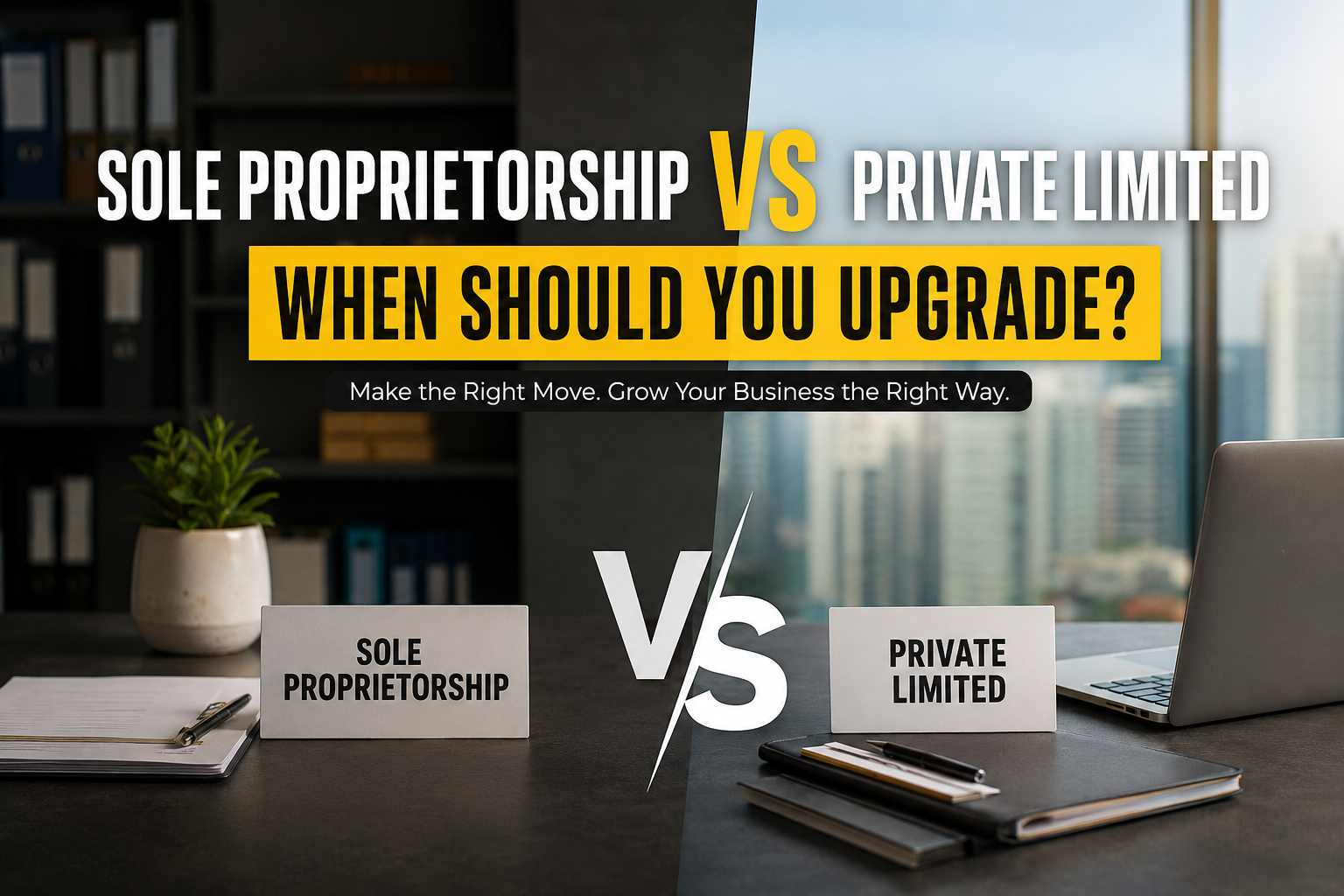
This comprehensive guide explains everything you need to know about Sole Proprietorship vs Private Limited Company, their differences, advantages, disadvantages, and the right time to make the switch.
What is a Sole Proprietorship?
A Sole Proprietorship is the simplest form of business in India.
It is owned and managed by one individual, and legally, the owner and the business are considered the same entity.
There is no separate legal identity.
This means the owner receives all profits but is also personally responsible for all losses, debts, and liabilities.
Common Examples
- Grocery shops
- Mobile stores
- Freelancers
- Small agencies
- Restaurants
- Online sellers
- Consultants
- Tailors
- Home-based businesses
Advantages of Sole Proprietorship
Easy to Start
No complicated incorporation process.
Low Cost
Minimal registration and compliance expenses.
Complete Control
The owner makes all business decisions independently.
Easy Tax Filing
Income is taxed as personal income.
Less Compliance
No board meetings or annual MCA filings.
Limitations of Sole Proprietorship
While suitable for small businesses, sole proprietorship has several limitations.
Unlimited Personal Liability
If your business incurs debt, your personal assets like your house, car, or savings may be at risk.
Limited Growth
Banks and investors usually prefer registered companies.
Lower Credibility
Many large companies hesitate to work with unregistered businesses.
Difficult to Raise Funds
Equity investment isn't possible.
Business Ends with the Owner
The business has no separate legal existence.
What is a Private Limited Company?
A Private Limited Company is a separate legal entity registered under the Companies Act, 2013.
It exists independently from its owners.
This means the company can:
- Own property
- Enter contracts
- Borrow money
- Sue or be sued
- Continue operating even if shareholders change
The owners are known as shareholders.
The company is managed by directors.
Benefits of a Private Limited Company
Limited Liability
Personal assets remain protected.
Shareholders lose only the amount invested.
Separate Legal Identity
The company has its own PAN, bank account, and legal existence.
Better Brand Image
Customers, vendors, investors, and banks trust registered companies more.
Easier Funding
Private Limited Companies can:
- Raise equity investment
- Add shareholders
- Attract venture capital
- Secure bank loans
Business Continuity
Ownership changes do not affect business operations.
Better Expansion Opportunities
Suitable for:
- Multiple branches
- Online businesses
- Franchises
- National expansion
- International business
Sole Proprietorship vs Private Limited
| Feature | Sole Proprietorship | Private Limited Company |
|---|---|---|
| Legal Identity | No | Yes |
| Owner Liability | Unlimited | Limited |
| Separate PAN | No | Yes |
| Number of Owners | One | 2–200 Shareholders |
| Investment Opportunities | Limited | High |
| Business Continuity | Depends on Owner | Perpetual |
| Compliance | Low | Moderate |
| Brand Credibility | Moderate | High |
| Government Recognition | Limited | Better |
| Scalability | Limited | Excellent |
Signs It's Time to Upgrade
Many businesses continue operating as sole proprietorships long after they've outgrown the structure.
Here are clear indicators that it's time to consider upgrading.
1. Your Revenue is Increasing Rapidly
If your business is generating significant annual turnover, a Private Limited Company can provide a more structured framework for growth.
2. You're Hiring Employees
As your team expands, having a formal company structure makes payroll, HR policies, and statutory compliance easier to manage.
3. You Want Investors
Investors generally prefer Private Limited Companies because they can receive equity shares.
4. You're Applying for Large Loans
Banks often view Private Limited Companies as more reliable borrowers.
5. You're Working with Large Corporate Clients
Many large organizations require vendors to operate through registered companies before awarding contracts.
6. You're Launching a Strong Brand
A Private Limited Company enhances professionalism and customer confidence.
7. You Want Legal Protection
As your business grows, so do its risks.
Limited liability helps safeguard your personal assets from business obligations.
8. You Plan to Expand Across India
A registered company simplifies opening branches and doing business in multiple states.
Tax Differences
Many business owners assume a Private Limited Company always pays less tax.
This isn't necessarily true.
Tax efficiency depends on factors such as:
- Annual profit
- Salary structure
- Business expenses
- Applicable deductions
- Dividend distribution
- Future investment plans
Consulting a qualified tax professional before changing your business structure is recommended.
Documents Required for Private Limited Registration
Generally, you'll need:
- PAN Card
- Aadhaar Card
- Passport-size photograph
- Mobile number
- Email ID
- Address proof
- Office address proof
- Electricity bill or utility bill
- No Objection Certificate (if applicable)
Additional documents may be required depending on the specific circumstances.
Registration Process
The typical process includes:
Step 1
Choose a unique company name.
Step 2
Obtain Digital Signature Certificates (DSC).
Step 3
Apply for Director Identification Numbers (DIN).
Step 4
Prepare incorporation documents.
Step 5
File the incorporation application with the Ministry of Corporate Affairs (MCA).
Step 6
Receive the Certificate of Incorporation.
Step 7
Apply for PAN and TAN.
Step 8
Open a company bank account.
Step 9
Complete GST registration if required.
Common Mistakes Business Owners Make
Many entrepreneurs delay incorporation until it's too late.
Common mistakes include:
- Operating with high turnover as a sole proprietor
- Mixing personal and business finances
- Ignoring legal liabilities
- Delaying trademark registration
- Using personal accounts for business transactions
- Not maintaining proper accounting records
These issues can create challenges when seeking loans, investments, or large contracts.
Who Should Continue as a Sole Proprietor?
A sole proprietorship may still be suitable if you:
- Are just starting your business
- Have low business risk
- Operate on a small scale
- Have no immediate need for investors
- Want minimal compliance
- Are testing a new business idea
Who Should Upgrade to a Private Limited Company?
Upgrading is worth considering if you:
- Plan to scale quickly
- Want legal protection
- Need funding or investment
- Intend to build a long-term brand
- Work with corporate clients
- Expect significant business growth
- Want to separate personal and business finances
How Clockwell Can Help
Choosing the right business structure is an important strategic decision. At Clockwell, we help entrepreneurs evaluate their current business stage and guide them through the incorporation process with confidence.
Our services include:
- Private Limited Company Registration
- LLP Registration
- GST Registration
- MSME Registration
- Trademark Registration
- Digital Signature Certificate (DSC)
- Accounting & Compliance Support
- Annual ROC Filings
- Business Advisory Services
Whether you're transitioning from a sole proprietorship or launching a new venture, our experts can help ensure your business is structured for sustainable growth.
Frequently Asked Questions (FAQs)
1. Is a Private Limited Company better than a Sole Proprietorship?
Not always. It depends on your business size, risk profile, and future growth plans. Sole proprietorships work well for small businesses, while Private Limited Companies are better suited for businesses aiming to scale.
2. Can I convert my Sole Proprietorship into a Private Limited Company?
Yes. You can establish a Private Limited Company and transfer eligible business assets and operations, subject to legal and tax requirements.
3. Is GST mandatory for a Private Limited Company?
GST registration is required only if your business meets the applicable threshold or falls under categories where GST registration is compulsory.
4. How many directors are required?
A Private Limited Company in India requires a minimum of two directors.
5. Is annual compliance mandatory?
Yes. Private Limited Companies must comply with annual filing and statutory requirements under the Companies Act.
Every successful business reaches a stage where its legal structure should evolve alongside its ambitions.
A Sole Proprietorship is an excellent starting point due to its simplicity and low cost. However, as your business gains momentum—through higher revenue, larger clients, expanding teams, or funding opportunities—a Private Limited Company offers the legal protection, credibility, and scalability needed for the next phase of growth.
Upgrading at the right time isn't just about compliance—it's about creating a stronger foundation for long-term success. If you're unsure which structure is best for your business, seeking professional guidance can help you make an informed decision and avoid costly mistakes in the future.
Published on July 6, 2026