

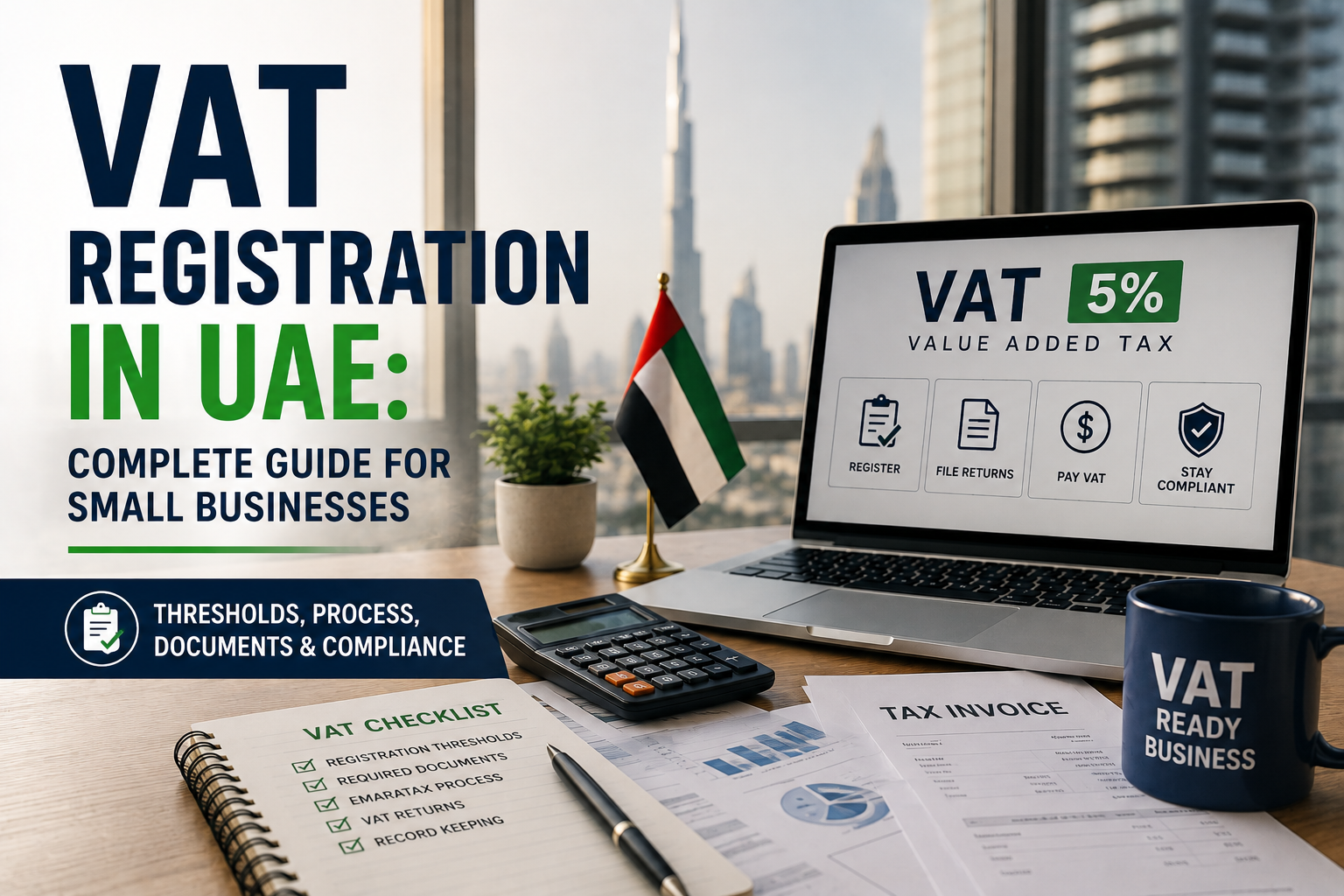
Value Added Tax (VAT) is a consumption tax applied at different stages of the supply chain. In the UAE, the standard VAT rate is 5% for supplies that are subject to the standard rate.
A business registered for VAT generally:
- Charges VAT on applicable sales.
- Pays VAT on eligible business purchases.
- Records the transactions properly.
- Files VAT returns with the Federal Tax Authority (FTA).
- Pays the net VAT liability to the FTA, or claims a refund where applicable.
VAT is ultimately intended to be borne by the final consumer, while registered businesses generally act as collectors within the supply chain.
Who Needs VAT Registration in UAE?
The first question every growing business should ask is:
Has my business crossed the VAT registration threshold?
For UAE-resident businesses, VAT registration is mandatory when the total value of taxable supplies and imports exceeds AED 375,000 over the previous 12 months, or when the business expects to exceed AED 375,000 within the next 30 days.
There is also a voluntary registration threshold.
A UAE-resident business may generally apply voluntarily when the value of its taxable supplies, imports or taxable expenses exceeds AED 187,500 over the previous 12 months or is expected to exceed that amount within the next 30 days.
The two important thresholds
| Type | Threshold |
|---|---|
| Mandatory VAT Registration | AED 375,000 |
| Voluntary VAT Registration | AED 187,500 |
These thresholds should not be confused with total bank deposits or simply the value of every transaction. The VAT rules determine which supplies, imports and expenses are relevant.
Is VAT Registration Mandatory at AED 375,000?
For a UAE-resident business making taxable supplies, registration becomes mandatory when the applicable threshold is exceeded based on the FTA's rules.
The test looks at:
- Taxable supplies
- Relevant imports
- Previous 12-month turnover
- Expected taxable supplies in the next 30 days
Therefore, businesses should monitor their turnover continuously rather than waiting until the end of the financial year.
What Is Voluntary VAT Registration?
A business doesn't necessarily have to wait until it crosses AED 375,000.
If its qualifying taxable supplies, imports or taxable expenses exceed the AED 187,500 voluntary-registration threshold, it may be eligible to register voluntarily.
Voluntary registration can sometimes make commercial sense for a growing business because VAT registration allows an eligible taxable person to account for input VAT on qualifying business expenses, subject to the applicable rules.
However, voluntary registration also creates ongoing compliance responsibilities.
So the decision should be based on the business's:
- Turnover
- Customer base
- Expenses
- Input VAT
- Business model
- Expected growth
- Administrative capacity
What About Free Zone Businesses?
A common misconception is:
“If my company is in a UAE free zone, I don't need VAT registration.”
That is not generally correct.
The FTA states that taxable turnover exceeding the mandatory threshold can require VAT registration whether the business is based in a free zone or mainland.
However, free-zone businesses can have more complex VAT treatment depending on the nature and location of the transactions.
Therefore, free-zone companies should not determine VAT treatment solely based on their licence location.
What About Mainland Businesses?
Mainland businesses are subject to the same general VAT registration framework.
A mainland company making taxable supplies should monitor its taxable turnover and imports against the applicable thresholds.
For example:
Business A
- Mainland trading company
- Taxable sales: AED 420,000
- Applicable taxable imports: additional relevant amounts
If the business meets the mandatory registration criteria, it should register for VAT rather than continuing to operate as an unregistered business.
What About Non-Resident Businesses?
This is an important distinction.
The AED 375,000 mandatory threshold does not apply in the same way to foreign businesses.
The FTA states that a non-resident business making taxable supplies in the UAE may be required to register for VAT regardless of the value of its supplies where there is no other person in the UAE responsible for accounting for the VAT.
This is particularly important for:
- Overseas suppliers
- International service providers
- E-commerce businesses
- Foreign companies selling into the UAE
Non-resident businesses should therefore obtain specific advice before assuming that the AED 375,000 threshold protects them from registration.
When Should a Business Apply for VAT Registration?
A person required to register for VAT must submit the registration application to the FTA within 30 days of becoming required to register.
This makes turnover monitoring extremely important.
Don't wait until:
“We will register once the accountant tells us.”
Instead, review turnover regularly and maintain a VAT threshold tracker.
How to Register for VAT in UAE
VAT registration is completed electronically through the FTA's EmaraTax platform.
The basic process is:
Step 1: Create an EmaraTax Account
Create and activate the relevant account on the FTA's platform.
Step 2: Create the Taxable Person Profile
Enter the business information required by the FTA.
Step 3: Select VAT Registration
Access the taxable person's account and select the VAT registration option.
Step 4: Complete the Application
Provide information relating to:
- Business activities
- Turnover
- Supplies
- Imports
- Customs information, where applicable
- Owners
- Authorized signatories
Step 5: Upload Supporting Documents
Attach the documents requested for your entity and application.
Step 6: Submit the Application
Review the information carefully before submitting.
Step 7: FTA Review
The FTA reviews the application.
Step 8: Receive the VAT Registration Certificate
Once approved, the VAT registration certificate becomes available through the taxpayer's electronic account.
The FTA currently lists the VAT registration service as free of charge and estimates approximately 20 business days for completion by the FTA after a completed application is received.
Documents Required for VAT Registration
The exact documents depend on the legal form and circumstances of the business.
The FTA currently lists supporting documents that can include:
- Certificate of Incorporation
- Memorandum of Association
- Partnership Agreement, where applicable
- Commercial Registration Certificate
- Valid Trade Licence
- Emirates ID and passport of owners
- Emirates ID and passport of authorized signatories
- Proof of authorization
- Official declaration of taxable supplies and monthly sales
- Invoices
- Purchase orders
- Contracts
- Lease agreements
- Customs information, where applicable
- Bank letter, where applicable
For applications based on expected revenue, the FTA may request supporting evidence such as signed contracts or purchase orders.
For expense-based voluntary registration, the FTA currently notes that supporting VAT invoices may be required.
What Is a TRN?
After successful VAT registration, the business receives a Tax Registration Number (TRN).
The TRN is used for VAT-related dealings with the FTA and should be included where required on tax documentation.
It should not be confused with:
- Trade licence number
- Commercial registration number
- Corporate Tax registration number
- Customs registration number
These are separate identifiers serving different purposes.
What Happens After VAT Registration?
VAT registration is not the end of the process.
It creates ongoing compliance responsibilities.
A VAT-registered business generally needs to:
- Maintain proper accounting records
- Issue compliant tax invoices
- Charge VAT where applicable
- Track input VAT
- Track output VAT
- Reconcile VAT accounts
- File VAT returns
- Pay VAT due
- Maintain supporting documentation
The FTA requires VAT-registered businesses to file VAT returns and make related payments within 28 days from the end of the applicable tax period.
How Does a VAT Return Work?
A simplified VAT calculation looks like this:
Output VAT – Eligible Input VAT = Net VAT Payable
Example
Suppose a business has:
VAT collected from customers: AED 20,000
Eligible input VAT on purchases: AED 8,000
Then:
AED 20,000 – AED 8,000 = AED 12,000
The business would generally have a net VAT liability of AED 12,000, subject to the applicable VAT rules and adjustments.
This is a simplified example. Actual VAT calculations can involve zero-rated supplies, exempt supplies, reverse charge, adjustments, imports and other considerations.
What Are Input VAT and Output VAT?
Output VAT
VAT charged by the business on taxable sales.
Input VAT
VAT incurred on eligible business purchases and expenses.
The business may generally recover eligible input VAT according to the applicable UAE VAT rules.
This is why proper purchase invoices and accounting records are important.
VAT Invoices: What Should Businesses Do?
Once registered, businesses need to ensure that their invoices comply with the applicable UAE VAT requirements.
Your invoicing system should be capable of:
- Applying the correct VAT treatment
- Separating taxable value and VAT
- Recording customer details
- Maintaining invoice numbers
- Recording VAT correctly
- Producing appropriate tax invoices
Don't simply add “5% VAT” to every invoice without checking the underlying transaction.
Some supplies may be zero-rated, exempt or outside the scope of UAE VAT depending on the circumstances.
VAT Compliance for Small Businesses
Small businesses often make the mistake of treating VAT as an accounting task that can be handled at the end of the tax period.
A better approach is to maintain VAT records continuously.
Every month:
- Record sales
- Record purchases
- Verify VAT invoices
- Reconcile bank transactions
- Review output VAT
- Review input VAT
- Check unusual transactions
Before filing:
- Reconcile sales with accounting records
- Reconcile purchase invoices
- Check VAT rates
- Review credit notes
- Review imports
- Check reverse-charge transactions where applicable
- Reconcile the VAT control account
This significantly reduces the risk of filing incorrect returns.
VAT Registration Mistakes Small Businesses Should Avoid
1. Waiting Too Long to Register
If the mandatory threshold is crossed and the business delays registration, it can create unnecessary compliance exposure.
The FTA requires a person who becomes required to register to submit the application within 30 days.
2. Confusing Revenue With Taxable Turnover
Not every amount entering a bank account should automatically be treated as taxable turnover.
The VAT rules need to be applied to the actual transaction.
3. Assuming Free Zone Means VAT Exemption
Being located in a free zone does not automatically remove VAT obligations.
4. Charging VAT Before Proper Registration
Businesses should ensure they understand when they become entitled or required to charge VAT and use compliant documentation.
5. Claiming Input VAT Without Proper Documents
Input VAT recovery depends on meeting the relevant conditions.
Maintain proper tax invoices and supporting records.
6. Using the Wrong VAT Treatment
Transactions may fall into different VAT categories.
Applying 5% automatically to every transaction can lead to errors.
7. Missing the VAT Return Deadline
VAT returns and related payments are generally due within 28 days after the end of the tax period.
8. Poor Record Keeping
The FTA states that taxable persons must retain VAT invoices they issue and receive for at least five years.
Don't rely solely on emails or bank statements.
Maintain an organized tax file.
VAT Registration Checklist for UAE Small Businesses
Before applying, review:
- Valid trade licence
- Business incorporation documents
- Owner details
- Authorized signatory details
- Emirates ID and passport copies
- Previous 12-month turnover
- Expected turnover
- Taxable supplies
- Imports
- Purchase invoices
- Customer contracts
- Purchase orders
- Bank information
- Customs information, if applicable
- Accounting records
- EmaraTax account
VAT Registration for Service Businesses
VAT registration is not limited to trading companies.
It can also apply to businesses providing services such as:
- Consulting
- Marketing
- IT services
- Accounting
- Professional services
- Maintenance
- Construction
- Design
- Training
- Digital services
The important question is whether the business is making supplies that fall within the UAE VAT rules and whether the applicable registration criteria are met.
VAT Registration for E-Commerce Businesses
E-commerce businesses should pay particular attention to VAT.
Online businesses can have complicated transaction flows involving:
- UAE customers
- Overseas customers
- Imports
- Exports
- Warehouses
- Marketplaces
- Payment gateways
- Third-party logistics providers
Simply looking at the amount received through Stripe, payment gateways or bank accounts may not be sufficient to determine VAT liability.
The underlying transaction should be analyzed.
VAT Registration and Corporate Tax Are Different
Another common misconception is:
“My company is registered for VAT, so my tax compliance is complete.”
Not necessarily.
UAE VAT and Corporate Tax are separate tax regimes with different registration criteria and compliance requirements.
A business may need to evaluate both.
VAT
Generally concerns consumption and taxable supplies.
Corporate Tax
Generally concerns the taxable income/profits of businesses within the scope of the UAE Corporate Tax regime.
Therefore, VAT registration should be treated as one part of the overall UAE tax-compliance framework.
Can a Small Business Deregister From VAT?
VAT deregistration can be possible in circumstances where the business no longer meets the applicable registration requirements, subject to the UAE VAT rules and FTA procedures.
However, businesses should not simply stop filing returns because turnover has fallen.
A formal deregistration process may be required.
Until deregistration is approved and effective, the business should continue meeting its VAT obligations.
How Clockwell Can Help With UAE VAT Compliance
VAT compliance becomes more complicated as a business grows, especially when there are multiple customers, suppliers, imports or cross-border transactions.
At Clockwell, we help UAE businesses with:
- UAE VAT Registration
- VAT Return Filing
- VAT Reconciliation
- VAT Advisory
- Input VAT Review
- Output VAT Review
- Corporate Tax Registration
- Corporate Tax Compliance
- Accounting & Bookkeeping
- Tax Compliance
- Audit Support
- Business Advisory
- Virtual CFO Services
We can help businesses determine whether VAT registration is required, prepare the supporting documents, manage the application process and establish a practical system for ongoing VAT compliance.
VAT registration in UAE is an important milestone for growing small businesses.
For UAE-resident businesses, mandatory registration generally applies when taxable supplies and imports exceed AED 375,000 over the previous 12 months or are expected to exceed that amount within the next 30 days. Voluntary registration may be available from AED 187,500, subject to the applicable conditions.
The key steps are:
Monitor Turnover → Determine VAT Applicability → Register Through EmaraTax → Obtain TRN → Issue Compliant Invoices → Maintain Records → File VAT Returns → Pay/Recover VAT
The biggest mistake is waiting until VAT becomes a problem.
If your business is approaching the AED 375,000 threshold, review your VAT position early. Proper registration, accounting and reconciliation systems can make ongoing compliance much easier.
Published on August 22, 2026