

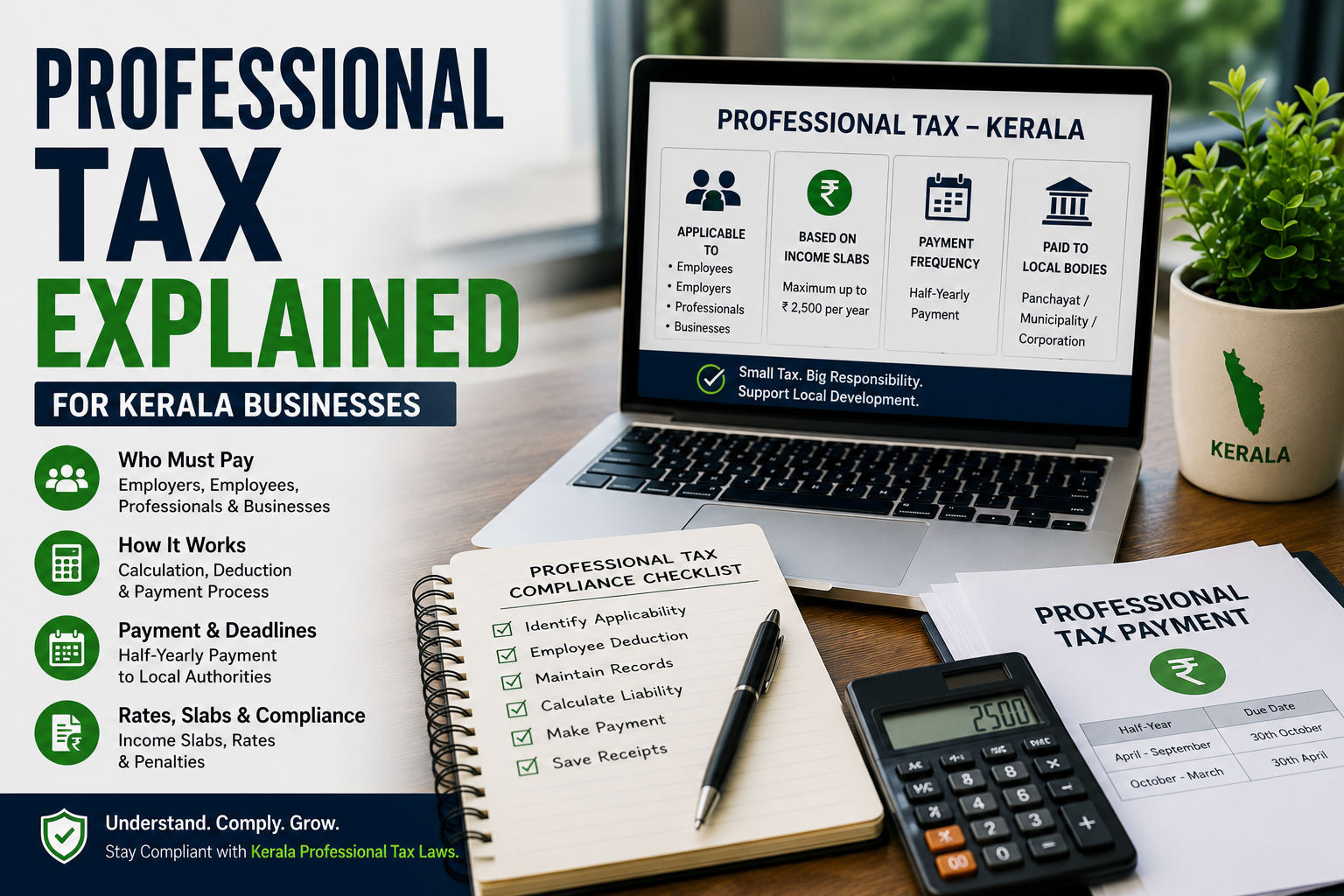
Professional Tax is a tax imposed on individuals and entities engaged in professions, employment, business or certain other activities.
In Kerala, professional tax is administered through the relevant local self-government institutions, such as Village Panchayats, Municipalities and Municipal Corporations.
The Kerala Panchayat Raj Act provides for profession tax in Panchayat areas, while the Kerala Municipality Act provides for profession tax in Municipalities and Corporations. The applicable local authority determines the rates within the limits prescribed by law.
It is important to understand that Professional Tax is different from Income Tax and GST.
| Tax | Generally relates to |
|---|---|
| Income Tax | Income/profits |
| GST | Supply of goods/services |
| TDS | Tax deducted at source on specified payments |
| Professional Tax | Profession, employment or business, as applicable |
Who Needs to Pay Professional Tax in Kerala?
Professional tax can apply to different categories of people and businesses.
These can include:
- Salaried employees
- Business owners
- Professionals
- Companies
- Self-employed individuals
- Persons carrying on a profession or business
- Certain other persons covered by the applicable local-body provisions
The Kerala Panchayat Raj Act, for example, provides for profession tax on companies doing business in a Panchayat area for at least 60 days in a half-year and on persons exercising a profession, art, calling, business or holding an appointment subject to the statutory conditions.
Therefore, having GST registration is not the only factor that determines professional-tax liability.
Is Professional Tax Applicable to Employees?
Yes.
Employees working for private companies can be liable to professional tax based on the applicable income slab and local-body rules.
In such cases, the employer generally:
- Determines the applicable professional-tax amount.
- Deducts it from the employee's salary.
- Maintains the relevant records.
- Remits the tax to the appropriate authority.
The Kerala Local Self Government Department's professional-tax portal specifically states that employers deduct professional tax from employees' salaries and deposit it with the government.
Example
Suppose an employee falls within a professional-tax slab requiring a particular amount for a half-year.
The employer would deduct the applicable amount from the employee's salary and remit it according to the prescribed procedure.
The exact amount depends on the applicable slab and local authority.
What About Business Owners?
Professional tax can also apply to persons or companies carrying on business or professions in Kerala.
For businesses, the assessment can depend on the applicable local-body provisions and the nature of the taxpayer.
The Kerala State Finance Commission explains that companies or persons engaged in business may be assessed based on income on which Income Tax or Agricultural Income Tax is assessed, or, where profit is not ascertainable, on turnover, subject to the applicable rules.
This means business owners should not assume that professional tax applies only to employees.
Who Collects Professional Tax in Kerala?
Professional tax is generally administered through the relevant Local Self Government Institution (LSGI).
Depending on where the business or individual falls, this can involve:
- Grama Panchayat
- Municipality
- Municipal Corporation
The governing legislation differs between Panchayat areas and urban local bodies.
Therefore, a business should first identify the correct local authority before completing its professional-tax compliance.
How Much Is Professional Tax in Kerala?
There is no single amount that applies to every taxpayer.
Professional tax is generally based on applicable income slabs and local-body rules.
The Kerala LSGD's official professional-tax FAQ states that rates are based on income slabs and that the maximum professional tax that may be levied by a State is capped at ₹2,500 per year under Article 276(2) of the Constitution.
Professional tax is generally paid semi-annually in Kerala.
Important
The exact rate applicable to an employee, professional or business should be checked against the rules and rate schedule applicable to the relevant local authority.
Do not assume that the same slab or amount applies identically across every Kerala local body.
Professional Tax Is Generally Paid Twice a Year
Unlike many monthly GST or TDS compliances, professional tax in Kerala is generally structured on a half-yearly basis.
The LSGD's official FAQ states that professional tax is paid semi-annually.
For businesses, this means professional-tax compliance should be added to the company's regular statutory compliance calendar.
A simple internal tracker can include:
| Compliance | Frequency |
|---|---|
| GST Returns | Monthly/Quarterly, as applicable |
| TDS Returns | Quarterly, where applicable |
| Professional Tax | Generally half-yearly |
| Income Tax Return | Annual |
| ROC Compliance | Annual/periodic |
| Director KYC | Annual, where applicable |
How Does Professional Tax Work for Employees?
For an employer with multiple employees, the process generally involves:
Step 1: Identify Applicable Employees
Review employees who fall within the professional-tax requirement.
Step 2: Determine Their Applicable Slab
The relevant salary/income information is reviewed against the applicable slab.
Step 3: Deduct From Salary
The professional-tax amount is deducted according to the applicable rules.
Step 4: Maintain Payroll Records
The deduction should be reflected appropriately in payroll and accounting records.
Step 5: Remit the Tax
The employer deposits the collected amount through the applicable local-body process.
Step 6: Maintain Proof
Keep payment receipts, payroll records and other relevant documents for future reference.
Can Professional Tax Be Paid Online in Kerala?
Yes.
Kerala provides an online professional-tax payment facility for organizations and individuals.
The official LSGD professional-tax portal states that online payment is available and that organizations can register, upload employee details and salary information, calculate the applicable professional tax and proceed with payment.
Online facilities have been made available for multiple Corporations and Municipalities in Kerala.
However, the exact online process can depend on the relevant local authority.
What Information Does a Business Need?
A business may need to maintain information such as:
- Business name
- Address
- PAN
- GSTIN, where applicable
- Local-body details
- Employee details
- Salary information
- Professional-tax registration details
- Previous payment records
- Applicable tax period
Keeping this information organized makes half-yearly compliance much easier.
Professional Tax and GST: Are They the Same?
No.
This is a common misunderstanding among small-business owners.
GST
GST is an indirect tax on specified supplies of goods and services.
Professional Tax
Professional tax is a separate levy associated with professions, employment and business activities under the applicable State/local-body framework.
Therefore:
GST registration does not automatically mean that professional-tax compliance is completed.
A business may need to address both separately.
Professional Tax and TDS: Are They the Same?
No.
TDS involves deducting tax at source from specified payments under Income Tax law.
Professional Tax is a separate levy under the applicable State/local-body framework.
For an employer, both can appear in payroll records.
For example, an employee's salary calculation could include:
- Gross salary
- TDS, where applicable
- Professional tax
- Other permitted deductions
- Net salary
Each deduction has its own legal basis and compliance process.
Is Professional Tax Deductible for Income Tax?
The Kerala LSGD's official FAQ states that professional tax paid during the year is allowed as a deduction under the Income Tax Act.
However, the treatment can depend on whether the payment is being considered in an individual's or business's tax computation and the applicable provisions.
Therefore, professional-tax payments should be appropriately recorded in the books and considered during tax preparation.
What Happens If Professional Tax Is Not Paid?
Failure to comply can result in penalty and/or late-fee consequences, depending on the applicable local-body provisions and circumstances.
The Kerala LSGD's professional-tax FAQ specifically notes that failure to collect and deposit the tax within the prescribed timeline can attract penalty and late fee.
Potential consequences can include:
- Additional financial liability
- Late fees
- Penalties
- Outstanding compliance
- Difficulty obtaining or maintaining certain local compliance records
The exact consequence depends on the applicable law and the nature of the default.
Common Professional Tax Mistakes by Kerala Businesses
1. Assuming GST Registration Covers Professional Tax
GST and professional tax are separate compliances.
2. Forgetting Employee Professional Tax
Companies may correctly handle TDS but forget to check professional-tax deductions.
3. Not Checking the Local Authority
Professional-tax administration is linked to the relevant local body.
The applicable procedure can therefore differ depending on whether the business falls under a Panchayat, Municipality or Corporation.
4. Missing the Half-Yearly Payment
Businesses sometimes focus on monthly GST and quarterly TDS and overlook professional tax.
Add it to your statutory calendar.
5. Incorrect Employee Salary Data
If the applicable professional tax is determined based on salary/income slabs, incorrect payroll information can lead to incorrect deductions.
6. Not Maintaining Payment Proof
Keep:
- Challans
- Payment receipts
- Employee deduction records
- Payroll reports
- Registration details
- Correspondence with the local authority
Professional Tax Compliance Checklist for Kerala Businesses
Use this checklist to stay organized:
- Identify the applicable local authority
- Determine whether professional tax applies
- Complete applicable registration/enrolment
- Review employee applicability
- Verify salary/income slabs
- Deduct professional tax where required
- Maintain payroll records
- Calculate half-yearly liability
- Pay within the applicable timeline
- Download and preserve payment receipts
- Reconcile payroll with accounting records
- Review outstanding professional-tax liabilities
Professional Tax for Small Businesses
Small businesses often assume that professional tax matters only to large companies.
That isn't necessarily the case.
A small business with a few employees or a proprietor carrying on business may still have professional-tax obligations depending on the applicable local-body provisions.
For example, a business may have:
5 employees + proprietor + GST registration + local business operations
and still need to separately review professional-tax compliance.
The size of the business alone should not be used to decide whether the tax applies.
Professional Tax for Professionals
Professional tax can also be relevant to individuals practising professions.
The Kerala LSGD identifies professions such as:
- Chartered Accountants
- Doctors
- Lawyers
- Engineers
- Consultants
- Artists
among the categories covered by its general explanation of professional tax.
Self-employed professionals should therefore check their professional-tax position with the applicable local authority.
A Practical Example
Consider a small IT company operating in Kerala with 12 employees.
The company should review:
Employee Side
- Which employees are liable?
- What income slab applies?
- What amount needs to be deducted?
- Has it been reflected in payroll?
Employer Side
- Is the business itself liable?
- Is the company registered/enrolled as required?
- Which local authority has jurisdiction?
- What is the half-yearly payment requirement?
Record Keeping
Maintain:
- Employee salary data
- Deduction records
- Payment challans
- Registration details
- Accounting entries
This simple process can prevent professional-tax compliance from becoming a year-end problem.
How Clockwell Can Help With Professional Tax
Professional tax is only one part of a business's overall statutory compliance.
At Clockwell, we help Kerala businesses manage their accounting, tax and compliance requirements through a structured process.
Our services include:
- Professional Tax Compliance
- GST Registration & Filing
- GST Reconciliation
- TDS Compliance
- Income Tax Filing
- Company Registration
- ROC Annual Filing
- DIR-3 KYC
- Accounting & Bookkeeping
- Payroll Support
- Tax Advisory
- Audit Support
- Business Advisory
- Virtual CFO Services
We can help businesses review their applicable professional-tax requirements, organize employee information, maintain records and coordinate the relevant payment/compliance process.
Professional Tax in Kerala is a separate compliance obligation that businesses, employers, professionals and other eligible persons should not overlook.
The tax is administered through the relevant local self-government framework, and the applicable liability can depend on the taxpayer's profession, employment, business activity, income and local authority.
For employees, employers may be responsible for deduction and remittance. For business owners and professionals, direct payment or local-body compliance may apply depending on the circumstances.
The key points to remember are:
Professional Tax ≠ GST
Professional Tax ≠ Income Tax
Professional Tax ≠ TDS
It is a separate compliance requirement that should be included in your business's statutory calendar.
Since professional-tax rules, rates and online procedures can vary by local authority and may be updated, businesses should verify the current requirements applicable to their location before making a payment or filing.
If you're unsure whether Professional Tax applies to your Kerala business, getting professional compliance advice can help you identify the correct local authority, determine your obligations and avoid unnecessary penalties.
Published on August 19, 2026