

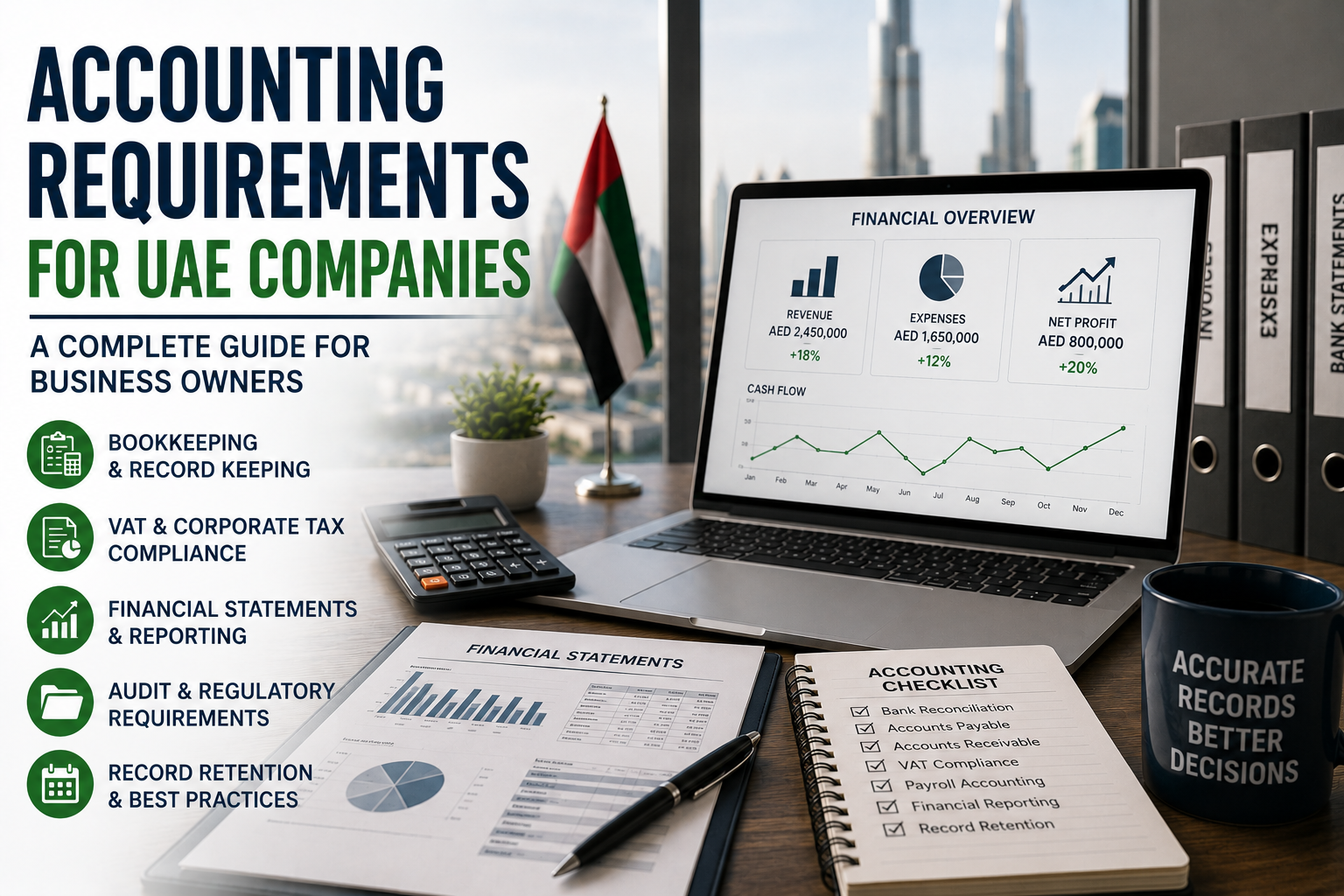
Accounting is the process of systematically recording and reporting a company's financial transactions.
For a UAE company, good accounting helps you understand:
- How much revenue the business generates
- Where money is being spent
- Whether the business is profitable
- How much customers owe you
- How much you owe suppliers
- Your cash position
- Tax obligations
- Business assets and liabilities
- Financial performance
It also creates the financial information needed for tax compliance and management decisions.
A company that maintains accurate books throughout the year is generally in a much better position when it needs to prepare a Corporate Tax return, VAT return, financial statements or supporting information for a bank or investor.
Is Accounting Mandatory for UAE Companies?
This is an important question.
The UAE Corporate Tax framework requires businesses within its scope to maintain records and documents that support the information relevant to determining their taxable income.
The Federal Tax Authority states that taxable persons must maintain adequate records and documents to support the information provided in their Corporate Tax returns. (tax.gov.ae)
Therefore, accounting should not be viewed simply as an optional service for companies that want better financial reporting.
For businesses subject to UAE tax laws, proper record keeping is an important part of compliance.
What Accounting Records Should a UAE Company Maintain?
The exact records depend on the nature and structure of the business.
However, a well-organized accounting system will generally maintain records such as:
Sales Records
- Sales invoices
- Credit notes
- Customer receipts
- Sales contracts
- Revenue reports
Purchase Records
- Supplier invoices
- Purchase orders
- Expense bills
- Credit notes
- Import documentation
Banking Records
- Bank statements
- Deposit records
- Payment records
- Bank reconciliations
Payroll Records
- Salary records
- Employee-related payments
- Benefits
- Payroll documentation
Asset Records
- Fixed asset register
- Purchase invoices
- Depreciation records
- Disposal documentation
Liability Records
- Loans
- Supplier balances
- Accrued expenses
- Other liabilities
These records should be organized so that transactions can be traced from the accounting system back to the underlying documents.
What Is Bookkeeping?
Bookkeeping is the process of recording financial transactions in the accounting system.
For example, imagine a UAE consulting company receives AED 20,000 from a client.
The transaction needs to be recorded appropriately in the books.
Similarly, if the company pays:
- AED 5,000 for office rent
- AED 1,000 for software
- AED 2,000 for marketing
those transactions should also be recorded correctly.
Over time, these individual entries form the company's financial records.
Bookkeeping vs Accounting
These terms are sometimes used interchangeably, but they are not exactly the same.
Bookkeeping
Primarily involves recording transactions.
Accounting
Includes broader activities such as:
- Classification
- Reconciliation
- Financial reporting
- Analysis
- Tax calculations
- Adjustments
- Financial statements
- Management reporting
A good accounting system starts with accurate bookkeeping but goes beyond simply entering transactions.
Monthly Accounting Is Better Than Year-End Bookkeeping
One of the biggest accounting mistakes made by small businesses is waiting until the end of the year.
Suppose a company has 12 months of transactions but only starts bookkeeping in March.
The accountant may then have to reconstruct:
- Sales
- Purchases
- Bank transactions
- Expenses
- Receivables
- Payables
- VAT
- Payroll
This increases the possibility of errors.
A better approach
Maintain accounts monthly.
A monthly accounting routine could include:
Sales → Purchases → Bank Reconciliation → Expenses → Payroll → Receivables → Payables → VAT Review → Management Reports
This gives the business owner a much clearer picture of financial performance.
Bank Reconciliation for UAE Companies
Bank reconciliation is a basic but important accounting control.
The accounting records should be compared against the actual bank statements.
For example:
Accounting balance: AED 245,000
Bank statement balance: AED 242,500
The difference could result from:
- Outstanding cheques
- Bank charges
- Unrecorded payments
- Deposits in transit
- Errors
- Timing differences
Regular reconciliation helps identify these differences.
For businesses with multiple bank accounts, monthly reconciliation becomes even more important.
Accounts Receivable Management
Accounts receivable represents money customers owe the business.
Suppose a UAE company issues:
Invoice: AED 50,000
but the customer has not paid.
That amount should be tracked as an outstanding receivable.
A good accounting system should allow the business to monitor:
- Customer name
- Invoice number
- Invoice date
- Due date
- Amount
- Amount received
- Outstanding balance
- Days overdue
This helps management identify customers who are consistently paying late.
Accounts Payable Management
Accounts payable represents amounts the business owes suppliers and other parties.
A company should maintain records of:
- Supplier invoices
- Due dates
- Outstanding amounts
- Payments
- Credit notes
This helps avoid:
- Duplicate payments
- Missed payments
- Supplier disputes
- Unnecessary late-payment costs
It also helps management plan cash flow.
VAT Accounting Requirements
If your company is VAT registered, accounting becomes closely connected to VAT compliance.
The business needs to properly record:
- Output VAT
- Input VAT
- Tax invoices
- Credit notes
- VAT adjustments
- Imports
- Exports
- Reverse-charge transactions, where applicable
The accounting records should support the VAT return submitted to the Federal Tax Authority.
A common mistake is preparing the VAT return separately from the accounting system.
Better approach
Use accounting records as the foundation for VAT reporting.
Before filing, reconcile:
Sales → Output VAT → Purchases → Input VAT → VAT Return
Corporate Tax and Accounting
The introduction of UAE Corporate Tax has made proper accounting even more important.
For companies within the Corporate Tax regime, taxable income generally starts with accounting income and is then adjusted according to the applicable Corporate Tax rules.
This means your financial statements and accounting records can directly influence your Corporate Tax calculation.
For example:
Accounting Profit
minus/plus applicable tax adjustments
=
Taxable Income
The accounting profit is therefore an important starting point.
What Financial Statements Should UAE Companies Prepare?
A properly maintained accounting system should allow a company to prepare financial statements.
The main financial statements include:
1. Statement of Financial Position
Also known as the balance sheet.
It shows:
Assets = Liabilities + Equity
It provides a snapshot of the company's financial position at a particular date.
2. Income Statement
Also known as the profit and loss statement.
It shows:
- Revenue
- Cost of sales
- Operating expenses
- Other income/expenses
- Profit or loss
This helps management understand business performance.
3. Cash Flow Statement
The cash flow statement explains how cash moved during a particular period.
It generally considers:
- Operating activities
- Investing activities
- Financing activities
A profitable company can still face cash-flow problems, which is why cash-flow reporting is important.
4. Statement of Changes in Equity
This statement explains movements in shareholders' or owners' equity.
It may include:
- Capital contributions
- Retained earnings
- Dividends/distributions
- Other equity movements
The exact presentation depends on the company's circumstances and applicable accounting framework.
Which Accounting Standards Apply in the UAE?
UAE businesses may prepare financial statements using applicable accounting standards, with IFRS being widely used.
The appropriate accounting framework can depend on the entity, regulatory requirements and circumstances.
For businesses preparing financial statements for banks, investors, shareholders or regulatory purposes, consistency in accounting policies is important.
Businesses should avoid changing accounting methods simply to make individual periods look better.
What Is the Role of an Accountant?
An accountant does much more than enter invoices.
Depending on the engagement, an accountant may handle:
- Bookkeeping
- Bank reconciliation
- Accounts payable
- Accounts receivable
- Payroll accounting
- VAT reconciliation
- Financial statements
- Month-end closing
- Corporate Tax support
- Management reports
- Audit preparation
For growing businesses, an accountant can also help management understand financial trends.
What Is Month-End Closing?
Month-end closing is the process of finalizing the accounting records for a particular month.
A typical month-end process can include:
1. Record all sales
Make sure revenue transactions are complete.
2. Record purchases and expenses
Capture all relevant supplier invoices and expenses.
3. Reconcile bank accounts
Compare accounting records with bank statements.
4. Review receivables
Identify overdue customer balances.
5. Review payables
Confirm outstanding supplier obligations.
6. Record payroll
Post salary and employee-related accounting entries.
7. Review VAT
Check VAT-related balances and transactions.
8. Record adjustments
Process appropriate accruals, prepayments and depreciation.
9. Generate reports
Prepare the monthly profit and loss, balance sheet and cash-flow information.
What Are Accruals and Prepayments?
These accounting concepts are important when preparing accurate financial statements.
Accrual
An expense that relates to the accounting period but has not yet been paid or invoiced.
Example:
A company receives professional services in December but receives the invoice in January.
The December accounts may need an appropriate accrual, subject to the accounting framework.
Prepayment
An amount paid in advance for a future benefit.
Example:
A company pays AED 120,000 for a 12-month annual insurance policy.
The accounting treatment generally requires the cost to be allocated over the relevant period rather than treating the entire amount as one month's expense.
These adjustments help present a more accurate picture of profitability.
Fixed Asset Accounting
Companies often purchase assets such as:
- Computers
- Furniture
- Vehicles
- Machinery
- Office equipment
- Production equipment
These should be appropriately recorded and tracked.
A fixed asset register can include:
- Asset description
- Purchase date
- Cost
- Location
- Useful life
- Depreciation
- Net book value
- Disposal details
Proper asset records are particularly useful during financial reporting and audits.
Payroll Accounting
Payroll should also be properly reflected in the company's accounting records.
Depending on the business, payroll accounting may involve:
- Employee salaries
- Allowances
- Benefits
- Employer-related costs
- Leave-related provisions
- Other employee expenses
The payroll records should reconcile with the company's bank payments and accounting entries.
Record Retention Requirements
Businesses should not delete financial documents simply because the financial year has ended.
The FTA specifies record-retention requirements under the relevant tax laws.
For VAT purposes, the FTA states that taxable persons generally need to retain required VAT records for at least five years. (tax.gov.ae)
For Corporate Tax, the FTA also provides record-keeping requirements, including maintaining records and documents supporting Corporate Tax obligations. (tax.gov.ae)
Businesses should establish a document-retention policy rather than deleting files randomly.
Should UAE Companies Get Audited?
This depends on the company's legal structure, licensing authority, regulatory requirements, size, activity and other circumstances.
Not every UAE company necessarily has the same statutory audit obligation.
However, an audit may be required or commercially useful for:
- Certain Free Zone entities
- Regulatory requirements
- Shareholders
- Banks
- Investors
- Financing
- Group reporting
- Specific licence conditions
Therefore, business owners should check the requirements applicable to their particular entity and jurisdiction.
Free Zone Companies and Accounting
Free Zone companies should not assume that their accounting obligations disappear because they benefit from a Free Zone structure.
A Free Zone business may need to maintain:
- Financial statements
- Accounting records
- Supporting invoices
- Bank records
- Related-party records
- Tax documentation
If the company intends to claim Qualifying Free Zone Person treatment for Corporate Tax purposes, maintaining proper records becomes particularly important.
Accounting for Related-Party Transactions
Indian entrepreneurs and other international business owners often have related companies in multiple jurisdictions.
For example:
Indian Company → UAE Company
The businesses may have transactions involving:
- Management fees
- Consultancy
- Software
- Marketing
- Loans
- Shared services
- Intellectual property
These transactions should be properly documented and recorded.
Where UAE transfer-pricing rules apply, the business should also consider the relevant arm's-length requirements and documentation.
Why Cross-Border Accounting Needs Extra Attention
Consider an Indian entrepreneur who owns:
Company A — India
and
Company B — UAE
If the two companies transact with each other, accounting should clearly identify:
- Which entity incurred the expense
- Which entity earned the income
- Which entity owes money
- Which entity is owed money
- Whether VAT applies
- Whether withholding-tax considerations arise in India
- Whether transfer pricing applies
- Whether DTA considerations arise
Simply transferring money between two companies does not automatically determine the correct accounting or tax treatment.
Accounting Software for UAE Companies
Modern businesses can use accounting software to automate many processes.
A suitable accounting system can help with:
- Invoicing
- Expense tracking
- Bank feeds
- Reconciliation
- VAT calculations
- Receivables
- Payables
- Financial statements
- Reporting
However, software does not eliminate the need for proper accounting controls.
Wrong input + good software = wrong output.
The accounting policies, transaction classifications and reconciliations still need to be reviewed.
Common Accounting Mistakes UAE Companies Should Avoid
1. Mixing Personal and Business Expenses
Business owners should avoid treating the company bank account as a personal wallet.
Personal expenses should be appropriately identified and accounted for.
2. Not Reconciling Bank Accounts
A company may have hundreds of transactions each month.
Without reconciliation, errors can remain hidden.
3. Recording Everything as an Expense
Not every payment is an immediate expense.
Some payments may relate to:
- Assets
- Deposits
- Prepayments
- Loans
- Advances
The correct accounting treatment should be determined.
4. Ignoring Receivables
A company may report strong revenue while customers are taking months to pay.
Track receivables closely.
5. Ignoring Payables
Late supplier payments can create cash-flow and commercial problems.
6. Preparing Accounts Only for Tax Filing
Accounting should help management run the business—not merely satisfy tax authorities.
7. Poor Document Management
Every major accounting entry should have appropriate supporting documentation.
8. Failing to Reconcile VAT
The VAT return should be supported by underlying accounting records.
9. Not Separating UAE and India Transactions
For cross-border entrepreneurs, separate accounting records and intercompany reconciliations are critical.
10. Waiting Until the Audit
If the first time management reviews its financial records is when an auditor asks for them, the business has already waited too long.
Practical Monthly Accounting Checklist
A UAE company can use the following monthly checklist:
Sales
- Record all sales invoices
- Record credit notes
- Reconcile sales with bank receipts
Purchases
- Record supplier invoices
- Verify supporting documents
- Review outstanding supplier balances
Banking
- Reconcile every bank account
- Record bank charges
- Investigate unmatched transactions
Payroll
- Record salary expenses
- Reconcile payroll payments
Tax
- Review VAT transactions
- Reconcile VAT balances
- Track Corporate Tax information
Receivables
- Review overdue invoices
- Follow up with customers
- Update ageing report
Reporting
- Profit & loss
- Balance sheet
- Cash-flow report
- Management dashboard
Accounting Checklist for New UAE Businesses
If you are starting a company in the UAE, establish the accounting system from day one.
Before starting operations:
- Open a business bank account
- Select accounting software
- Create chart of accounts
- Set up invoicing
- Establish expense policies
- Create document-storage system
- Identify VAT obligations
- Assess Corporate Tax requirements
Every month:
- Record transactions
- Reconcile bank
- Review receivables
- Review payables
- Reconcile VAT
- Prepare management reports
Annually:
- Finalize accounts
- Prepare financial statements
- Review Corporate Tax position
- Complete required tax filings
- Complete audit where applicable
- Review accounting policies
How Proper Accounting Helps Business Owners
Good accounting is not just about compliance.
It gives management answers to important questions:
Are we profitable?
The profit and loss statement provides an overview of business performance.
Where is our cash going?
Cash-flow reporting identifies major cash movements.
Which customers owe us money?
Receivables reports provide visibility.
Which expenses are increasing?
Monthly comparisons reveal cost trends.
Can we afford to hire?
Management can assess recurring cash requirements.
Can we take a business loan?
Banks often require financial information when assessing financing applications.
Are we ready for investors?
Investors generally expect reliable financial records and reporting.
How Clockwell Can Help With UAE Accounting
Managing accounting, VAT and Corporate Tax together can become difficult as a UAE business grows.
Clockwell provides accounting and financial support for businesses operating in the UAE, including:
- Monthly Bookkeeping
- UAE Accounting Services
- Bank Reconciliation
- Accounts Payable Management
- Accounts Receivable Management
- Financial Statement Preparation
- VAT Accounting & Reconciliation
- VAT Return Support
- Corporate Tax Support
- Payroll Accounting
- Management Reporting
- Audit Support
- Tax Advisory
- Business Advisory
- Virtual CFO Services
For entrepreneurs who want to focus on sales and business growth, outsourcing accounting can provide a structured way to maintain accurate books and stay on top of recurring financial responsibilities.
Understanding the accounting requirements for UAE companies is essential for businesses that want to operate professionally and remain prepared for tax and regulatory obligations.
Good accounting starts with:
Accurate Bookkeeping → Monthly Reconciliation → Proper Documentation → Financial Reporting → Tax Compliance → Management Review
UAE companies should maintain appropriate financial records, reconcile their accounts regularly, understand their VAT and Corporate Tax obligations, retain supporting documents and prepare reliable financial statements where required.
For Indian entrepreneurs operating businesses in the UAE, accounting becomes even more important when there are transactions between India and the UAE. Separate books, clear intercompany records and proper tax analysis can help prevent unnecessary complications.
Most importantly, don't wait until the end of the year to organize your accounts.
Monthly accounting is easier to manage, easier to reconcile and far more useful for making business decisions.
A well-maintained accounting system doesn't just tell you what happened to your money. It helps you understand where your business stands today and where it can go next.
Published on August 28, 2026