

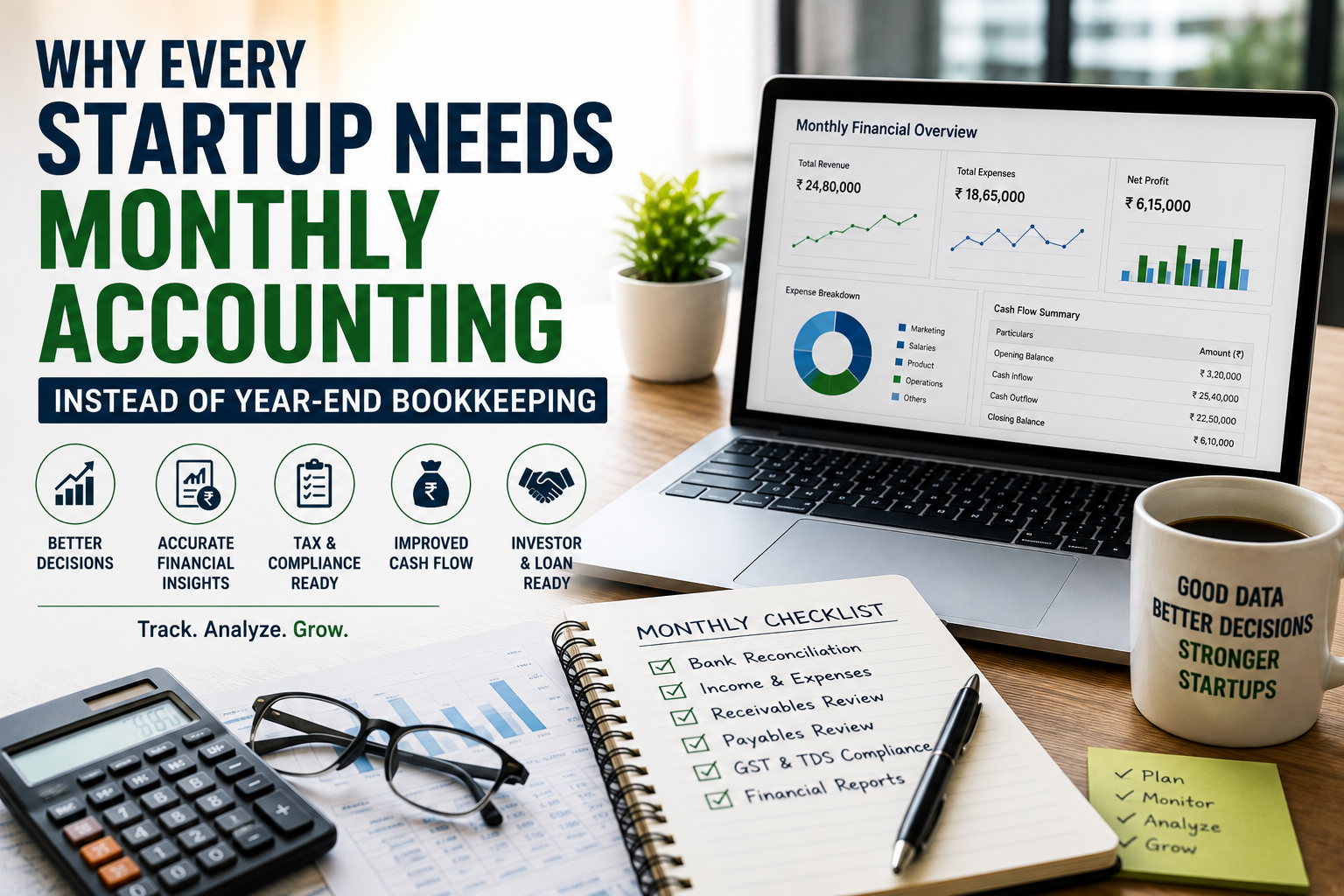
Starting a business is exciting. Founders usually focus on building products, acquiring customers, hiring employees, and generating revenue.
Accounting often gets pushed to the background.
A common approach among early-stage businesses is to maintain basic records throughout the year and hand everything over to an accountant just before the financial year ends.
It may appear to save money and time, but year-end bookkeeping can leave startups with limited financial visibility and create unnecessary compliance pressure.
For a growing startup, accounting should not be viewed only as a tax-filing requirement. Proper accounting is a management tool that helps founders understand where the business stands financially every month.
This is why monthly accounting for startups can be a much more effective approach.
What Is Monthly Accounting?
Monthly accounting means recording, reconciling, reviewing, and reporting a business's financial transactions regularly—typically every month.
It can include:
- Recording sales and purchases
- Bank reconciliation
- Accounts receivable tracking
- Accounts payable tracking
- Expense classification
- Payroll accounting
- GST reconciliation
- TDS accounting
- Financial statement preparation
- Cash-flow monitoring
- Management reporting
Instead of discovering financial information once a year, founders get a regular picture of business performance.
What Is Year-End Bookkeeping?
Year-end bookkeeping is when a business waits until the end of the financial year to organize and finalize its accounting records.
The accountant may then need to process months of:
- Bank transactions
- Sales invoices
- Purchase invoices
- Expenses
- Payments
- Receipts
- Tax records
This can create a significant workload in a short period.
More importantly, the founder may have already made important business decisions without having accurate financial information.
Monthly Accounting vs Year-End Bookkeeping
| Factor | Monthly Accounting | Year-End Bookkeeping |
|---|---|---|
| Financial Visibility | Regular | Limited |
| Cash Flow Monitoring | Continuous | Often delayed |
| Error Detection | Earlier | Potentially late |
| Tax Preparation | Easier | Last-minute |
| Decision Making | Data-driven | Often based on estimates |
| Compliance Management | More organized | Higher year-end pressure |
| Management Reporting | Available regularly | Usually prepared later |
1. Know Your Real Financial Position
One of the biggest benefits of monthly accounting is visibility.
At any point, founders can understand:
- Revenue
- Expenses
- Profit or loss
- Cash balance
- Receivables
- Payables
- Outstanding liabilities
This helps answer a crucial question:
"How is the business actually performing right now?"
Without updated accounts, founders may rely on bank balance or sales figures, which don't necessarily represent the company's true financial position.
2. Improve Cash Flow Management
Cash flow is particularly important for startups.
A startup can have strong sales but still run out of cash if:
- Customers pay late.
- Expenses increase rapidly.
- Inventory absorbs cash.
- Payroll grows.
- Loan repayments increase.
Monthly accounting helps identify these trends early.
A monthly cash-flow review can show:
- Expected customer collections
- Upcoming supplier payments
- Salary obligations
- Tax liabilities
- Loan repayments
- Available working capital
This gives founders more time to take corrective action.
3. Track Startup Burn Rate
For many startups, burn rate is a critical metric.
Burn rate indicates how quickly the company is consuming cash.
For example, if a startup has ₹50 lakh available and is spending ₹5 lakh more than it receives each month, its cash runway becomes an important management concern.
Monthly accounting makes it easier to track:
- Monthly operating expenses
- Net cash burn
- Cash runway
- Changes in spending
- Funding requirements
This information becomes especially important before a fundraising round.
4. Make Better Business Decisions
Founders constantly make decisions about:
- Hiring
- Marketing
- Pricing
- Product development
- Office expenses
- Technology
- Inventory
- Expansion
Without current financial data, these decisions may be based on assumptions.
Monthly financial reports provide evidence to support those decisions.
For example, if marketing expenditure increased by 40% but customer acquisition did not improve, the founder can identify the issue much earlier.
5. Identify Unnecessary Expenses
Small recurring expenses can become significant over time.
Monthly expense reviews can reveal:
- Unused software subscriptions
- Excessive travel expenses
- Unnecessary office costs
- Duplicate services
- High transaction charges
- Uncontrolled marketing expenditure
Cost control becomes easier when expenses are reviewed regularly.
6. Keep Receivables Under Control
A startup's revenue may look impressive, but unpaid invoices can create cash-flow problems.
Monthly accounting allows you to monitor:
- Total receivables
- Overdue invoices
- Customer payment patterns
- Average collection period
- High-risk customers
This helps the finance team follow up on outstanding payments before they become serious problems.
7. Manage Payables Better
Accounting isn't only about collecting money.
Startups also need to know what they owe.
Monthly accounts can help track:
- Supplier invoices
- Employee reimbursements
- Rent
- Professional fees
- Loan obligations
- Tax liabilities
Knowing upcoming obligations helps prevent unexpected cash shortages.
8. Stay on Top of GST and TDS
Startups may have several recurring tax compliance requirements depending on their activities.
Regular accounting makes it easier to reconcile:
- Sales
- Purchases
- Input tax credit
- GST liability
- TDS deductions
- Tax payments
Errors are also easier to identify when records are reviewed monthly instead of reconstructing the entire year at once.
9. Prepare Better Financial Statements
Monthly accounting makes it possible to generate management-level financial statements throughout the year.
These can include:
Profit & Loss Statement
Shows monthly and year-to-date revenue, expenses, and profitability.
Balance Sheet
Shows assets, liabilities, and equity.
Cash Flow Report
Shows cash inflows and outflows.
Receivables Report
Shows outstanding customer balances.
Payables Report
Shows amounts owed to suppliers and other parties.
10. Make Fundraising Easier
Investors typically want more than a pitch deck.
During due diligence, they may ask for:
- Financial statements
- Bank statements
- GST records
- Tax returns
- Revenue details
- Expense reports
- Cap table
- Outstanding liabilities
- Financial projections
If your accounting records are maintained monthly, preparing this information is much easier.
Clean and organized financial records can also improve investor confidence.
11. Improve Loan Readiness
Banks and financial institutions may request financial information when evaluating business financing.
Depending on the loan, lenders may review:
- Bank statements
- Financial statements
- Income Tax Returns
- GST records
- Turnover
- Profitability
- Existing liabilities
- Cash flow
Monthly accounting helps ensure these records are available and up to date.
12. Detect Accounting Errors Early
Errors become harder to identify when transactions accumulate for an entire year.
Monthly reconciliation can identify:
- Duplicate entries
- Missing invoices
- Incorrect classifications
- Bank mismatches
- Incorrect tax entries
- Unrecorded expenses
- Customer balance discrepancies
Early correction is generally easier than reconstructing an entire year's records.
13. Understand Your Unit Economics
Startups should look beyond total revenue and profit.
Depending on the business model, useful metrics may include:
- Customer Acquisition Cost (CAC)
- Customer Lifetime Value (LTV)
- Gross Margin
- Contribution Margin
- Average Revenue Per Customer
- Monthly Recurring Revenue (MRR)
- Churn
- Burn Rate
- Cash Runway
Accounting data provides the foundation for calculating and monitoring many of these metrics.
14. Prepare Accurate Budgets and Forecasts
Historical financial information is essential for preparing realistic forecasts.
With monthly accounting data, startups can analyze trends in:
- Revenue
- Payroll
- Marketing
- Technology costs
- Rent
- Inventory
- Customer collections
This allows management to create more realistic budgets and cash-flow forecasts.
15. Reduce Year-End Stress
Year-end compliance can become extremely stressful when accounting records have been neglected for 12 months.
The business may need to suddenly organize:
- Bank statements
- Invoices
- Expenses
- GST records
- TDS information
- Fixed assets
- Receivables
- Payables
With monthly accounting, much of this work has already been completed throughout the year.
What Should a Startup Review Every Month?
A practical monthly accounting routine can include:
- Bank reconciliation
- Sales reconciliation
- Purchase reconciliation
- Expense review
- Receivables ageing
- Payables ageing
- GST reconciliation
- TDS reconciliation
- Payroll review
- Profit & Loss analysis
- Cash-flow review
- Budget vs actual comparison
The exact reporting package should be tailored to the startup's size and business model.
A Simple Monthly Accounting Workflow
Week 1: Record
Collect and record:
- Sales invoices
- Purchase invoices
- Expenses
- Receipts
- Payments
Week 2: Reconcile
Compare:
- Bank records
- Accounting records
- GST data
- Customer balances
- Supplier balances
Week 3: Review
Analyze:
- Revenue
- Expenses
- Profitability
- Cash flow
- Receivables
- Payables
Week 4: Report
Prepare a concise management report showing:
- Key financial numbers
- Major changes
- Cash position
- Outstanding collections
- Upcoming obligations
- Areas requiring management attention
Common Accounting Mistakes Startups Make
Avoid these common practices:
- Waiting until year-end to update books
- Mixing personal and business expenses
- Ignoring bank reconciliation
- Not tracking receivables
- Failing to record small expenses
- Ignoring GST reconciliation
- Not reviewing cash burn
- Making decisions without current financial data
- Treating accounting only as a tax requirement
How Often Should a Startup Do Accounting?
For most startups, monthly accounting is a practical minimum for management purposes.
However, businesses with high transaction volumes or complex operations may benefit from:
- Weekly cash-flow monitoring
- Weekly receivables review
- Monthly financial statements
- Quarterly management reviews
The frequency should match the complexity and financial risk of the business.
How Clockwell Can Help
At Clockwell, we help startups and growing businesses maintain accurate financial records and turn accounting data into useful management information.
Our services include:
- Monthly Accounting & Bookkeeping
- Financial Statement Preparation
- GST Accounting & Filing
- TDS Compliance
- Bank Reconciliation
- Accounts Receivable & Payable Management
- Cash Flow Reporting
- Budgeting & Forecasting
- Financial Reporting
- Tax Compliance
- Virtual CFO Services
- Business Advisory
Our goal is not just to record transactions at the end of the year. We help businesses maintain timely, organized, and decision-ready financial information throughout the year.
Year-end bookkeeping may appear cheaper or simpler, but it can leave startup founders operating without a clear understanding of their financial position.
Monthly accounting provides continuous visibility into revenue, expenses, cash flow, receivables, payables, profitability, and tax obligations.
More importantly, it turns accounting from a year-end compliance exercise into a business management tool.
For startups, this can mean better decisions, earlier problem detection, stronger cash-flow management, easier fundraising, improved loan readiness, and less year-end stress.
If your startup is still updating its books only once a year, moving to a monthly accounting system could be one of the simplest steps toward building a more financially disciplined and scalable business.
Published on August 13, 2026