

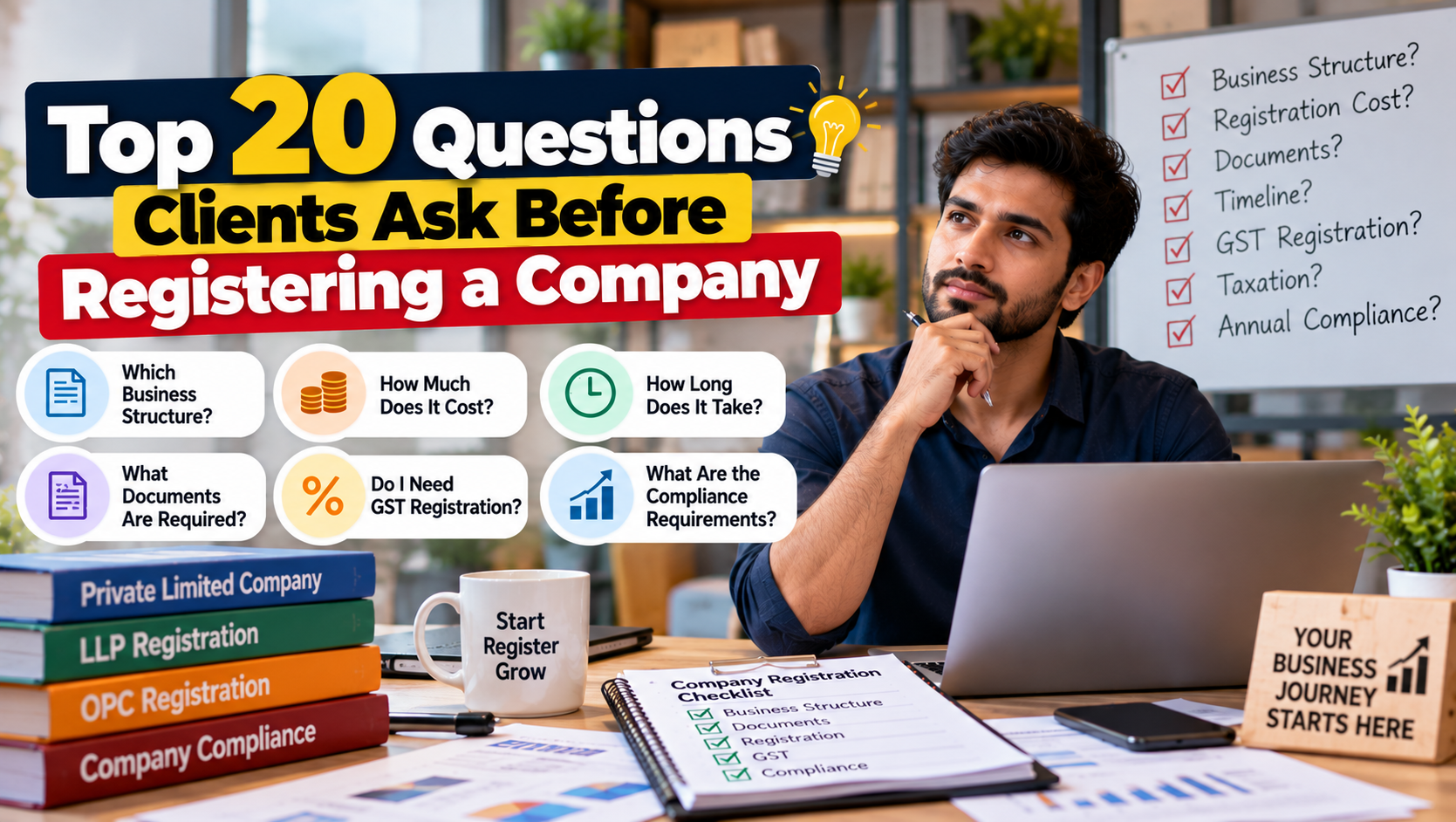
Why Should You Understand Company Registration Before Starting a Business?
Company registration is more than obtaining a certificate. It involves selecting a suitable legal structure, deciding ownership, preparing documents and understanding the compliance obligations that follow incorporation.
In India, the registration process depends on the chosen structure. Companies are generally incorporated through the Ministry of Corporate Affairs (MCA) using the applicable incorporation forms, while Limited Liability Partnerships (LLPs) follow their own registration procedure. The MCA provides official incorporation resources and forms through its official website.
Before beginning, entrepreneurs should understand the differences between a sole proprietorship, partnership, LLP and private limited company.
Let's look at the questions clients most frequently ask.
1. Which Business Structure Is Best for My Business?
This is often the first question entrepreneurs ask.
The right structure depends on the business's size, ownership, risk, funding plans and future growth.
Common options include:
Sole Proprietorship: Suitable for many small businesses owned and managed by one individual. It is relatively simple to operate, but the owner and business are generally not separate legal persons.
Partnership Firm: Suitable for two or more people operating a business together under a partnership agreement. Partners should understand their liability and responsibilities.
Limited Liability Partnership (LLP): Combines a separate legal entity with limited liability for partners, subject to applicable law. It can suit professional firms and businesses with multiple owners.
Private Limited Company: Often suitable for startups, growing businesses and entrepreneurs planning structured ownership, shareholding or external investment.
One Person Company (OPC): A company structure designed for a single member, subject to statutory eligibility and requirements.
There is no single structure that is best for everyone. The decision should be based on the business model, ownership arrangements and long-term plans.
2. What Is the Difference Between a Private Limited Company and an LLP?
A Private Limited Company and an LLP are both separate legal entities, but they operate under different legal frameworks.
| Feature | Private Limited Company | LLP |
|---|---|---|
| Governing law | Companies Act, 2013 | LLP Act, 2008 |
| Ownership | Shareholders | Partners |
| Management | Directors and company governance structure | Designated partners and partners |
| Liability | Generally limited, subject to law | Generally limited, subject to law |
| Ownership transfer | Shares can be transferred subject to applicable rules and restrictions | Changes in partnership interests follow the LLP agreement and applicable law |
| Compliance | Company-specific statutory filings and governance | LLP-specific statutory filings and governance |
| Investment structure | Often more suitable for equity-based investment | Investment and ownership arrangements differ from a company |
A private limited company may be more appropriate for a startup seeking equity investment. An LLP may suit a professional or service business that prefers a partnership-based ownership model.
The best choice depends on the founders' objectives, not simply the registration fee.
3. How Much Does Company Registration Cost in India?
The cost varies according to the legal structure, State, authorised capital where relevant, number of participants, professional fees, stamp duty and other applicable charges.
The overall cost may include:
-
Government filing fees
-
Stamp duty
-
Digital Signature Certificates (DSCs)
-
Professional fees
-
Documentation and drafting charges
-
Other applicable registration expenses
An LLP and a private limited company may have different cost structures. Additional requirements, such as special approvals or complex ownership arrangements, can also affect the total.
Important: There is no single fixed registration price that applies to every business.
Before proceeding, ask for a clear quotation that separates government charges from professional service fees and identifies any additional costs.
4. What Documents Are Required for Company Registration?
The documents depend on the selected structure and the people involved.
Common requirements for company incorporation can include:
-
PAN and identity documents of proposed directors and subscribers
-
Address proof of directors and subscribers
-
Recent photographs, where required
-
Proof of the proposed registered office
-
Utility bill or other accepted address evidence
-
Rent agreement or ownership documents, as applicable
-
No-objection certificate from the property owner, where required
-
Digital Signature Certificates for relevant signatories
-
Memorandum and Articles of Association, where applicable
-
Additional declarations and consent forms
For an LLP, the documentation includes information and consent relating to partners and designated partners.
Foreign nationals, corporate shareholders and special business structures may need additional documents or authentication.
Providing accurate, consistent documents at the beginning can help reduce resubmissions and delays.
5. How Long Does Company Registration Take?
The timeline depends on the accuracy of the application, name availability, document readiness, government processing and whether clarification or resubmission is required.
The process generally includes:
-
Selecting the business structure.
-
Finalising the proposed name.
-
Preparing identity and address documents.
-
Completing the relevant incorporation application.
-
Submitting the required forms and attachments.
-
Responding to any questions raised during processing.
-
Receiving incorporation approval if the application meets the requirements.
A straightforward application may be processed relatively quickly, but no universal timeline can be guaranteed.
Entrepreneurs should avoid making major commitments based on an assumed incorporation date until the registration is approved.
6. Can I Register a Company from My Home Address?
In many cases, a residential address can be used as the registered office, provided the relevant legal and documentary requirements are met.
The applicant may need to provide accepted address proof, a recent utility bill and owner consent or a no-objection certificate, depending on the circumstances.
However, a registered office is not the same as permission to conduct every type of business at that location.
Before using a residential address, consider:
-
Property ownership or rental terms
-
Local rules and permissions
-
Society or building restrictions
-
Business activity
-
Requirements for customer visits or storage
-
Any industry-specific licensing conditions
A home address may be sufficient for some service businesses, while other activities may require commercial premises or additional approvals.
7. How Do I Choose a Company Name?
Choosing a company name involves more than selecting something attractive or memorable.
The proposed name must satisfy applicable naming rules and should not be unacceptable because of similarity to an existing company or LLP, restricted wording or other legal concerns.
Before finalising a name:
-
Check availability through the MCA system.
-
Search for similar company and LLP names.
-
Check relevant trademark databases.
-
Consider domain-name availability.
-
Avoid misleading descriptions of the business.
-
Confirm whether any special approval or consent is needed.
The MCA's incorporation process includes a name-reservation stage for companies through SPICe+ Part A. The official MCA incorporation FAQs explain aspects of name reservation and linked incorporation filings.
Remember: Approval of a company name does not automatically give you trademark protection. Trademark availability should be checked separately.
8. How Many Directors or Partners Are Required?
The minimum number depends on the business structure.
-
Private Limited Company: Generally requires at least two directors and two members.
-
One Person Company: Can have one member, subject to statutory conditions, and must comply with the applicable director and nominee requirements.
-
LLP: Generally requires at least two partners and at least two designated partners, with at least one designated partner resident in India under the applicable rules.
-
Sole Proprietorship: Has one individual owner.
The choice also depends on who will own the business, who will manage it and how responsibilities will be shared.
For example, two founders who want separate shareholding may consider a private limited company. Two professionals who want a partnership-style arrangement may consider an LLP.
9. Do I Need a Digital Signature Certificate (DSC)?
A Digital Signature Certificate is used to digitally sign specified electronic filings.
During company or LLP incorporation, the relevant individuals and authorised signatories may need valid DSCs for the applicable forms.
The exact requirements depend on the structure, the people signing the documents and the current MCA filing procedure.
A DSC is not the same as a company registration certificate. It is a digital signing credential used for authorised electronic transactions and filings.
Entrepreneurs should ensure that the DSC is valid and correctly associated with the relevant MCA user profile where required.
10. Is GST Registration Mandatory After Company Registration?
No, GST registration is not automatically mandatory for every newly incorporated company.
GST applicability depends on factors such as:
-
Aggregate turnover
-
Nature of goods or services supplied
-
State and location of the business
-
Inter-State transactions
-
E-commerce activities
-
Special compulsory-registration provisions
-
Applicable exemptions
Some businesses must register even when their turnover is below a general threshold, while others may qualify for an exemption.
Also, company incorporation and GST registration are separate legal processes, even when the relevant application system allows GST registration to be requested through linked incorporation services.
Before applying, determine whether GST registration is required for the specific business model.
11. Do I Need a Current Bank Account?
A separate business bank account is useful for maintaining clear financial records and distinguishing business transactions from personal transactions.
For an incorporated company, opening a bank account in the company's name is an important part of setting up operations. The MCA's incorporation framework includes linked procedures relating to bank-account opening.
The bank may request documents such as:
-
Certificate of Incorporation
-
Company PAN
-
Constitutional documents, where applicable
-
Board resolution or authorised signatory details
-
KYC documents
-
Other bank-specific documents
For a proprietorship, the bank may require proof of the business and the proprietor's identity.
A separate business account can simplify bookkeeping, bank reconciliation, tax reporting and financial management.
12. What Is the Difference Between Authorised Capital and Paid-Up Capital?
This question is particularly relevant when registering a company.
Authorised share capital is the maximum share capital that a company is authorised to issue under its constitutional documents, subject to applicable law.
Paid-up share capital represents the amount credited as paid up on shares issued by the company.
These terms are not interchangeable.
For example, a company may have authorised share capital of ₹10 lakh but issue shares representing paid-up capital of ₹1 lakh.
The appropriate capital structure depends on the founders' funding requirements, ownership plans and future needs.
Entrepreneurs should not select capital figures randomly. The decision can affect incorporation charges, ownership arrangements and later corporate actions.
13. Do I Need to Deposit Money Before Registering a Company?
There is no universal requirement to deposit the entire authorised share capital into a bank account before incorporation.
However, the founders must understand the capital subscription and payment obligations applicable to their structure and documents.
For a company, the subscribers agree to take the shares specified in the incorporation documents and must comply with applicable requirements relating to payment and corporate records.
For an LLP, the contribution arrangements are governed by its applicable legal framework and LLP agreement.
The founders should clarify:
-
How much each participant will contribute
-
Whether the contribution is cash or another permitted form
-
Ownership percentages
-
How future funding will be handled
-
How contributions will be recorded
A written understanding can prevent disputes between founders later.
14. What Taxes Does a Newly Registered Company Need to Pay?
The tax obligations depend on the legal structure, income, transactions and applicable laws.
Potential obligations can include:
-
Income tax
-
GST
-
Tax Deducted at Source (TDS)
-
Tax Collected at Source (TCS), where applicable
-
Advance tax, where applicable
-
Other industry-specific or State-level taxes
The tax treatment of a company is not identical to that of an LLP or proprietorship.
Businesses should also distinguish between taxes that the business pays itself and amounts it must deduct or collect on behalf of the Government.
A new business should establish a tax calendar and accounting process from the beginning instead of waiting until the end of the financial year.
15. What Annual Compliance Is Required After Registration?
Company registration is the beginning of the legal relationship, not the end of the process.
An incorporated business may need to maintain books of account, prepare financial statements, conduct an audit where required and file statutory returns.
For companies, compliance can include:
-
Maintaining statutory registers and records
-
Holding required board and shareholder meetings
-
Preparing financial statements
-
Filing applicable annual returns
-
Filing financial statements with the MCA
-
Completing income-tax compliance
-
Maintaining accounting records
-
Complying with GST and TDS requirements, where applicable
LLPs have their own annual filing and statement requirements.
The exact obligations and deadlines depend on the structure, financial year, turnover, applicable law and specific circumstances.
A compliance calendar helps prevent missed filings and avoidable additional fees or penalties.
16. Can I Register a Company Alone?
Yes, but the suitable structure matters.
An entrepreneur who wants to operate independently may consider a sole proprietorship or an eligible One Person Company.
A private limited company generally requires at least two members and two directors. An LLP generally requires at least two partners and two designated partners.
A single founder who plans to raise investment in the future may also want to consider how the ownership structure will accommodate additional shareholders.
The decision should reflect both current needs and long-term business plans.
17. Can Foreign Nationals or NRIs Become Directors or Shareholders?
Foreign nationals and Non-Resident Indians may be able to participate in Indian companies or LLPs, subject to the applicable legal requirements.
However, the process may involve additional considerations, including:
-
Identity and address documentation
-
Notarisation or apostille, where applicable
-
Foreign investment rules
-
Sectoral restrictions
-
FEMA compliance
-
Resident-director requirements for companies
-
Banking and reporting requirements
-
Tax implications
The rules depend on the proposed ownership, nationality, residence, business activity and investment structure.
Anyone planning cross-border ownership should obtain appropriate advice before finalising the incorporation documents.
18. Can I Change My Business Structure Later?
In some cases, a business can convert from one legal structure to another, but conversion is not always simple.
For example, an existing business may consider moving from a proprietorship to an LLP or company as it grows.
The process can involve:
-
Legal documentation
-
Asset and liability transfers
-
Tax considerations
-
Contracts and licences
-
Bank-account changes
-
GST updates
-
Employee-related matters
-
Customer and supplier communication
-
Statutory filings
A conversion may also have implications for ownership, business continuity and existing obligations.
If an entrepreneur expects rapid growth, outside investment or multiple owners, it is worth evaluating the long-term structure before registering.
19. Can I Start Business Operations Immediately After Incorporation?
Not necessarily.
The Certificate of Incorporation establishes the company's legal existence, but it does not automatically authorise every business activity.
Depending on the industry and business model, additional registrations or licences may be required.
Examples include:
-
GST registration, where applicable
-
Shops and Establishments registration, where applicable
-
FSSAI licence for relevant food businesses
-
Trade or local licences, where required
-
Import Export Code for applicable import-export activities
-
Sector-specific regulatory approvals
-
Labour registrations, where applicable
A company operating in consulting may have different requirements from a restaurant, manufacturer, medical business or construction company.
Before starting operations, check the registrations and licences relevant to the specific activity and location.
20. Should I Register a Company Now or Wait Until My Business Grows?
This depends on the business model and commercial objectives.
Registration may be appropriate early when the entrepreneur needs a separate legal entity, formal ownership arrangements, limited liability or a structure suitable for investment and contracts.
Waiting may be reasonable in some cases where the entrepreneur is still validating an idea and can lawfully operate under a simpler structure.
Before deciding, consider:
-
Expected turnover
-
Business risks
-
Number of founders
-
Funding plans
-
Customer requirements
-
Industry regulations
-
Tax implications
-
Compliance costs
-
Expansion plans
The aim is not simply to register as early as possible or as late as possible. It is to select a structure that supports the business at its current stage and anticipated growth.
Documents to Prepare Before Company Registration
Preparing documents in advance can help make the registration process more organised.
Use this checklist as a starting point; the exact requirements depend on the chosen structure.
-
Proposed business names
-
PAN and identity documents of founders
-
Address proofs of relevant individuals
-
Email addresses and mobile numbers
-
Registered-office address proof
-
Utility bill or other accepted address evidence
-
Property-owner consent, where applicable
-
DSCs for relevant signatories
-
Ownership and contribution details
-
Business activity description
-
Initial capital and funding plan
-
Additional documents for foreign or corporate participants, if applicable
Tip: Make sure the spelling of names, addresses and other details is consistent across the supporting documents and application forms.
Company Registration Process in India: Step by Step
The process varies according to the legal structure, but company incorporation generally follows these stages.
Step 1: Understand the Business Model
Identify the business activity, founders, ownership and future plans.
Step 2: Choose the Legal Structure
Compare a proprietorship, partnership, LLP, OPC and private limited company.
Step 3: Finalise the Name
Check name availability and potential trademark conflicts.
Step 4: Prepare Documents
Collect identity, address, registered-office and other required documents.
Step 5: Complete the Incorporation Application
For a company, the MCA uses the SPICe+ incorporation framework and linked forms. For an LLP, the applicable LLP incorporation procedure includes Form FiLLiP.
Step 6: Submit the Application
File the required forms and attachments and pay applicable charges.
Step 7: Respond to Queries
Provide clarification or corrections if requested by the authorities.
Step 8: Receive Incorporation Approval
Once the application is approved, the relevant registration details and certificate are issued.
Step 9: Complete Post-Incorporation Requirements
Set up banking, accounting, tax registrations and any licences required for the business.
For the latest procedures and forms, refer to the Ministry of Corporate Affairs.
Common Mistakes to Avoid During Company Registration
Entrepreneurs can reduce delays and future problems by avoiding these mistakes:
1. Choosing a structure without planning ahead: A structure that works for a solo business may not suit a company seeking investors.
2. Selecting a name without proper checks: Similar company names or trademark conflicts may create problems.
3. Providing inconsistent documents: Differences in spelling, address or identity details can delay processing.
4. Ignoring post-registration compliance: Businesses need an ongoing compliance plan after incorporation.
5. Assuming GST is always mandatory or never mandatory: GST applicability must be assessed under the relevant rules.
6. Mixing personal and business transactions: Separate financial records make accounting and tax reporting easier.
7. Ignoring founder agreements: Ownership, responsibilities, funding and exit arrangements should be clarified early.
8. Underestimating ongoing costs: Annual filings, accounting, audit and tax compliance can create recurring expenses
How Professional Support Can Make Company Registration Easier
Company registration involves legal forms, documentation, business decisions and follow-up compliance. Entrepreneurs who are unfamiliar with these requirements may find it difficult to manage everything while also planning their business.
A professional company-registration and compliance service can help with:
-
Selecting an appropriate structure
-
Preparing incorporation documents
-
Name-availability checks
-
Filing the applicable forms
-
Coordinating the registration process
-
Identifying GST and other registration requirements
-
Setting up accounting processes
-
Creating a compliance calendar
-
Supporting post-incorporation filings
Professional support does not remove the founders' responsibilities, but it can help them understand the process and make informed decisions.
Frequently Asked Questions About Company Registration
1. What is the easiest business structure to register in India?
The answer depends on the business. A proprietorship may be simpler for a single owner, while an LLP or company may suit businesses that need a separate legal entity and structured ownership.
2. Is company registration compulsory for every business?
No. Different business structures have different registration requirements. However, specific licences, tax registrations or other approvals may still be required depending on the activity.
3. Can I register a company online?
Yes. Company and LLP incorporation applications are submitted through the relevant MCA online filing systems.
4. Do I need GST before registering my company?
Not necessarily. Company incorporation and GST registration are separate processes. GST applicability depends on the business's activities and the relevant provisions.
5. Does company registration guarantee a business licence?
No. Some industries require additional licences or regulatory approvals before operations can begin.
Registering a company is an important milestone, but making the right decisions before incorporation is equally important.
Understanding the top 20 questions clients ask before registering a company can help entrepreneurs choose the appropriate legal structure, prepare documents, plan costs and understand their ongoing obligations.
Before starting the process, review your ownership plans, business activity, expected growth, funding requirements and compliance needs.
The right registration structure should support your business today while allowing it to grow tomorrow.
If you are planning to start a business in India, consider seeking professional guidance to evaluate your options and understand the registration and compliance requirements that apply to your situation.
Disclaimer: This article is for general educational purposes and does not constitute legal, tax or professional advice. Registration procedures, fees and compliance requirements may change. Verify the current requirements with the relevant authorities or a qualified professional before proceeding.
Published on October 9, 2026